


By Antonis Pastellopoulos, Postdoctoral Researcher, University of Cyprus
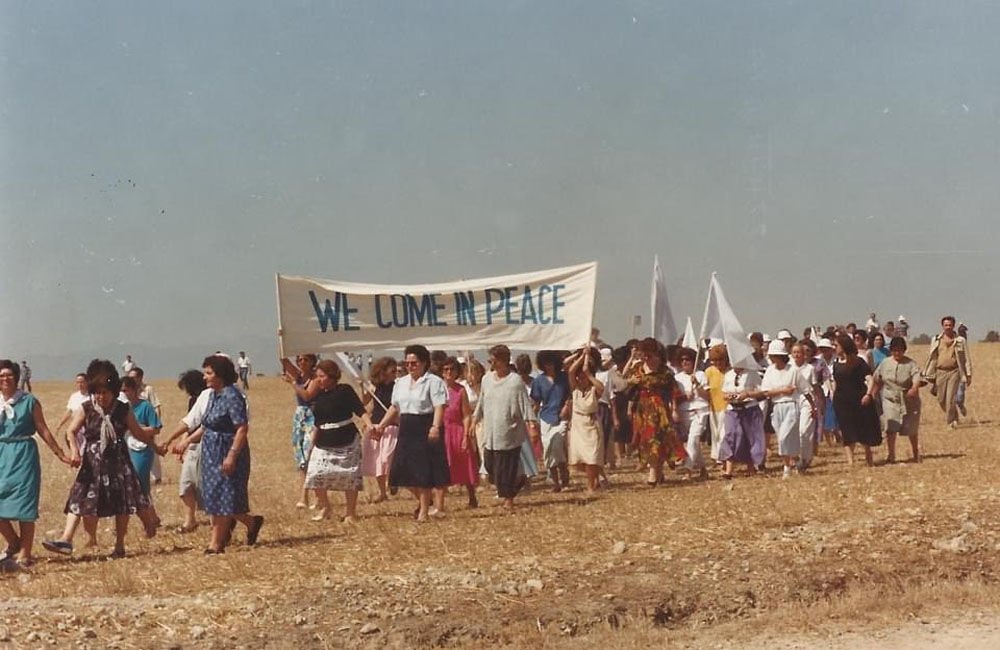
On April 20, 1975, thousands of Greek Cypriot women, the majority of them displaced following the 1974 Turkish invasion, marched towards Famagusta, stopping at the Derynia checkpoint. Their banner reading “We Come in Peace”, they were accompanied by women’s delegations from various countries across the globe. An estimated 30,000 women participated in the march, which took place in a solemn atmosphere, with women walking silently in the rain towards the buffer zone dividing the island. The 1974 march acts as the precursor to the “Women Walk Home” movement of the 1980s, more commonly known within Cyprus as the “Women Return” marches.
It would take more than a decade for another women’s march to take place. The Women Walk Home movement reappeared in 1987, when some of the women who had played a central role in coordinating the 1975 demonstration reorganised the group. They declared their determination to act independently of political parties and stressed the right to peaceful demonstration, planning another march with the aim to cross the buffer zone and enter the occupied areas. The United Nations (UN) urged the government to postpone the women’s march, while both the Cypriot and Greek governments considered the action harmful and attempted to restrict it.
Despite governmental opposition, political parties, trade unions and associations voiced their support for the initiative. On June 18, 1987, approximately three hundred women disembarked from Aglantzia and marched up the hill of Aronas before being blocked by UN peacekeepers. In November of the same year, the movement organised another march; with around a thousand women marching towards Ayios Pavlos. The procession split into two routes, managing to bypass UN peacekeepers and cross into the occupied areas; and for the first time, women participating in the marches came face-to-face with Turkish soldiers. With the Republic of Cyprus in the midst of a presidential electoral campaign, the march received wider press coverage than the previous mobilisation, and the demonstrations became a point of contestation in the political discourse.
On June 13, 1988, the movement carried out its only action outside of Cyprus. One hundred women staged a symbolic occupation of the Acropolis in Athens during the visit of Turkish Prime Minister Turgut Özal. An 18-meter banner reading “No to Occupation” was unfurled on the sacred rock. Following their forceful removal by the Greek police, the women regrouped at the Parthenon and read an oath declaring the continuation of their struggle for the freedom of Cyprus. It is worth noting that the Cypriot press did not cover this action with the intensity it had afforded to the group’s past initiatives.
On 19 March, 1989, the movement held one of its most massive and militant demonstrations. Two marches were organised, one in Lympia and another one in Achna. In Lympia, women carrying white flags marched up the hill of the chapel of the Holy Cross, which is located within the occupied areas. They were subsequently blocked by Turkish soldiers and beaten. In Achna, marchers managed to set foot in the ruined village and to enter the church of Agia Marina, where they sang the Akathist Hymn. Over 50 march participants were detained by Turkish soldiers, but were released by the following day.
This was the last major political action taken by the Women Walk Home movement. By the time of the Lympia-Achna marches, internal divisions had already began to become evident within the movement’s leadership, crystalised by disagreements surrounding the emerging rapprochement movement, bi-communalism and the key aims of the movement in general. The eventual split led to the creation of a new initiative under the name “Return”, which organised what came to be the last anti-occupation women’s march. On 19 July, 1989, women entered the buffer zone dividing the walled city of Nicosia at the Ayios Kassianos neighbourhood. Carrying Greek flags and accompanied by church officials, they bypassed UN peacekeepers, proceeding to enter the Ayios Kassianos elementary school and the Ayios Georgios chapel. The Turkish army responded with beatings, detaining more than a hundred protest participants, who were held for up to 10 days in prison cells. In response to their prolonged detainment, a sit-in protest was organised by the Return initiative at the buffer zone close to Nicosia airport, receiving widespread support within Greek Cypriot society. The sit-in protest lasted until the release of the detained.
Following 1974, Greek Cypriot women were frequently depicted as embodiments of the loss and suffering caused by the war. In mass media portrayals this symbolic role was crystallised, with women shown as grieving mothers, sisters, wives and daughters of the missing, as widows mourning the dead, and as refugees deprived of their homes. At the same time, Cyprus itself was personified as a female figure abused and enslaved by the Turkish army. These depictions confined Greek Cypriot women to the role of passive victims within the public discourse, emphasizing their suffering while largely denying them agency and political subjectivity.
The women’s marches reshaped the image of displaced Greek Cypriot women from one of passivity to one of active political participation. Organised independently of political parties and rooted primarily on their gender identity, the women’s mobilisations of the 1980s highlighted Greek Cypriot women as autonomous political actors. In doing so, they asserted women’s presence in the public sphere within a field of political activity that had largely remained the prerogative of the state and of formal politics following 1974.
This article is part of a series exploring themes of refugeehood and emplacement in relation to Cyprus. The factual information presented above is based on a conference paper prepared and presented on 05/10/24 with doctoral candidate Arestia Papadimitriou. Any interpretations of the facts expressed in the article are exclusively mine.
(Featured image originates from the Polignosi Encyclopaedia website)


