


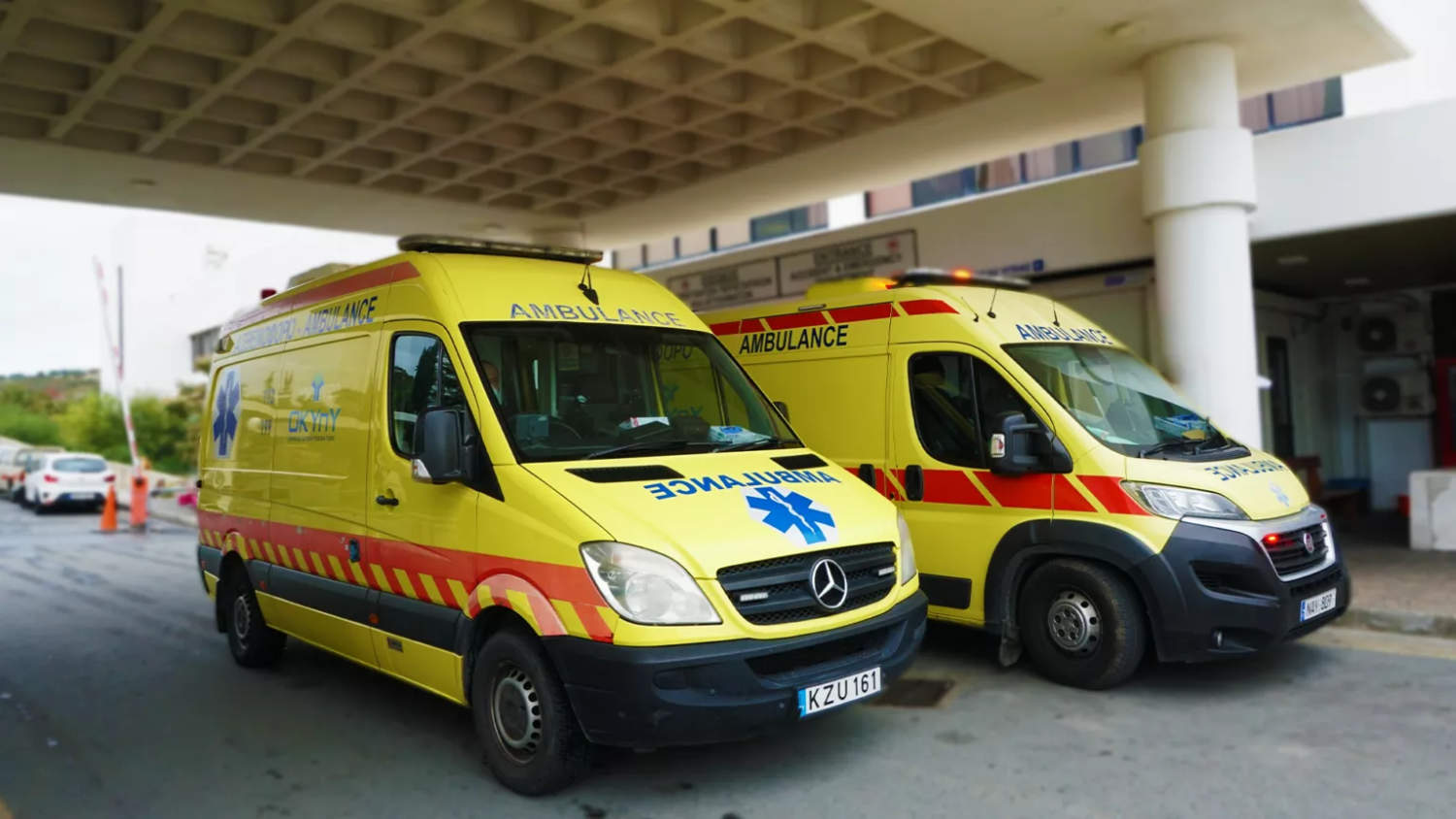
Cyprus’s State Health Services Organisation (SHSO) will have a full cost audit of its ambulance service ready by September, paving the way for a compensation claim against the state ahead of the service’s transfer to a new National Ambulance Authority.
Roberto Karahannas, the SHSO’s chief financial officer, told Phileleftheros the organisation has invested several million euros over the past six years upgrading the service and intends to recover those costs. The audit will cover specialised ambulances, systems, equipment, training and personnel.
The transfer itself will not proceed until two interlinked studies are complete, Karahannas said. Alongside the cost audit, a separate study is under way to map the organisation’s needs for inter-hospital patient transfers, which the SHSO will take over from January 1, 2027.
“Once both studies are finalised, the method of transferring the ambulance service to the Ministry of Health will be decided,” he said, adding that all scenarios for securing vehicles, equipment and staff would be examined to ensure the SHSO continues to function smoothly after the new authority is established.
Karahannas said the SHSO acknowledges the need for the National Ambulance Authority but stressed that its own uninterrupted operation must be guaranteed, and that the transition must happen smoothly and in cooperation with the Ministry of Health.
On the broader question of financial autonomy, Karahannas argued that meaningful progress requires first resolving structural imbalances that weigh heavily on the organisation. “It is easy to pursue financial autonomy while ignoring fundamental distortions that affect the organisation’s operation,” he said, adding that the SHSO is working to resolve these through dialogue and documentation.
Central to that argument is a stark disparity between the SHSO’s workload and its compensation. Although the organisation holds around 40% of hospital beds, it treats 75% of the country’s internal medicine and respiratory cases, Karahannas said, covering primarily elderly patients, those with multiple conditions, chronic patients and complex long-stay cases.
“The compensation the organisation receives is disproportionate to the actual cost of these services and the critical infrastructure it must maintain to handle them, which contributes significantly to operating deficits,” he said.
Unlike private providers, the SHSO cannot turn patients away. “In contrast to the private sector, the SHSO does not select cases — it accepts all patients, whether or not beds are available,” Karahannas said. Cutting loss-making services to reduce deficits, as a private provider could do, would undermine the organisation’s public mission and universal patient access, he added.
The SHSO also bears costs that are not compensated elsewhere in the system. It is the only provider maintaining on-call cover across all specialities on a continuous basis, and it must keep sufficient bed capacity even during low-demand periods — citing Famagusta Hospital, where demand rises sharply in summer due to tourism and drops in winter.
It must also maintain pandemic and epidemic readiness across all its hospitals without receiving payment for that standing capacity, Karahannas said.
Staffing arrangements add further pressure. Karahannas said that unlike the private sector, where sick leave and light-duty cases are covered by social insurance, the SHSO absorbs these costs directly, running to tens of millions of euros through both absences and the overtime needed to cover the resulting gaps.
“These factors are not taken into account in the way the state prices the organisation’s services, which leads to a distorted picture of its financial performance,” he said. “It is unfair to present the SHSO as a loss-making organisation when the reasons for those deficits are well known.”
On the outlook, Karahannas said the Ministry of Health has responded positively to the organisation’s positions. An agreement on public health services has already been reached and is undergoing legal review, and the Health Insurance Organisation has received documented claims and is expected to continue talks.
Difficulties remain with the Ministry of Finance, mainly over staffing arrangements, though Karahannas said he expects solutions to be found.
Tens of millions of euros in upgrade works are under way across all hospitals, alongside an ongoing accreditation process. “When the organisation’s action plan is completed, the goal is to become the first choice for the Cypriot patient — and when that happens, the SHSO will certainly achieve financial autonomy,” Karahannas said.

