


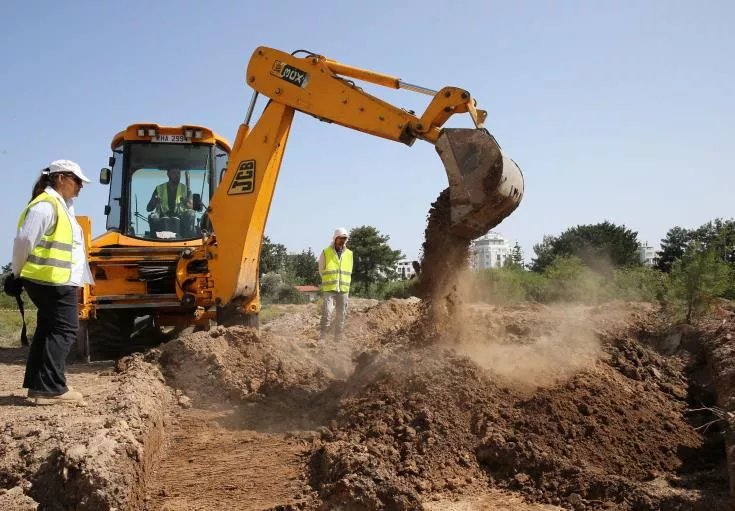
Teams from the Committee on Missing Persons (CMP) are searching the site of a hotel in occupied Lapithos, whose construction began illegally in the late 1980s. A man who worked on the building has said bones were found there and that the contractor ordered them to be covered over so that building could continue.
Illegal construction in the occupied north is changing the situation on the ground, affecting both the missing persons issue and archaeologists’ efforts to locate burial sites from witness testimony and to excavate in the hope of recovering remains for identification.
Two teams went to the Lapithos site on Monday, 2 November, and searches are under way. “We are optimistic,” said Leonidas Pantelides, the Greek Cypriot representative on the CMP.
The worker gave detailed information about the exact spot, Pantelides said, but efforts to persuade the contractor came to nothing. Construction later stopped because of financial difficulties, and the building passed to a new contractor who decided to demolish it.
The CMP contacted the new contractor, who was willing to let the committee’s archaeologists monitor the demolition to try to pinpoint the spot, and then to give them access to excavate for any remains, Pantelides said.
Soldiers believed buried in a well
The CMP has faced access problems in another case, involving eight soldiers believed to be buried in a well in the garden of a house that was bought illegally by a German man. He persistently refused permission for a search, and years later sold the villa. The CMP is now in contact with the new buyer to persuade him to allow an excavation at the spot, and Pantelides said there was some willingness on his part.
Because the well is no longer visible, ground-penetrating radar (GPR) will be used to scan the ground and locate exactly where it stood.
The CMP has signed a cooperation protocol with the Cyprus Institute on the use of advanced, specialised technology. Experts from the US and Canada previously used such technology in a pilot programme. They are expected to return to Cyprus to train their students in the field.
Identifications
According to updated CMP figures, 1,090 of the 2,002 Greek Cypriot and Turkish Cypriot missing persons have been identified: 765 Greek Cypriots and 325 Turkish Cypriots. A further 217 people who are not on the CMP’s official list have also been identified.
In 2026, 28 people have been identified, 27 of them on the official list and one not. There were 12 identifications in 2025.
Excavations under way
Remains have been found at three current excavations. At Agios Georgios Spatharikou, where two Greek Cypriots were believed to have been buried in a well, an excavation has been completed and two bones belonging to two people were found. In Lapithos, the first phase of an excavation has been completed, with two people located, and work is continuing. At Neo Chorio Kythreas, towards Mia Milia, fragments and small bones belonging to one person were found at a spot where information had pointed to four or five Greek Cypriots being buried.
Two completed excavations found nothing: at Koutsoventis, which was searched for one Greek Cypriot, and at Livadia, Famagusta, where a Greek Cypriot was believed to have been buried in a pit. A large-scale excavation is also under way at Exo Metochi, where four to six Greek Cypriots are believed to be buried, though nothing has been found so far.
Elsewhere, the Spatharikou team has moved to a well in Trikomo, which is thought to hold the remains of three Turkish Cypriots from 1963-64 as well as Greek Cypriots buried there in 1974. At Karmi, an excavation is under way in a military zone following information about the burial of one Turkish Cypriot. It is the second-to-last excavation in a military zone this year. The Livadia team has moved to Galateia, where excavations began on Monday, 2 November, and searches are continuing at Gerolakkos following information about a Turkish Cypriot burial from 1963-64.
Investigations have been completed for about 100 cases, which have been added to the list of sites to be excavated over the coming months, depending on team availability. About 300 more cases are under investigation.
Those killed in action
At least 550 Greek Cypriots killed in action are on a list kept by the Republic of Cyprus, but the CMP has no mandate to investigate them. Pantelides said there are three lists: this one, the CMP’s official list, and a third list of 126 names, half of whom have already been identified.
Most of those killed in action were buried at sites where missing persons may also lie, which complicates matters. Pantelides described an excavation in the Morphou area where 24 people were found, one of them buried in a coffin with an unknown person, but the CMP could not carry out an exhumation.
A Republic of Cyprus programme has carried out similar investigations for Turkish Cypriots killed in action and buried in the free areas, at the request of their families.
Pantelides said it would be useful to allow some flexibility so that a number of such cases could be included in the CMP’s work where families ask for it. The CMP is not seeking a change to its terms of reference, which would take time, he said, but a small relaxation would allow it to carry out, for example, five to ten such excavations a year.
(Information from Cyprus News Agency)

