


Archaeologist Federica Di Biase discusses what we overlook when we treat islands as peripheral, and how digital storytelling can bring people closer to Cyprus’s cultural heritage.
From Naples, where she grew up surrounded by archaeological remains, to her research at the University of Cyprus, one concern has run through the Italian archaeologist’s work: understanding people and societies through the traces they leave behind. Following the Island Relations exhibition at the Moise Palace on the Croatian island of Cres, she discusses the particular conditions of island life and the role of digital technology in presenting and communicating cultural heritage.
As an archaeologist, how would you define “islandness”?
One thing archaeology teaches us is that context is crucial. On an island, that context shapes relationships both within the island and between it and other places. So the “island condition” is something we need to take into account, but it is more than a geographical characteristic. Looking at context means examining how social, cultural, political and historical factors have shaped, and continue to shape, people’s experiences and their relationships with the places they live in. I think “islandness” is better understood as a condition to examine than as a fixed definition.
Crete has been an important part of your research, and you are now working in Cyprus. What interests you about islands as archaeological and cultural landscapes?
Islands are often seen as isolated or self-contained, but archaeology shows that, however strong their local character, they are deeply connected to many other places. Crete in the Hellenistic period, for example, is sometimes described as being outside the wider movement of trade, goods and people that characterised the Mediterranean. Archaeology allows us to question that assumption. Crete participated differently from other Mediterranean centres, but it was not isolated: it received imported goods, maintained contact with other places, and its strategic position was used for transit trade. What interests me is that archaeology gives us the means to see how deeply connected islands have always been to wider Mediterranean networks.
Why is there still a tendency to regard islands as “secondary” places?
This often reflects a mainland perspective, or a dominant narrative that benefits from this kind of categorisation, rather than the experiences and histories of island communities themselves. When the narrative treats islands as peripheral, they appear to have played insignificant roles in historical events and processes. That marginalises people and their contributions, and silences stories that can offer a different and valuable perspective on those processes and on their own history.
How did the idea for the Island Relations exhibition come about?
The three of us met through YUFE4Postdocs, a Marie Skłodowska-Curie COFUND fellowship initiative, and the funding gave us the chance to work alongside one another. Each of us was working on islands, and our conversations kept returning to questions about what an island perspective could add to our research and whether similar dynamics appeared in other island settings.
An important part of our work involved interviews with people who live and work on the islands. When we looked at the material together, we found that many issues kept recurring, from the limitations and challenges of island life to the particular circumstances of each place. In Cyprus, for example, the island’s division shapes people’s experiences in distinctive ways.
Showing the exhibition on Cres — an island hosting an exhibition about other islands — made that relationship particularly tangible. It was held at the Moise Palace, a 500-year-old Renaissance townhouse in the historic town centre. We presented our work about islands on an island, and we are now trying to understand how visitors responded to it.
Your three research projects concern cultural heritage, migration and sustainability. How did such different subjects come together?
At first glance, the three topics seem unrelated, but when we looked across our material, we found common threads running through them. People move to and from islands, and that matters to each of our projects. Decisions about how resources are used, what is preserved and how it is presented, and who can or cannot stay have specific effects on each island and the people who live there. Those decisions are often made far from the islands themselves. Living with the consequences is part of everyday island life. These issues surfaced in all three projects, even though none of us had gone looking for them.
The concept of diffractive ethnography helped us. It offers a methodological lens for bringing together research material from different fields. Comparison places cases side by side and asks what they share and where they differ. A diffractive approach reads the materials through one another, revealing overlaps that might otherwise go unnoticed and that none of us could see from within our own project.
How did you present that idea in the exhibition?
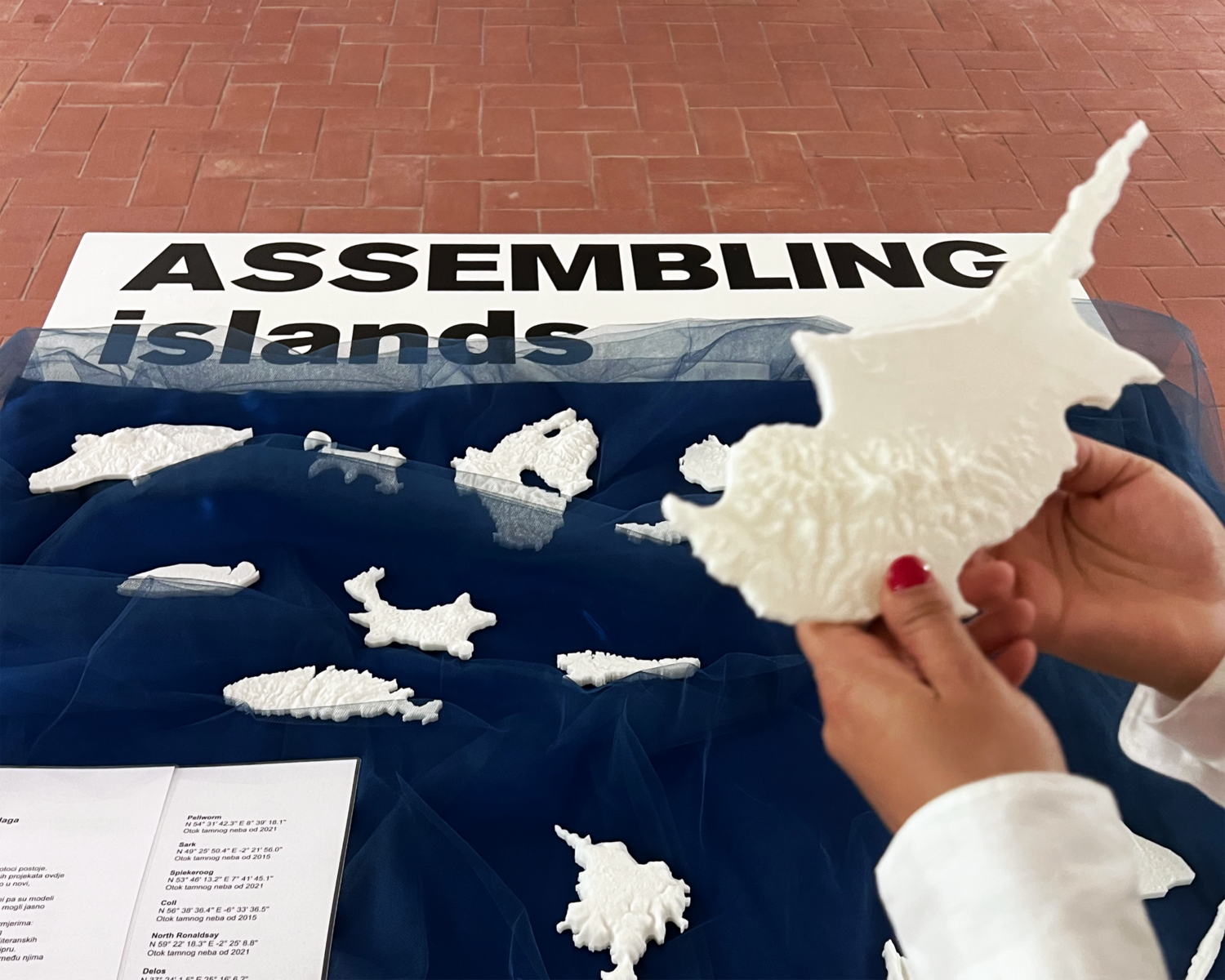
One piece is a video, filmed off Scandinavian and Mediterranean islands, that brings together footage of waves meeting. Another is a network map of the literature behind our projects, created using VOSviewer. It maps scholarship on dark-sky island communities, cultural heritage and digital storytelling, and migrant reception infrastructure.
The map consists of coloured clusters, each representing a different conceptual island, but none belongs exclusively to a single project. Each click reconfigures which relationships come to the fore and which recede. The idea was to make the literature an active part of our research and the exhibition. Another example is the archipelago of fifteen islands: each island carries a different story, but what visitors see are the relationships between them.
Your research focuses on digital storytelling by cultural heritage organisations on small Mediterranean islands. How do you define “digital storytelling”?
There are different definitions, but essentially they all revolve around using digital tools and formats — such as a podcast, a story map or a virtual tour — to tell a story. They combine elements such as text, images, audio and video. Digital storytelling asks researchers to think carefully about the story they want to tell and to choose the right medium for it.
My research began with an interest in how cultural heritage institutions can use digital technologies to make their collections more accessible and meaningful to different audiences. Through MEDISHARE, I look at Cyprus alongside other Mediterranean islands to understand which challenges they share, where they differ and how they might learn from one another.
Can digital technology change the way we perceive an archaeological artefact or site?
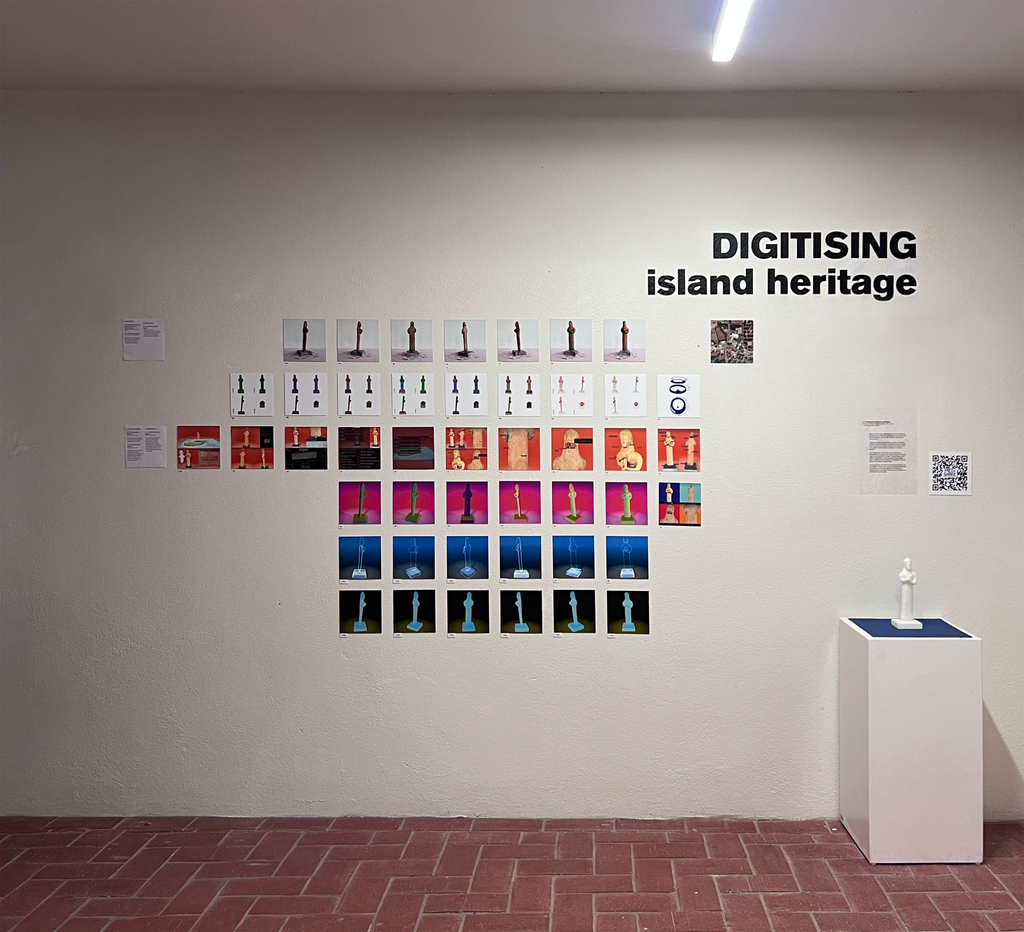
It can change how we look at them and the questions we ask about them. With a 3D model of an object, for example, we can rotate it, view it from different angles, zoom in on details and notice features that might otherwise go unseen. In a museum display case, we generally have a limited view and cannot hold the object. A model recreates something of the experience of holding it and allows closer observation. Digital storytelling can take this further by connecting the object to its archaeological context, its possible functions and the people who made, used or encountered it.
What could technology make possible in archaeology that was previously impossible or very difficult?
There are many possibilities. One that comes to mind is making archaeological heritage accessible beyond the physical site or museum. You might not be able to travel to Cyprus, but you could still explore a 3D model of an artefact or archaeological site, examine its details and engage with the research through digital storytelling.
Technology and digitisation also make it possible to access material held in museum storerooms that usually remains invisible to the public. They allow us to bring collections scattered across different museums together in a single digital space, which is particularly relevant for Cyprus.
Technology also allows us to connect different types of archaeological data. We can combine spatial data, photographs, excavation records, scientific analyses and 3D models to investigate archaeological questions. Three-dimensional documentation allows us to record objects and structures in considerable detail, share them with researchers in other countries, use them to monitor damage to monuments and sites, and much more.
Are there common challenges or opportunities between Cyprus and the smaller islands you study?
In Cyprus, I have found recurring challenges related, for example, to funding and the difficulty of maintaining digital projects over the long term. These also arise on other islands. My research builds a bridge between the Cypriot situation and other islands, while also pointing to conditions that small museums face in many places. Smaller islands face different challenges related to remoteness, connectivity or access to specialised services.
At the same time, there are important differences. Cyprus has a particular institutional and political context, including the island’s division, which affects how cultural heritage is managed and which areas fall within the scope of my research.
Which aspects of Cyprus’s cultural heritage do you think could make better use of digital technologies?
Imagine I take you to the Cyprus Museum and ask what you would like to know about this figurine, this coin, this collection. What matters is not what I would like to explore, but what a non-expert would like to see online and what would spark their interest — a secondary school student, a museum visitor, anyone. Museums and researchers need to make the effort to understand how to bring people closer to cultural heritage and use technology for that purpose.
Can digital technology bring different narratives of the same place into dialogue?
Yes, I think this is one of its most interesting possibilities. A digital platform can bring together archaeological evidence, historical documents, photographs, oral histories and personal memories that might otherwise remain scattered across different collections or institutions. For example, an interactive map can show the location of an archaeological site and present archaeological and historical information, while audio recordings can add the personal memories of people living nearby.
But technology is not a neutral medium in which all narratives automatically come together. We still decide which stories to tell, and that is never a neutral process, so we need to examine it critically.
How different are today’s islands from those you study as an archaeologist?
I would say it is less about how different the past is from the present than about how similar they are. Every place, on an island or on the mainland, has always been a point of connection and exchange of people, goods and ideas. There is a tendency to frame phenomena such as migration as isolated “crises”. Each has its own causes, which can be very different, but the past helps us see that many contemporary phenomena are not unprecedented. They are a fundamental part of how humans live on this planet.
About the exhibition
Island Relations brought together Federica Di Biase and Ana Ricchiardi from the University of Cyprus and Dominique van de Klundert from the University of Rijeka, with three research projects exploring islandness, migration, digital cultural heritage and sustainability.
Read more:

