


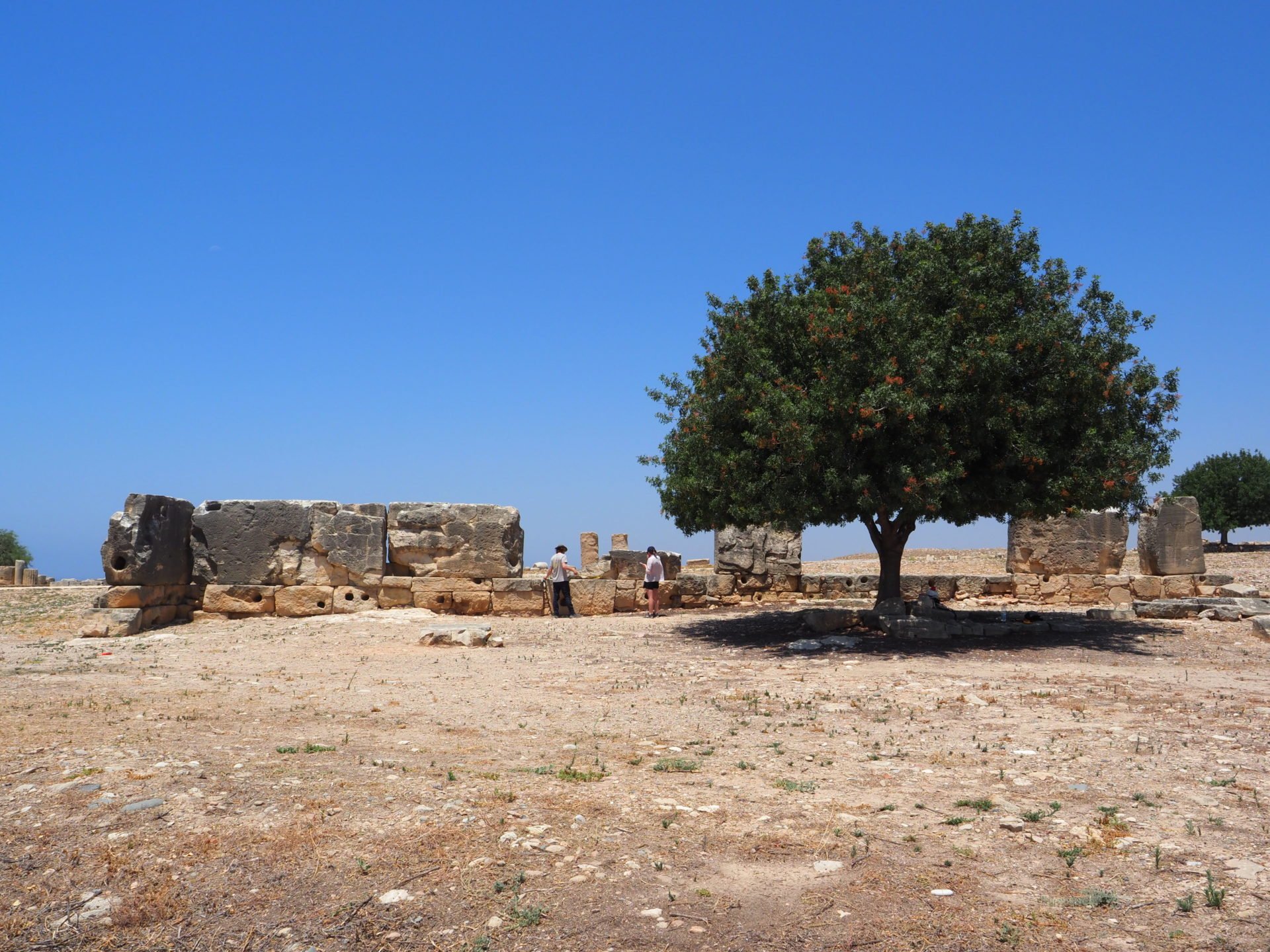
Ashlar masonry may seem like a dry architectural detail, but for archaeologist and Fulbright scholar Caroline Barnes, it offers critical insights into how communities shaped their environments—and themselves—through architecture.
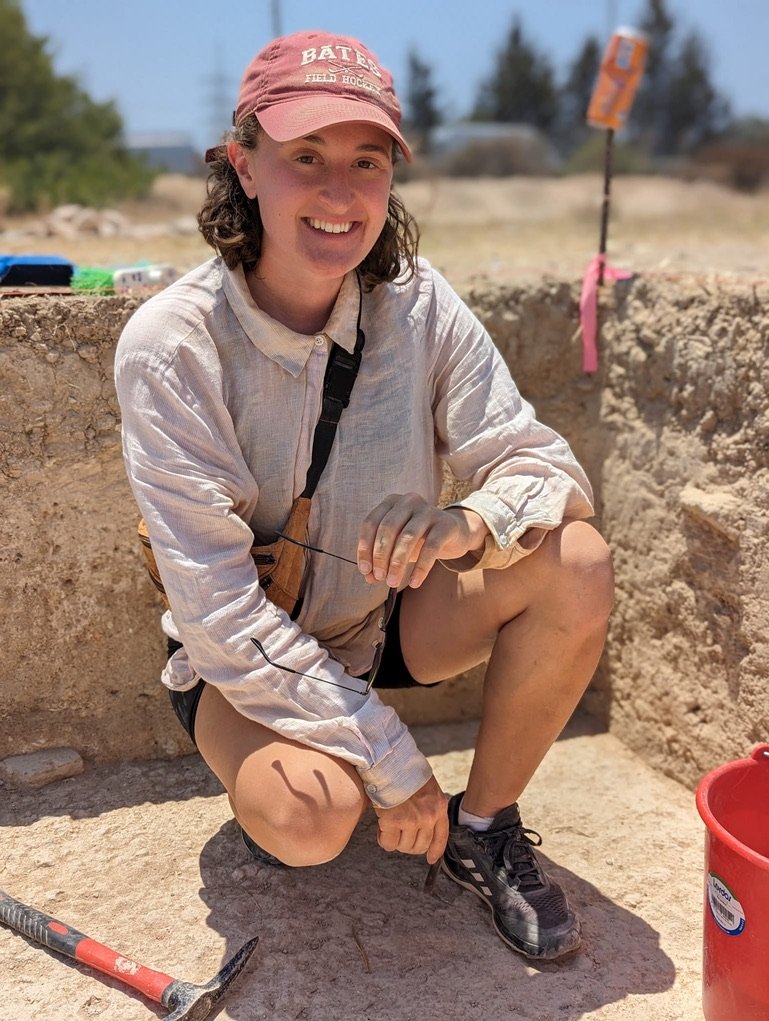
A PhD student in the Department of Ancient Mediterranean and Near Eastern Studies at the University of British Columbia (UBC), her academic path began with an undergraduate degree in Anthropology and Classics at Bates College in Maine, followed by two years in Athens, Greece, before moving to Canada to pursue graduate research. Her dissertation investigates the emergence of Cyprus’s first cities, focusing on how local communities interacted and connected across the Mediterranean to build early urban networks.
Barnes’ field experience includes participation in the Kalavasos and Maroni Built Environment (KAMBE) Project—co-directed by her PhD supervisor, Dr. Kevin Fisher—and the excavations at Kissonerga Skalia, led by Dr. Lindy Crewe of the Cyprus American Archaeological Research Institute (CAARI). It was through CAARI that Barnes also held a Fulbright research fellowship, deepening her engagement with the archaeology of Late Bronze Age Cyprus. A major strand of her current research focuses on the rise of stone masonry around 1650 BCE. Her study examines the technical expertise of ancient builders, the monumental scale of construction projects, and what these can tell us about social organisation in the absence of textual records or clear evidence of centralised authority.
In this interview, Barnes reflects on how the built environment in ancient Cyprus can be read as both material and social history. Drawing from fieldwork, architectural study, and digital modelling, she challenges traditional narratives of state formation by highlighting regional variation, labour distribution, and the agency of non-elite actors. Whether through the standardisation of construction techniques or the symbolic reuse of monumental stone in later periods, Barnes argues that architecture was not just a backdrop to history—it was an active participant in shaping community, identity, and power from the ground up.
What first drew you to the study of ashlar masonry in Cyprus?
In 2022, I received a graduate student fellowship for my Master’s research at the Cyprus American Archaeological Research Institute (CAARI), which gave me the chance to explore what research questions needed answering. The support and encouragement from the archaeological community at CAARI and in Cyprus generally have been instrumental in all of my research, and my nine-month stay as a Fulbright scholar with CAARI has profoundly impacted my growth as a scholar.
As mundane as it seems to us now, ashlar masonry (rectilinear cut blocks of stone) was considered an impressive form of monumentality in the Bronze Age. While previous research has focused on the practical measurements of the stone and the social impact of monumentality, my co-author Graham Braun and I were interested in combining these two aspects. This project also provided an excellent opportunity for us integrate traditional methodologies with digital recording techniques such as laser scanning and 3D modelling.
Your calculations suggest some buildings would take over 27,000 labour hours. What does that tell us about the social organisation behind these projects?
While 27,000 labour hours may seem like a substantial amount of time, it’s important to consider how this workload could have been distributed. For example, if it were a team of 10 people working 5-hour days, the project would take considerably longer than if it were a team of 50 people working 8-hour days. To gain a better understanding of the social organisation behind these projects, we need to look beyond just these numbers, which is why these calculations should be just one component of understanding ancient building projects.
There’s no evidence of a ruling elite or coercive labour in Bronze Age Cyprus. How do you interpret this?
One of the challenges in archaeology is trying to build arguments based on a lack of evidence, which can sometimes be due to issues of visibility; some things survive better while others don’t, or we may not be looking in the right places. Importantly for Cyprus, we know that Late Bronze Age Cypriots used a script called Cypro-Minoan, which has not been deciphered. As a result, we know very little about the details of social organisation and have to rely on material culture for insights; hence the importance of archaeology.
Regarding coercive labour specifically, there is evidence for it elsewhere in the Mediterranean (Egypt, the Levant, the Aegean), primarily from textual sources. The absence of similar evidence in Cyprus does not necessarily mean these practices did not exist here; it simply means that with our current knowledge, we cannot definitively speak to their presence or absence.
Your study highlights striking differences in how ashlar was worked and displayed across sites. What do these differences suggest about regional identity in Late Bronze Age Cyprus?
Ashlar masonry was displayed in similar ways across the island, which suggests a shared architectural ‘language’, let’s say. But there are notable differences in construction methods and stone details that vary not only from region to region but also from site to site. For example, the sites of Maroni and Kalavasos, which are only about 7 km apart, demonstrate different building techniques and preferences in their ashlar buildings.
These variations suggest the presence of local work teams who, while not working in complete isolation from one another, were sharing techniques and skills. So instead of a single team of masons moving from site to site around the island, each settlement probably had its own team of builders.
We see similar regionalism and site-specificity in ceramic production styles, and it’s possible that masonry can also be understood as a broadly islandwide craft but with local traits.
How much cross-cultural exchange or influence do you think shaped ashlar traditions in Cyprus—especially from the Levant or Egypt?
Archaeologists have long been interested in the cross-cultural exchange between Cyprus and the rest of the Eastern Mediterranean. Archaeologists such as Gunnel Hult, Eddie Peltenburg, and Kevin Fisher have looked at this specifically as it relates to ashlar traditions in Cyprus.
During the Late Bronze Age, Cyprus was highly active in Eastern Mediterranean trade, and there were probably frequent visits to Cyprus by foreigners and Cypriots who were traveling abroad. As with other aspects of material culture, there were architectural trends, but it is challenging to understand precisely how architectural styles were transferred and transformed in practical terms. Certainly, ashlar masonry was present in the Levant, Egypt, and the Aegean during this time, indicating that this architectural ‘language’ extended beyond just Cyprus. But Cyprus still retained its own unique ‘dialect’ in ashlar masonry. For example, the frequent use of drafted margins as a decorative feature is distinctive to Cyprus.
What role do you think ritual played in the construction process itself? Were these buildings simply functional, or also sacred?
In the construction process itself, we can imagine that there was a sort of ritualistic aspect as people gathered and repeated the same processes in concert. If you’re asking about strictly religious ritual significance, we are less certain. We have some evidence of what we call ‘foundation deposits,’ where items were buried in the walls or foundations of buildings, presumably as a form of blessing.
There is also evidence that ashlar buildings themselves were used for ceremonial or religious purposes. For example, at the site of Engomi, there are artifacts interpreted as cult statues, such as the Ingot God and the Horned God, which you can see in the Cyprus Museum. Additionally, the ashlar buildings at Kition in Larnaca have been described by excavators as temples. However, it’s not a one-to-one relationship. It’s more likely that ashlar masonry was monumental, and this monumentality made it special. Special places were often designated for religious use, much like how we view our religious spaces today.
How does Cyprus complicate or challenge the typical narrative of Bronze Age state formation in the eastern Mediterranean?
Because we cannot read Cypro-Minoan, we are limited to what people from outside of Cyprus say about the island. It is believed that Cyprus was known as Alashiya in the Late Bronze Age, according to texts from the Levant and Egypt. These texts refer to a King of Alashiya, but on the ground in Cyprus, we don’t have strict archaeological evidence for a king—no palace, capital, or clear ‘ruling centre,’ and no consistent imperial art and ideology like we see, for example, in Egypt. Reconciling this evidence has been a point of long-standing debate in Cypriot archaeology.
We do know that some people had more access than others to imported goods and buried these objects with their dead, which tells us there was some socioeconomic differentiation. However, we don’t know how social classes were divided or how the state structure worked.
Cyprus is a resource-rich and well-connected island, so it would have been difficult for any one person or group to control everything. Many archaeologists explain this by suggesting that Cyprus had heterarchical regional polities, which were sort of precursors to the city-kingdoms we see later in the Iron Age.
Do you think builders and masons in Late Bronze Age Cyprus formed a proto-subaltern class—skilled but ultimately anonymous in the archaeological record?
I’m not sure we can consider them a subaltern class, as that would presuppose the existence of a small ruling elite group that marginalised and exploited builders. While this has certainly been the case in parts of history and our modern world today, we cannot definitively say that builders and masons were inherently stuck in inequality in Late Bronze Age Cyprus.
In general, Late Bronze Age communities on Cyprus were small, with the largest numbering probably in the thousands, so construction projects would have been highly visible and likely communal endeavors beyond just the builders themselves. The buildings they constructed were perhaps used by the community at large, for example, for agricultural processing and storage. The communal benefit of these buildings and the communal visibility of these constructions would likely have meant that builders were not subaltern in the same way we think of labour exploitation and marginalisation today.
In your view, how did monumental architecture participate in the reproduction of social order in Bronze Age Cyprus, even without a formal state?
Even without a formal state, the ability to organise and execute monumental construction projects shows that certain groups had control over resources and labour. But this capability wasn’t just about top-down control, but also involved interactions and relationships between social classes.
Construction projects helped reinforce social bonds, obligations, and expectations, not just vertically (between higher and lower classes) but also horizontally (within social classes). So, we can think of monumental building projects as spaces where social order was reproduced but also probably, at times, challenged. We should think about monumental construction projects as much dynamic places than just reinforcing hierarchical control.
Could the reuse and emulation of ashlar architecture in the Iron Age be seen as ideological appropriation—invoking the past to legitimise new forms of power?
Definitely, but there are both practical and symbolic aspects.
On one hand, it is simply more convenient to use stone that is available from an older building than to quarry, transport and shape new blocks. This kind of recycling is familiar to us even today.
On the other hand, practicality and symbolism are not mutually exclusive. Emulating and re-using older ashlar and building traditions could have been a way for people to tap into the legacy and authority of the past. Perhaps they were trying to convey “We’re part of this great tradition” in order to legitimise or strengthen their position in the present.
How might your findings reshape how we think about who had agency in ancient construction—especially beyond the elite?
Archaeology has long tended to focus on elites, partly due to archaeological visibility. Elites had the means to bury lots of fancy items with their dead, and the structures they built were often more durable; there’s arguably a greater chance of excavating a grand palace than a small mudbrick house of a non-elite. But of course, elites were not the only inhabitants of the past. In fact, the dichotomy between elite and non-elite can be quite misleading; social classes likely operated on a much broader spectrum like they do today.
In general, though, I’d say it is a matter of perspective. We need to tease out elements of the material record that are not solely elite-focused if we want to get a full picture. One way to do this is, even when focuses on ‘elite’ contexts, to consider the other people involved in creating those spaces, such as builders and masons.

