


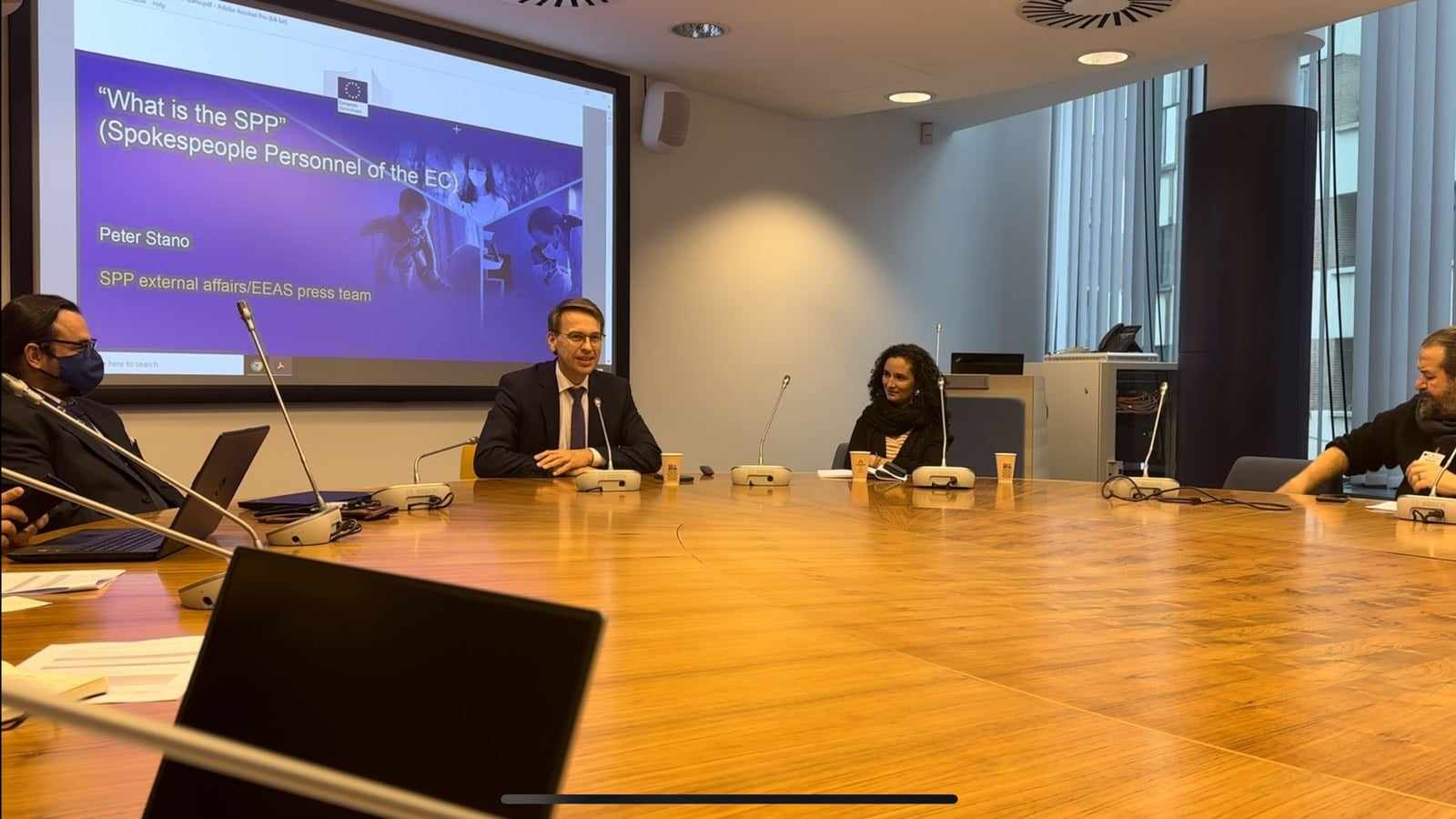
The EU is actively involved with the Cyprus issue and the violations in the buffer zone, but it must first consult with the parties involved in the negotiations and the United Nations, before acting, said Peter Stano, the European Commission’s (EC) Lead Spokesperson for Foreign Affairs and Security Policy.
Stano was responding to questions during a press briefing with Cypriot journalists in Brussels on Monday.
Addressing enquiries about the EU’s response to the violations of the status quo in the buffer zone in Pyla and Ayios Dometios by the Turkish occupying forces, Stano clarified the EU’s approach, stating, “There are two ways the EU is reacting. One is, of course, the public statements.” He emphasised that these statements institutional positions of the EU as a whole.
The EC’s Spokesperson stressed that Cyprus, being an EU member, actively participates in decision-making processes, with its diplomats bringing issues to the attention of relevant EU bodies.
Stano acknowledged that public statements are just one layer of the EU’s response. He elaborated, “The second layer, and this is what we are using most often, is engagement.” Stano highlighted the importance of diplomatic channels, describing it as an attempt to avoid “loudspeaker diplomacy.” He explained that engaging through diplomatic channels is a more nuanced way of addressing issues, demonstrating the EU’s commitment to resolving conflicts behind the scenes.
“So even if there is no public reaction, it doesn’t say that the EU institutions and other member states are not active enough,” he said.
Stano outlined the EU’s approach in dealing with incidents involving Cyprus, saying, “We always first ask our Cypriot partners what is the most appropriate way to do things in order to achieve the desired response.” He highlighted the importance of consulting with the United Nations (UN) in these matters, reinforcing the UN’s critical role in the EU’s positions on the Cyprus issue.
Regarding the EU’s relationship with Turkey, Stano underscored the significance of Turkey’s actions on Cyprus, stating, “Turkey knows very well that their future with the EU goes through their relationship with Cyprus.” He explained that the deterioration in EU-Turkey relations since 2019 has direct links to Turkey’s actions against Cyprus.
He added that this was made evident with the joint communique issued last week by the EU Commission on the state of play of bilateral Turkey-EU relations, which noted that a positive agenda in the European Union’s bilateral relations with Turkey “will remain extremely challenging in the absence of a solution to the Cyprus issue.”
Stano noted that the EU is actively engaged in addressing the situation, with a focus on collaboration with Cyprus and consultation with the UN to find an appropriate and effective resolution.
He further stressed that a two-state solution for Cyprus is non-negotiable for the European Commission.
Read more:

