


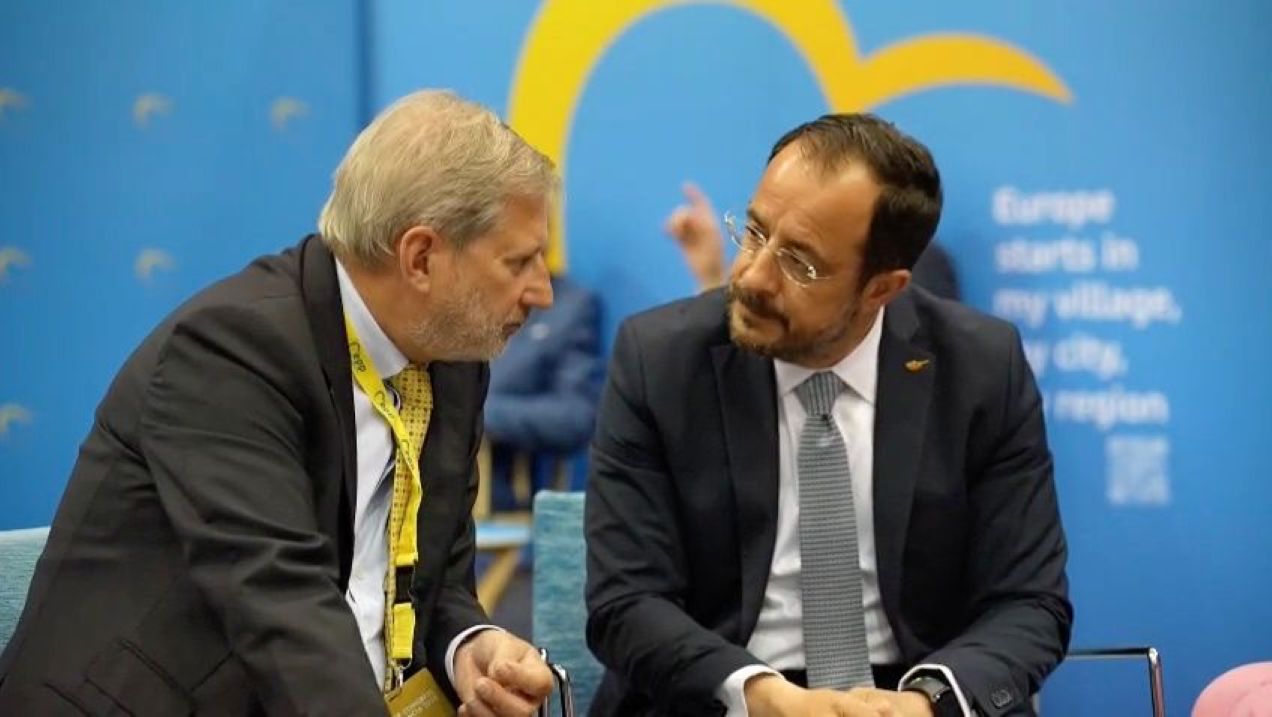
The European Union has appointed former Commissioner Johannes Hahn as special envoy for Cyprus, establishing a direct connection between progress on the Cyprus problem and EU-Turkey relations.
The Cyprus problem has historically remained under the United Nations umbrella and it is widely accepted that it will stay there until resolution. However, various external factors have consistently influenced developments surrounding the issue, with Turkey using its involvement in other organisations such as NATO and regional developments to gain advantages in Cyprus discussions.
The appointment, announced nearly simultaneously with the United Nations naming Maria Angela Holguin Cuellar as its special representative, marks a significant shift in the EU’s approach to the Cyprus issue.
The European Council stated in its April 2024 conclusions that progress on the Cyprus problem is a structural prerequisite for improving EU-Turkey relations, sending a clear message that strategic enhancement of EU-Turkey relations cannot continue if Turkey remains inactive or negative regarding Cyprus settlement.
In previous years, the European Union factor in Cyprus settlement efforts functioned either as a tool for Greek Cypriots, who viewed the EU as a body that would solve everything “magically,” or as an excuse for Turkish Cypriots, who consistently sought pretexts to avoid dialogue. The EU itself did not see a role in the Cyprus issue and made sure to message Nicosia that it was a United Nations matter, satisfying Turkish audiences.
With this new development, it is evident the EU acknowledges it has a supportive and effective role to play. Significantly, Hahn will report directly to European Commission President Ursula von der Leyen.
“He not only understands the pathways through which Turkish foreign policy moves, but also knows how to seek common ground without compromising on European principles,” government sources in Nicosia said.
The Turkish Foreign Ministry responded by describing the appointment as “an internal EU matter” and claimed that “the EU’s biased approach, which exclusively defends Greek Cypriot positions and claims regarding the Cyprus issue, has been further strengthened recently.”
Over a two-year period, from President Nikos Christodoulides’ election in 2023 until March 2025, three significant developments have reinforced the EU’s role in the Cyprus issue:
- European Council conclusions in July 2023 expressing the EU’s readiness to actively support all stages of the UN-led process with all appropriate means at its disposal
- European Council conclusions in April 2024 explicitly linking progress in EU-Turkey relations with Turkey’s Cyprus-related obligations in a gradual, proportional, and reversible manner
- A joint letter from the Presidents of the European Council and European Commission to the UN Secretary-General in March 2025 highlighting Cyprus as a European issue of tremendous importance to the EU itself and expressing readiness to escalate efforts to support the UN Secretary-General’s process
Hahn co-managed the implementation of the 2016 EU-Turkey agreement on refugees which provided European financial support for hosting Syrian refugees on Turkish soil. He maintained communication with power centres in Turkey, seeking to prevent Ankara’s complete disconnection from European institutional dialogue.
The relationship between President Christodoulides and Commission President von der Leyen appears to have been influential. Government officials point to cooperation during the previous year’s European election campaign, which brought von der Leyen to Cyprus for efforts to send aid to Gaza and promote an agreement with Lebanon regarding illegal migration.
In October 2024, Christodoulides and von der Leyen privately discussed the upcoming appointment in light of Cyprus developments, ahead of a dinner in New York between the UN Secretary-General and the two leaders.
The United Nations stated it “looks forward to working with the EU special envoy on Cyprus”.
Hahn’s appointment challenges Turkey’s narrative about the disconnection between EU-Turkey relations and the Cyprus issue, with Turkish reactions suggesting that Ankara and the Turkish Cypriot leadership did not want another player, particularly from the EU, involved in the Cyprus problem.

