


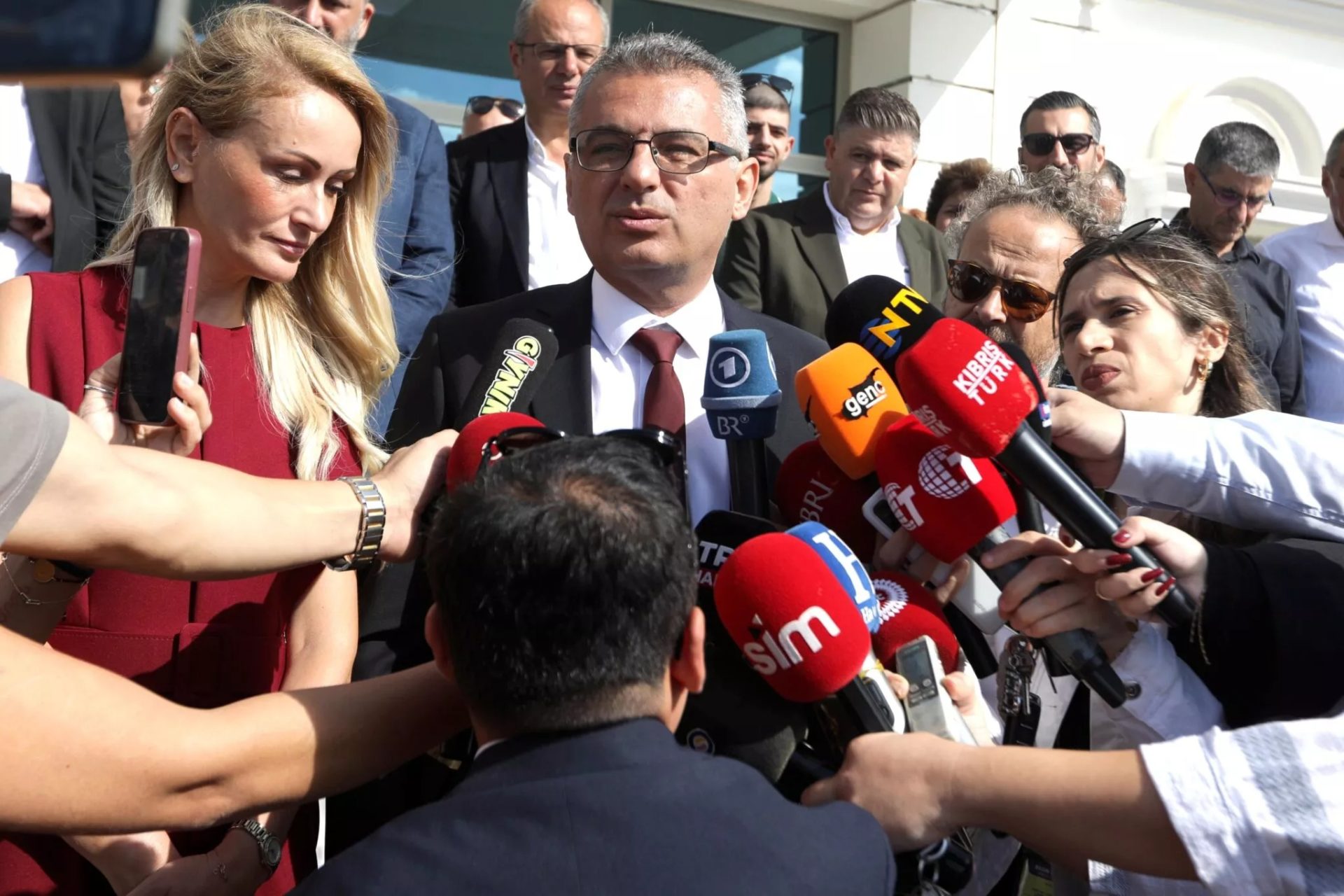
Tufan Erhurman’s landslide victory in the occupied Cyprus elections has revived prospects for resuming Cyprus reunification talks.
The Greek Cypriot side has sent initial messages expressing readiness for dialogue, but observers are now waiting to see how Ankara will respond after openly supporting Ersin Tatar, who was decisively defeated.
Erhurman secured 62.76% of votes compared to Tatar’s 35.81% in Sunday’s election, winning outright in the first round. Voter turnout was 64.87%, with analysts noting that many right-wing Turkish Cypriot voters abstained, indicating their dissatisfaction with Tatar and the current “administration”.
In his first statement, Erhurman thanked his supporters and promised to work with consensus. While initially not mentioning the Cyprus issue, he later stated that “foreign policy” would be conducted in close consultation with Ankara.
Erhurman appeared cautious in his victory speech. Regarding foreign policy and the Cyprus issue, he said that, like previous Turkish Cypriot leaders, he would work in coordination with Turkey.
He thanked Turkish President Recep Tayyip Erdogan, Vice President Cevdet Yilmaz, and Foreign Minister Hakan Fidan for their congratulations.
The newly elected leader is not expected to take actions that might provoke reactions at this stage, particularly considering warnings from right-wing Turkish Cypriot circles in the administration that the Cyprus issue should be handled by the so-called “foreign ministry”.
His first trip to Ankara will indicate Turkey’s true intentions and how Erdogan will respond to the victory of a Turkish Cypriot who has not been staunchly aligned with him on the Cyprus issue.
Attention has now turned to how Erdogan will react both toward the Turkish Cypriots and regarding the Cyprus issue.
There is also interest in how Erhurman will approach key parameters already established by Turkey: the two-state solution proposal introduced by Tatar and the resolution adopted by the unrecognised parliament supporting a two-state solution – both bearing Ankara’s approval.
Erdogan’s congratulatory message to Erhurman raises questions about their future cooperation. He wished the “electoral process” to be “beneficial for our countries and our region” and stated that Turkey “will continue, together with our Turkish Cypriot brothers, to defend the sovereign rights and interests of the ‘TRNC’ on every platform”.
President Christodoulides, who attempted to establish direct communication with Erhurman, sent his first message through a written statement. He congratulated Erhurman on becoming the leader of the Turkish Cypriot community.
The president reiterated his firm political will to restart substantive negotiations for resolving the Cyprus issue, emphasising his determination to contribute to this effort “from the point where they were interrupted at Crans Montana”.
He added that this would be within the framework of UN Secretary-General Antonio Guterres’ declared commitment. Referring to upcoming developments, he described the imminent informal, expanded meeting announced by the Secretary-General as “a crucial opportunity to restart the process”.
President Christodoulides underscored that the solution to the Cyprus problem must be based on “UN resolutions, Security Council decisions, and the principles and values of the European Union, of which the Republic of Cyprus is and will continue to be a member state”.
DISY President Annita Demetriou expressed the view that “Turkish Cypriots turned their backs on the two-state solution”. She congratulated Erhurman and expressed hope that “the road to substantive negotiations for a solution to the Cyprus problem within the agreed framework will open”.
AKEL Secretary General Stefanos Stefanou believes that “the Turkish Cypriot community has decided in favour of a federation solution and reunification”.
He further noted that “we should all now focus on efforts to continue negotiations from where they were interrupted, safeguarding the negotiating acquis and achieving a comprehensive solution”.
DEPA considers Erhurman’s victory as a message for a bi-zonal, bi-communal federation solution and rejection of the “two-state” solution.
With the completion of the election in occupied Cyprus, new momentum from the United Nations is expected ahead of the announced new informal multilateral meeting before year’s end.
During the July meeting, the Secretary-General informed the parties that after the electoral process, Maria Angela Holguin would undertake a new mission to the region.
The UN Secretary-General’s personal envoy is expected on the island in the first half of November for meetings with both President Christodoulides and the new Turkish Cypriot leader Tufan Erhurman.
During Holguin’s visit, it will become clear whether the situation has changed and whether, unlike Tatar, Erhurman will have no objection to a joint meeting with Christodoulides.
The dates for convening the next informal five-party conference, which is expected before the end of the year, will also be clarified during Holguin’s visit.

