


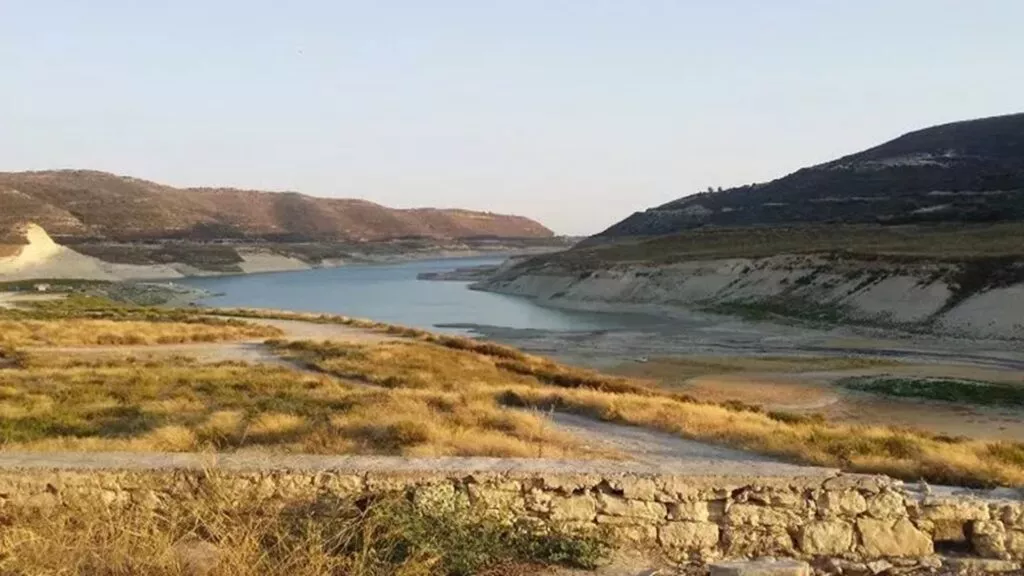
Cyprus has launched a nationwide campaign to reduce water consumption as dam levels drop to about 21% of capacity amid prolonged dry conditions.
The initiative, titled “Water for tomorrow”, is being led by the Ministry of Agriculture in cooperation with the Ministry of Education and the Water Development Department (WDD). The campaign aims to raise awareness and encourage households to reduce water waste.
Authorities have set a target of cutting water consumption by 10% in 2026, equivalent to saving about 10 million cubic metres of water.
Officials say the campaign will also inform the public about the current state of water reserves and address questions about water use in sectors such as tourism and golf courses, as well as explain the complexities of water management.
A central element of the strategy is outreach in schools. Officials from the Water Development Department have already visited 30 schools in Nicosia, Limassol and Paphos during 2026.
The programme is expected to expand across the government-controlled areas of Cyprus, with students encouraged to act as “ambassadors” for water conservation within their families.
The Kouris dam, which supplies water to the districts of Nicosia, Limassol, Larnaca and Famagusta, has been placed at the centre of the campaign.
Water reserves at the dam currently stand at 22 million cubic metres, with the reservoir about 19% full.
A short film produced as part of the campaign presents the Kouris dam as a symbol of the island’s water resources and highlights the need to protect it through conservation and other measures.
The communication strategy also includes three teaser videos inspired by the visual style of the television series Stranger Things. The clips contrast children watching water levels drop with adults distracted by screens, while encouraging the public to download a new mobile application called “Stagono-metro” to monitor their water consumption.
Alongside the awareness campaign, authorities are introducing practical measures aimed at reducing water use.
The Ministry of Agriculture has begun procuring 1,500 water-saving devices for businesses and plans to extend similar measures to households across the island.
The Water Development Department has also launched a tender to supply three million faucet aerators and shower flow reducers. The devices will be distributed nationwide by post in 600,000 envelopes, with residents able to report installation progress through a digital platform.
The Ministry of Education is also introducing programmes in schools, including the initiative “Not a drop wasted”. Education Minister Athena Michaelidou said systems for reusing “grey water” from sinks will be installed in schools, while a campaign titled “Words flow, not water” will encourage students to promote water conservation.
According to the ministry, raising awareness about sustainable water management is a long-standing priority, with water conservation incorporated into environmental education policies and school curricula.
The ministry said schools are also being equipped with drinking water coolers as part of efforts to provide safe water and reduce reliance on bottled water.
Environmental programmes are also being implemented at the school level to promote water conservation and reuse.
Through the “Greening my school” initiative, schools are being supported to install smart irrigation systems, use boreholes and plant species with low water requirements.
Cyprus remains one of the driest countries in the European Union. Authorities say 2025 was the eighth-worst year on record for rainfall, and average annual rainfall has declined by about 10% since the mid-1990s.
According to data from the Ministry of Agriculture, the average daily water consumption per person in Cyprus is about 140 litres, with authorities aiming to reduce it to 125 litres.
The campaign will also address public questions about water use in tourism and golf facilities through a documentary titled “Water speaks”, which will examine water management and the energy cost of desalination.
Officials are also encouraging residents to take simple steps to save water, including limiting showers to five minutes, avoiding the use of hoses for cleaning, choosing plants that require less water, checking for leaks and using the “Stagonometro” application to track consumption.

