


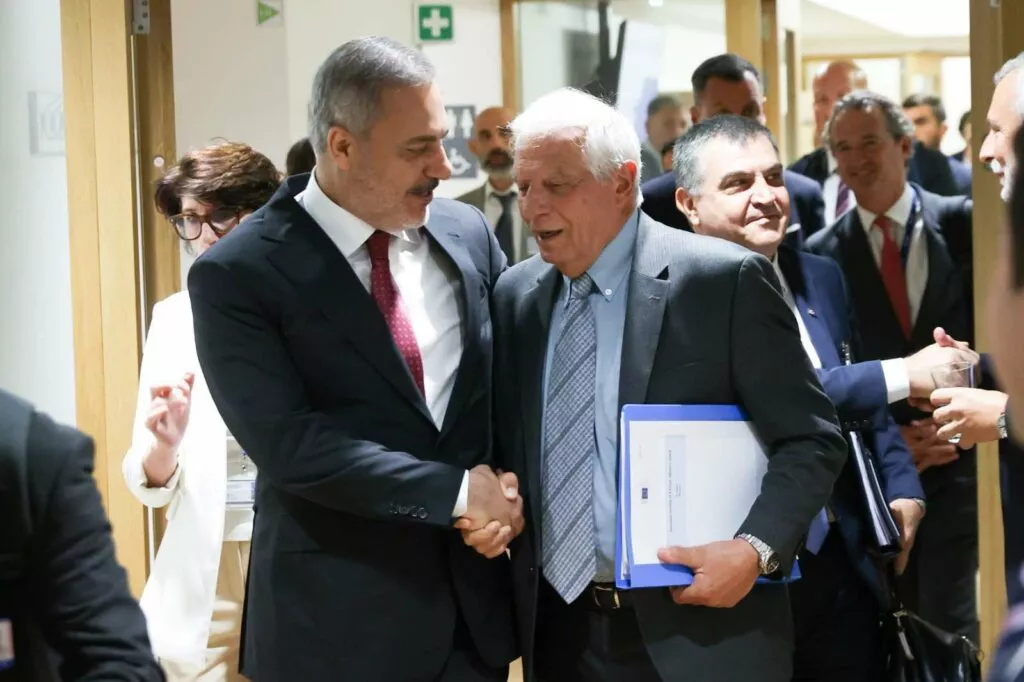
At a recent informal meeting of the European Union’s Foreign Ministers, discussions centered on the Cyprus issue, Greek-Turkish relations, and EU-Turkey ties, revealing key insights and conclusions. The focus was identifying common ground among these interconnected, though separate, areas of diplomatic concern.
During the working lunch, attended by Turkish Foreign Minister Hakan Fidan, no significant shift in Turkey’s stance on the Cyprus issue was observed. This was expected, as Turkey has maintained a consistent position. However, the meeting underscored the evolving attitudes of EU member states.
Several EU Foreign Ministers and two senior European Commission officials highlighted Nicosia’s decision to agree to Fidan’s presence at the meeting, viewing it as a notable diplomatic gesture. Despite this, Fidan reiterated Turkey’s uncompromising stance on Cyprus.
EU High Representative for Foreign Affairs, Josep Borrell, emphasized the importance of resolving the Cyprus issue, stressing the EU’s commitment to restarting negotiations based on UN Security Council resolutions and European Council conclusions. Commissioner for Neighbourhood and Enlargement Oliver Várhelyi also pointed out that Turkey’s positive involvement is crucial for progress in EU-Turkey relations.
Turkish Foreign Minister Hakan Fidan refrained from addressing the Cyprus issue in his initial remarks. Instead, he focused on Turkey’s importance as a major state. He reiterated his country’s aspiration for full EU membership, noting that “it is up to the EU to take the necessary steps.”
Following Fidan’s statement, 22 foreign ministers, including those from Cyprus and Greece, responded. Beyond the predictable positions of Cyprus and Greece, several other ministers expressed support for Cyprus and a resolution to the Cyprus issue. These included the foreign ministers of Italy, Germany, France, Finland, Ireland, Spain, the Netherlands, Luxembourg, Portugal, Latvia, Slovakia, Romania, Croatia, and Malta. However, representatives from Hungary (currently holding the EU presidency), Belgium, the Czech Republic, Slovenia, Sweden, and Bulgaria did not address the Cyprus issue in their remarks.
Positions of EU Foreign Ministers
The German Foreign Minister emerged as one of the most supportive voices, stressing the need for Turkey to meet the Copenhagen criteria, particularly regarding foreign policy. She pointedly reminded Fidan that the EU consists of 27 member states, not 26, implying the importance of Cyprus within the Union. She emphasized that discussions of a two-state solution for Cyprus, a position Turkey has previously endorsed, were unacceptable. Furthermore, she warned against any Turkish actions in the exclusive economic zones (EEZs) of Cyprus and Greece.
The French Foreign Minister highlighted major shared concerns between the EU and Turkey, particularly in relation to Ukraine and the Middle East. He reaffirmed that the Cyprus issue is a matter of EU concern, reiterating France’s well-known position and the need for negotiations to resume.
Turkish Foreign Minister Hakan Fidan, following widespread references to the Cyprus issue by the majority of EU member states, addressed the matter during his second intervention at the informal EU foreign ministers’ meeting. Fidan argued that EU-Turkey relations should be decoupled from the Cyprus issue, citing unspecified public opinion in Turkey. He reiterated claims of the so-called isolation of Turkish Cypriots, accusing the EU of failing to fulfill promises to them. He also restated Turkey’s position advocating for a two-state solution, demanding “sovereign equality” and “equal international status.”
Fidan’s remarks were met with immediate pushback from Luxembourg’s Foreign Minister, who criticized the Turkish minister for disregarding the positions expressed by EU member states. EU foreign policy chief Josep Borrell concluded the discussion by reaffirming the importance of the Cyprus issue to the EU.
Cyprus Responds
Cypriot Foreign Minister Konstantinos Kombos exercised his right to respond, accusing Turkey of attempting to impose its stance on the international community and the EU. He reminded the gathering of the EU’s decisions on Cyprus, emphasizing that the bloc operates under binding rules and obligations. Kombos warned that any deviation from the agreed framework could undermine the EU’s institutional integrity. He further noted that a two-state solution would result in Turkish Cypriots losing their EU citizenship, and reiterated that their so-called isolation is the result of Turkey’s invasion and ongoing occupation of the island.
Kombos drew parallels between EU solidarity with Ukraine’s sovereignty and territorial integrity and the situation in Cyprus, a fellow EU member state.
Turkey’s Broader Geopolitical Moves
While Turkey made no concessions at the meeting, which was anticipated, its foreign policy strategy extended beyond the EU. Just days after Fidan’s participation in the informal talks, Turkey submitted a formal application to join BRICS, an economic bloc of emerging markets that currently includes Russia, China, India, Brazil, South Africa, Egypt, Ethiopia, the UAE, Iran, and Saudi Arabia. This unexpected move caught Brussels off guard, signaling Turkey’s broader geopolitical ambitions outside the EU framework.

