


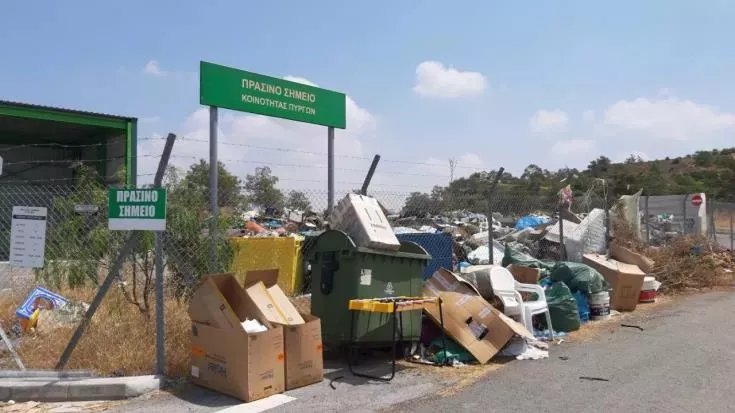
Gaps in Cyprus’s network of Green Points are forcing people in many areas to travel long distances to drop off their waste, adding to illegal dumping in the countryside, according to information gathered by the Department of Environment.
The original plan for the network was never completed, leaving a significant number of local authorities without direct access to a permanent Green Point, where waste is collected separately. There are currently no actions that could be taken immediately to substantially improve the situation, and state planning needs to develop further before specific, workable measures can emerge.
The department has identified the main problems from available data and from information provided by District Local Government Organisations (DLGOs) and the district operating boards. Besides the gaps in coverage, they include a shortage of licensed facilities for some types of waste, problems with the operation of temporary Green Points and the need for closer monitoring of how the sites are run.
New sites
The Department of Environment expects to complete its review of the Strategic Plan (Phase B) at the end of 2026. When the revised plan goes to the Cabinet, ministers will consider whether the state should cover the cost of building new Green Points.
The plan provides for new Green Points, small Green Points and Green Kiosks, which are expected to improve coverage and make separate collection easier to reach. The need for a denser network has become more pressing since the recent wildfires, which highlighted the need to clear waste from illegal dumps and rubbish tips in the countryside and manage it properly.
Few licensed facilities
Only a limited number of facilities are licensed to take bulky and green waste, an almost monopolistic situation that is pushing up delivery costs and causing technical and procedural problems. In several districts there are not enough licensed facilities or operators to handle specific types of waste such as polystyrene, insulation materials and some recyclables. The development of new facilities is held back by, among other things, market conditions, high investment costs and licensing requirements.
Some licensed operators also close for long periods in summer, in some cases for up to a month. During that time, some types of waste cannot be removed from Green Points, or can be removed only partly, so it builds up and takes up available space.
The smooth running of Green Points also depends heavily on having suitable vehicles to remove and transport waste on time. Breakdowns or a shortage of vehicles can delay the emptying of containers, leading to waste piling up. The spread of Green Kiosks and small Green Points, particularly in remote areas, is expected to increase the need for vehicles, staff and collection routes.
Municipal sites and businesses
Some municipalities, such as Agios Dometios and Kaimakli, run temporary sites outside the official network and charge their own fees. The Department of Environment is considering either bringing them into the official network or gradually closing them.
Green Points serve only members of the public, who can drop off waste free of charge. Businesses cannot use them for any type of waste.
Kostas Konstantinou, director general of the General Directorate of the Environment said that once DLGOs take over the running of Green Points, the authorities are considering allowing businesses to drop off waste for a fee, under certain conditions. This could make better use of the sites and help make them financially viable, provided the necessary infrastructure, procedures and arrangements are in place.

