


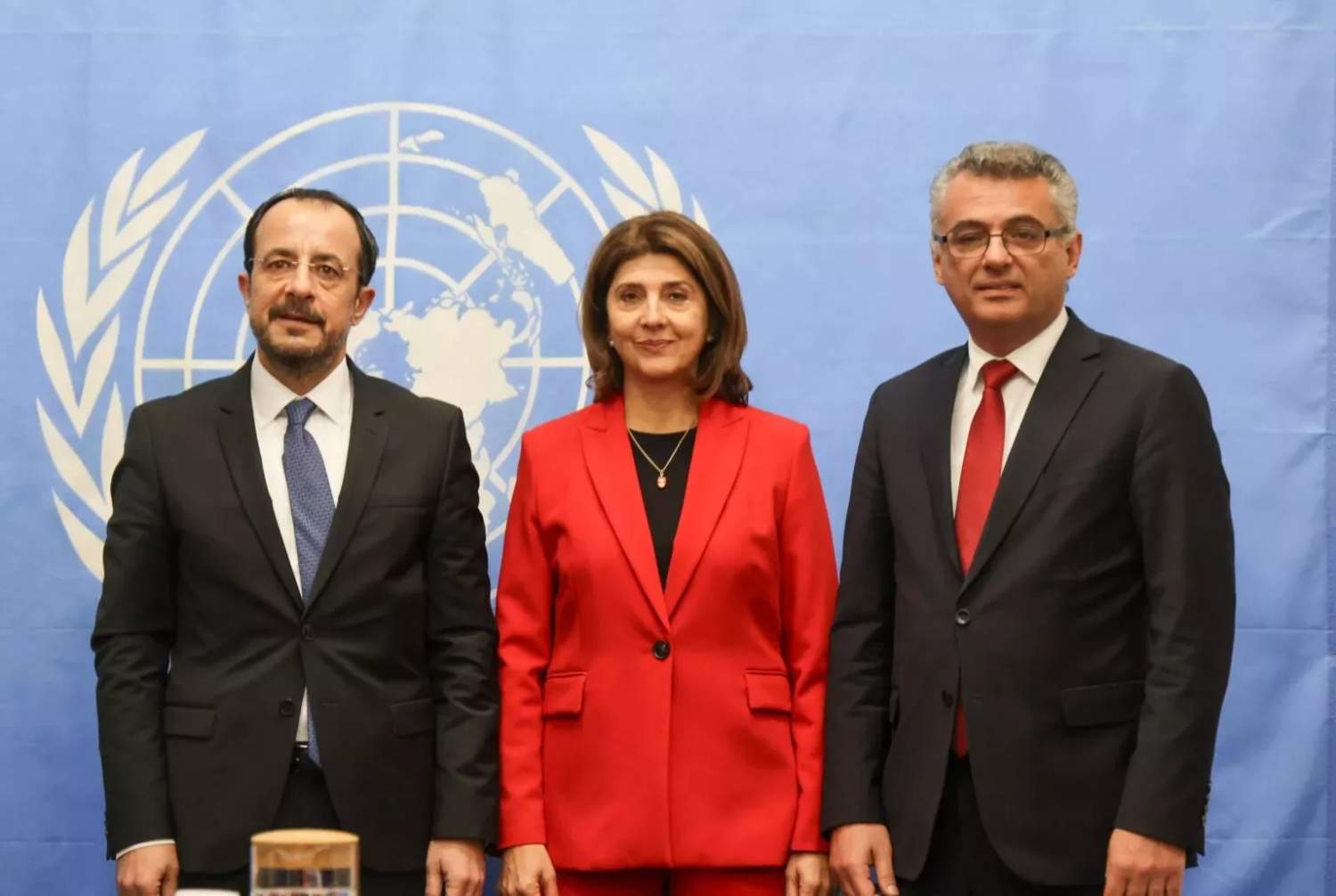
Cyprus President Nikos Christodoulides will raise the problems faced by enclaved Greek Cypriots in the Karpasia peninsula — and in particular the difficulties at the occupied Rizokarpaso school — when he meets Turkish Cypriot leader Tufan Erhürman today.
According to sources, Christodoulides will ask Erhürman to look at the issue and take some straightforward steps to ease conditions for the enclaved community generally, and specifically to allow the Rizokarpaso school to function properly.
The school’s difficulties have been recently documented in a European Parliament Research Service report titled “Enclaved pupils in Cyprus,” commissioned by Cypriot MEP Loucas Fourlas.
The report notes that UNFICYP continues to facilitate the delivery of school textbooks and the appointment of teachers to Greek Cypriot primary and secondary schools in the Karpasia peninsula.
As in previous years, the Turkish Cypriot side refused the use of seven Greek school textbooks in Karpasia schools and rejected the appointment of seven teachers, disrupting the normal running of Greek Cypriot schools, the report states.
Confidence-building measures are also expected to feature on today’s agenda, with discussion likely to focus on opening new crossing points. Last week, the Greek Cypriot negotiator said the Turkish Cypriot side had communicated, through its own negotiator, that it was rejecting the opening of the Athienou checkpoint.
Efforts will nonetheless be made to achieve progress at other crossing points, the negotiator said.
The broader goal remains the resumption of substantive negotiations, though expectations for today’s meeting are low.
The talks take place against the backdrop of a recent article by UN envoy María Ángela Holguín on the Cyprus issue, which drew a response from Christodoulides.
Adding to the complicated picture, Erhürman said last week from Istanbul that he is “on the same page” as Turkey on the Cyprus issue — a statement that raises questions about his actual position, given Turkey’s known stance in favour of a two-state solution in Cyprus.
Christodoulides is expected to seek clarification from Erhürman on whether he is willing to move to the next stage of the process — resuming substantive negotiations as soon as possible — and not to lose valuable time on the pretext of the Cypriot EU Presidency or the parliamentary elections scheduled for next May.
Holguín’s article last week had itself referenced the EU Presidency and the elections, prompting Christodoulides to point out that neither he nor his government is taking part in the elections, and to reiterate his commitment to a new multilateral conference on the Cyprus issue and substantive negotiations.
In an interview with Greek newspaper Ta Nea published last Saturday, Christodoulides said that neither the assumption of the EU Presidency nor internal electoral processes can be an obstacle to resuming talks.
He also reiterated his five-point proposal, which he said he had presented during Holguín’s last visit to Nicosia: reaffirmation of the agreed basis for a solution as set out in the 11 December joint communiqué, with explicit reference to political equality and UN Security Council resolutions; a UN mapping of convergences reached up to Crans-Montana; the convening of an Enlarged Conference by the UN Secretary-General on that basis; an announcement there of the resumption of substantive talks; and the opening of four checkpoints. He said he was ready to engage in such a process as early as next week.
The current situation leaves little room for optimism that any movement on the Cyprus issue will occur before the summer.
The question that arises is whether, after the summer, a new effort leading to substantive negotiations can practically get under way, given that UN Secretary-General António Guterres’ term in office is drawing to a close.
Read more:

