


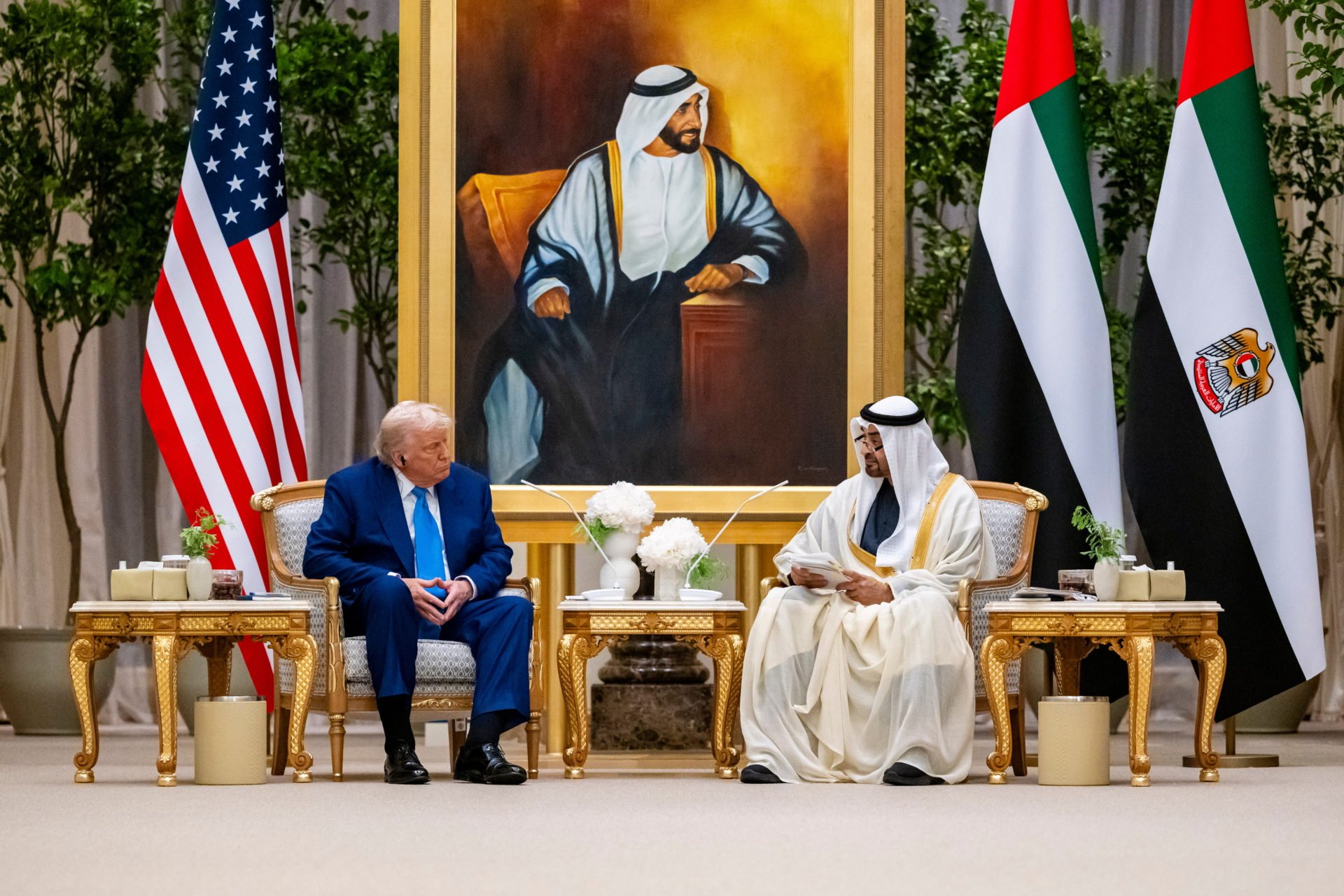
U.S. President Donald Trump pledged on Friday to address the humanitarian crisis in Gaza, stating that the United States would get the situation “taken care of” amid reports of Israeli strikes killing at least 64 Palestinians.
“We’re looking at Gaza. And we’re going to get that taken care of. A lot of people are starving,” Trump told reporters during the final day of his Gulf tour, according to AFP.
The Integrated Food Security Phase Classification, a leading authority on hunger crises, reports that nearly half a million Palestinians face possible starvation while another million barely have enough food.
The death toll from Israeli strikes across Gaza on Friday reached 64, with 48 bodies brought to the Indonesian hospital and 16 to Nasser hospital, health officials said. Gaza’s civil defence agency had earlier reported 50 deaths, noting that many people remained trapped under rubble.
The overnight strikes targeted areas on the outskirts of Deir al-Balah and the city of Khan Younis.
Trump’s comments came as he met with U.S. and UAE business executives alongside UAE President Sheikh Mohammed bin Zayed Al Nahyan in Abu Dhabi.
During the visit, the United Arab Emirates and the United States signed an agreement for the Gulf country to build the largest artificial intelligence campus outside the U.S. The deal would give the UAE expanded access to advanced AI chips, with sources telling Reuters the UAE could be allowed to import 500,000 of Nvidia’s most advanced AI chips annually starting in 2025.
The agreement represents a significant shift from the previous Biden administration’s restrictions over concerns about potential Chinese access to the technology. The Trump administration’s approach reflects confidence that the chips can be managed securely, partly by requiring data centres be managed by U.S. companies.
Nvidia CEO Jensen Huang was seen conversing with Trump and Sheikh Mohamed at a palace in Abu Dhabi on Thursday.
The Gulf state has been investing billions in becoming a global AI player while attempting to balance relations between its longtime ally the U.S. and its largest trading partner China.
Donald Trump’s recent visit to the United Arab Emirates (UAE) was overshadowed by allegations of corruption, as prior to the trip he accepted a $400 million luxury Boeing 747-8 aircraft from Qatar, intended for use as Air Force One.
This drew criticism from Democratic senators, who argued it could violate the U.S. Constitution’s emoluments clause and represent a conflict of interest, especially given Trump’s family’s business ventures in the Gulf region.
Further scrutiny arose from the announcement of over $200 billion in commercial deals between the U.S. and the UAE during Trump’s visit. Critics questioned whether these agreements were influenced by Trump’s personal business interests in the region, including real estate and cryptocurrency ventures.
Read more:

