


Italy has approved the cost and rules for the long-delayed bridge over the Strait of Messina, clearing the way for one of Europe’s most debated infrastructure projects.
The project aims to link Sicily with mainland Italy, connecting Messina in northern Sicily with Calabria in the south and reshaping transport across one of the Mediterranean’s most challenging crossings.
The Italian state has approved the total cost of the project at €14.442 billion. The decree was passed by parliament with 160 votes in favour, 110 against and seven abstentions, giving formal approval to the financial framework and the revised rules under which the project will move ahead.
The bridge is one of the largest and most ambitious infrastructure projects discussed in Italy, both because of its cost and because of the technical challenges involved in building across an area known for seismic activity, strong sea currents and major safety demands.
The approved financing includes a significant rescheduling of spending. About €2.787 billion will be shifted from the 2026-2029 period to 2030-2034, meaning part of the cost will be pushed into later years to make the project’s funding more manageable.
The decision follows observations by Italy’s Court of Auditors, which had blocked some stages of the final planning process. The Italian Infrastructure Ministry must now update the project’s financial data, review the technical opinions, reassess the environmental impact and coordinate with the European Union before moving to the next phases.

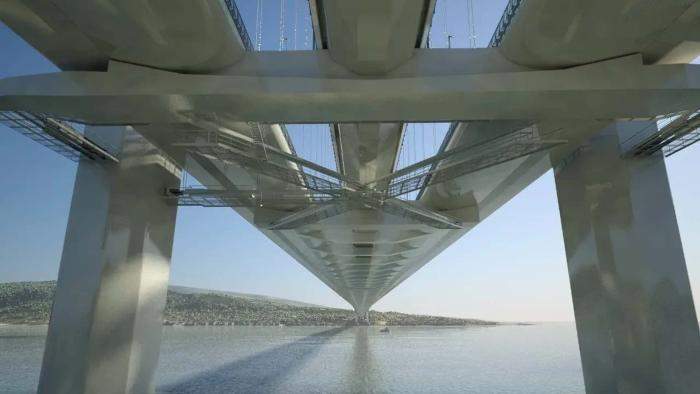
If built, the bridge is expected to become the world’s longest single-span suspension bridge, with a main span of 3.3 kilometres. It would surpass Turkey’s Çanakkale Bridge, which has a main span of 2,023 metres.
The bridge is designed to carry six traffic lanes, three in each direction, as well as two railway lines in the centre. Under the plans, it would be able to handle up to 200 trains a day and 6,000 cars an hour, sharply reducing reliance on the current ferry connection.
The idea of linking the Italian peninsula with Sicily is not new. It dates back to the Roman Empire, with the Strait of Messina long seen as one of the Mediterranean’s most difficult and important crossings.


