


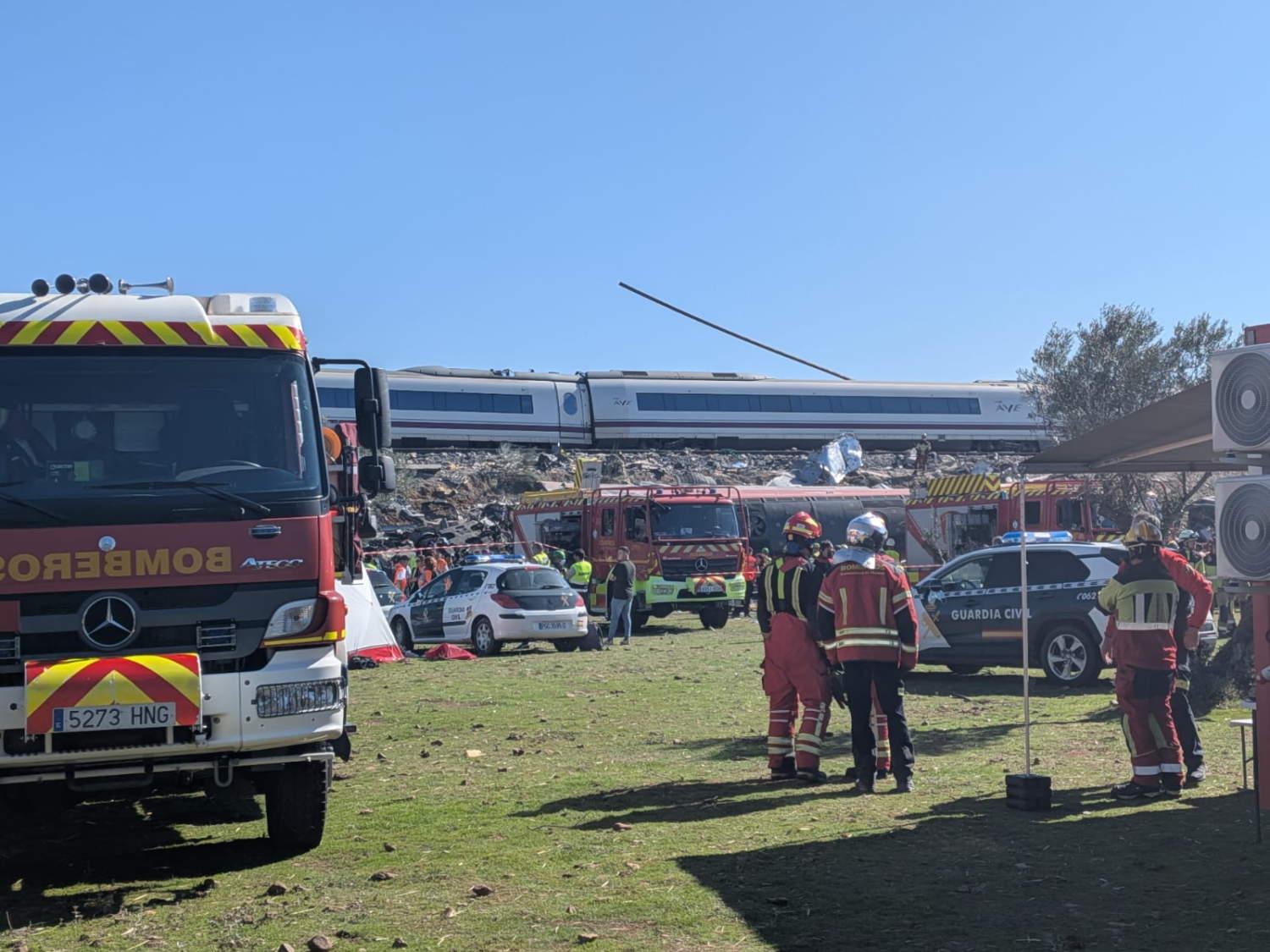
At least 68 people died when two Spanish high-speed trains collided on Wednesday, with rescuers scouring the wreckage for more bodies after Spain’s second deadly rail accident this year and Europe’s deadliest since 2013.
Spain’s transport minister said Wednesday’s crash south of Madrid occurred after a Renfe train was authorised to continue its journey despite there being an active red signal because of a stationary train on the track ahead.
Oscar Puente told reporters in Madrid that the red signal was issued due to a computer communications failure, which automatically stopped traffic, and an erroneous decision had been made to restart the Renfe train, in a breach of protocol.
Ambulances, funeral home vans and helicopters were parked next to one of the trains on an elevated section of track, while twisted metal, broken panels and wreckage were strewn across an embankment down which at least three carriages had plunged.
RESCUERS LOOKING FOR MORE VICTIMS
Evacuated passengers streamed along a nearby road. Some were splattered with blood or had bandaged wounds, while others wheeled suitcases and were handed water by volunteers.
Miguel, who was travelling with several colleagues in the rear carriage of one of the trains, described the moment of the accident and its immediate aftermath.
“We heard a massive roar, a truly enormous thud that went on for 10 seconds, as if the train were about to derail. Through the right-hand window, we could see a wrecked train,” he told COPE radio.
The head of Castilla-La Mancha’s regional government said the death toll had risen to 68, while rescue workers were still going carriage by carriage looking for other crash victims.
OPERATOR RENFE SAYS CIRCUMSTANCES BEING INVESTIGATED
The collision comes after an accident in January between high-speed trains belonging to the same operators and on the same line that killed 46 people.
In that crash a train derailed and smashed into an oncoming train near Adamuz, in Cordoba province, prompting a debate about the level of investment in railway maintenance in recent years.
A person briefed on Wednesday’s disaster said a train operated by private consortium Iryo stopped near Toledo on orders from infrastructure manager Adif due to a signal fault.
A train operated by Renfe then struck the stationary train at high speed, causing several carriages of both trains to derail, the person said.
Renfe said in a statement that after being authorised to continue its journey, its train had crashed into the Iryo train that had remained stationary “for reasons we don’t know”.
“The Renfe train continued on its way as instructed, and a collision occurred. The exact sequence of events, the traffic conditions and the circumstances of the impact will have to be established by the investigation,” Renfe said.
There was no immediate response to a Reuters request for comment from Iryo or Adif.
PASSENGER DESCRIBES SEEING FATALITIES
Authorities gave no immediate figure for the number of injured but Health Minister Mónica García urged people in a post on X to donate blood. Castilla-La Mancha region spokesperson Esther Padilla said 147 people had been travelling on the Iryo train and 397 on the Renfe train.
The accident is the deadliest in Europe since a 2013 crash in Spain’s Santiago de Compostela left 80 people dead.
Eduarda, a passenger on the Iryo train, told Cadena SER radio she felt a strong impact that threw her forward, initially making her think the train had made an emergency stop.
She only realised the seriousness of the accident after seeing injured people and being told to evacuate.
After climbing down an embankment to safety, she saw what she described as a catastrophic scene, with part of the train hanging down the slope and a fire in one carriage.
Emergency responders, including a helicopter, police and ambulances, arrived within about 20 minutes, she said. “I saw dead people,” she said.
The Renfe and Iryo trains crashed just after 9 a.m., causing two Iryo wagons to derail, a spokesperson for the Castilla-La Mancha region said.
Renfe said it had activated a special line for families of victims and expressed its condolences. Iryo said it had activated emergency protocols.
The causes of the January accident near Cordoba are still under investigation. A preliminary report by Spain’s Civil Guard in February pointed to defects in the track, rail or weld between two sections of track as the main hypothesis for the accident, but kept seven other theories open.
ELECTION DUE NEXT MONTH
The latest accident comes as Spain gears up for an election on November 29. Prime Minister Pedro Sanchez was on his way to the scene of the crash, his office said. The opposition People’s Party cancelled all campaign events, a spokesperson said.
“Shocked by the serious train accident in Toledo. My affection, solidarity, and support to all the victims and their families,” Sanchez said on X.
Accidents, including derailments and collisions, increased from 45 in 2016 to 57 in 2024 and 69 last year, according to Spain’s railway safety authority.
Some 25 million passengers used a high-speed train in Spain in the first half of the year, a decline of roughly 14% compared with the same period last year, according to a Reuters analysis of data from Spain’s competition authority.
European Commission data shows Spain’s maintenance investment in its roughly 4,000 km (2,485 miles) of high-speed lines has lagged large European peers, despite an unmatched drive to expand the network.
Spain spent an average of about €1.5 billion a year from 2018 to 2022 on its high-speed network, more than any other country. The vast majority went to new infrastructure with only some 16% earmarked for maintenance, renewal and upgrades.
(Reuters)

