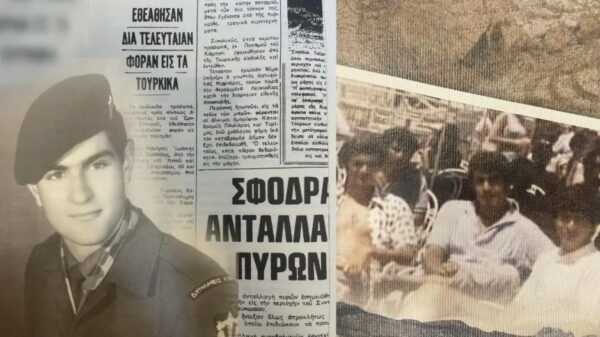
A sister has walked a difficult path, searching for traces of her brother who has been missing since the summer of 1974 following the Turkish invasion. Maria Karefyllidou-Ioannou has repeatedly climbed her own Calvary and will continue to do so until her brother is found. Christos Karefyllides, a reserve sergeant in the 33rd Commando Squadron during the Turkish invasion, was captured and taken prisoner. Traces of him have been sought ever since.
His sister has fought for the obvious: information regarding her brother’s fate and his recovery.
In her updated book In Search of Traces: Aspects of the Issue of the “Missing”, Cyprus 1974-2024 (Germanos Publications, 2025), her brother’s captivity is documented. This is backed by complementary testimonies from a Cypriot captain and a Greek lieutenant, a posted list from the Cyprus Red Cross, a publication in the daily press, and his reference number on the International Committee of the Red Cross list. Through our discussion, she proposes, even at this late stage, the creation of an Historical Archive of Missing Persons, Declared and Undeclared Prisoners of War, and Fallen of 1974.
She notes that Turkey deliberately withholds information. “Since Turkey consolidates its dominance by following a tactic of continuous violations, it follows that deliberately not even the remains of military personnel will ever be found—those who, at the end of grueling interrogations or atrocious acts, were thrown into the trash, or who were executed after completing forced labour so that monuments saving national prestige could be erected over their mounds,” she says.
Reading your book, not once but several times, I notice that you have tried to unravel a difficult knot, that of the missing persons, to find traces of your brother. How close do you think you have come?
My actions cover a period of half a century and point in every direction. Specifically, in addition to the competent state body of Cyprus, which is the Missing Persons Service, I have addressed international bodies such as the Cyprus Red Cross, the International Red Cross, the UN, as well as the European Court of Human Rights.
I have dedicated 52 years of life searching for traces, meaning evidence regarding my brother’s disappearance. The details I find entirely on my own are the traces I follow to find a lead. The latest information I have and announce in the re-edition of my book further supports that my brother, like so many others included in official lists of the “missing” from the 1974 Turkish invasion of Cyprus, was a prisoner of war (POW) who did not return.
You describe this path as difficult—I would characterize it as uphill and thorny. What was the biggest obstacle?
Initially, the biggest obstacle was incomplete information. Later, I had to deal with the withholding of information, which was impossible to rationalise outside the framework of politicisation of this paramount humanitarian issue imposed by Turkey’s intransigent policy, since Turkey itself does not count POWs nor has it signed the relevant Geneva Convention (1949) regarding their protection.
In short, in my brother’s case, the Missing Persons Service favoured and forwarded to the Committee on Missing Persons the unconvincing version of his possible death on the battlefield, which Turkey invoked before the ECHR to evade responsibility for yet another war crime.
However, you also conducted a parallel research project regarding your brother. Could the book also serve as an assessment of a lifelong struggle?
It is a relentless effort whose results culminate in my book. So I have a duty to continue investigating my brother’s fate, and it is not ruled out that I will re-issue my book to include newer information.
You have already published the updated version of your book In Search of Traces. What new elements have you added?
It is a multifaceted approach to the subject across hundreds of pages containing narratives, images, tables, findings, testimonies, official correspondence, and documents. My long-term research demonstrates that my brother’s captivity is established through complementary testimonies from a Cypriot captain and a Greek lieutenant, a posted list from the Cyprus Red Cross, a publication in the daily press, and his reference number on the International Red Cross list.
What was the most important piece of information you found about your brother?
My research to date concludes that my brother survived combat operations and was captured while wounded. In fact, he is included in the International Red Cross list, yet he was left helpless.
Fifty-two years later, is there hope and courage left? What would you want after so many years?
Official information on the issue of the “missing” remains incomplete, impacting social consciousness. Without information, neither memory nor judgment functions, nor is consciousness cultivated. Until the events between their disappearance and recovery are investigated, hundreds of people remain “missing” without anyone assuming at least moral responsibility. For this purpose, even at the last moment, I suggest establishing an Historical Archive of Missing Persons, Declared and Undeclared Prisoners of War, and Fallen of 1974.
The CMP and remains
Where has the state been all these years, and what role did it play in the fight to determine the fate of the missing?
From an historical perspective, 29 October was the day after the last date on which a number of prisoners were exchanged, while the remainder did not return. Even though the substantial figure of 1,619 “missing” persons resulted from the Turkish invasion, what became of so many people has not been verified since, nor do we highlight the fact that, for instance, women and children are among those unfound. We settled on the bi-communal CMP working on the transfer of remains. As I explained above, this is a political development imposed by Turkey’s intransigent stance, which furthermore discouraged individual legal applications.
Conversely, the ECHR rulings on Cyprus’s Fourth Inter-State Application against Turkey (2001) and the Varnava and Others case (2009) constitute landmarks on the “missing” issue, as they establish continuing violations of the European Convention on Human Rights regarding all missing persons; yet they have not been leveraged internationally.
Very recently, on 4 September 2026, the Supreme Court of Cyprus awarded compensation for ineffective investigation into the fate of two “missing” persons by competent state authorities. Without being in a position to judge the ruling, for me the key requirement is achieving the rule of law as a tribute to the 1974 war “missing”, which should not be valued in money. Restoring historical truth is a matter of national honour.
What do you believe about your brother’s fate?
Since Turkey consolidates its dominance by following a tactic of continuous violations, it follows that deliberately not even the remains of military personnel will ever be found—those who, at the end of grueling interrogations or atrocious acts, were thrown into the trash, or who were executed after completing forced labour so that monuments saving national prestige could be erected over their mounds.
Exploitation of human pain
Do you hope? And for what?
My concerns revolve around the possibility of immediate implementation of humanitarian law, because in practice the disregard of basic humanity continues to prevail.
All the “missing” are hundreds of cases of prisoners and victims of war where international humanitarian law fell into disuse. Ultimately, they are hundreds of cases of unsolved war crimes for which Turkey refuses to account, and here emerges the tragic timeliness of the weaponisation of human pain by the war machine.
I hope for a better world and that Cyprus will play an important role in proclaiming collective responsibility for the near-absent respect for inherent human rights resulting from the fragile balance of international relations.