


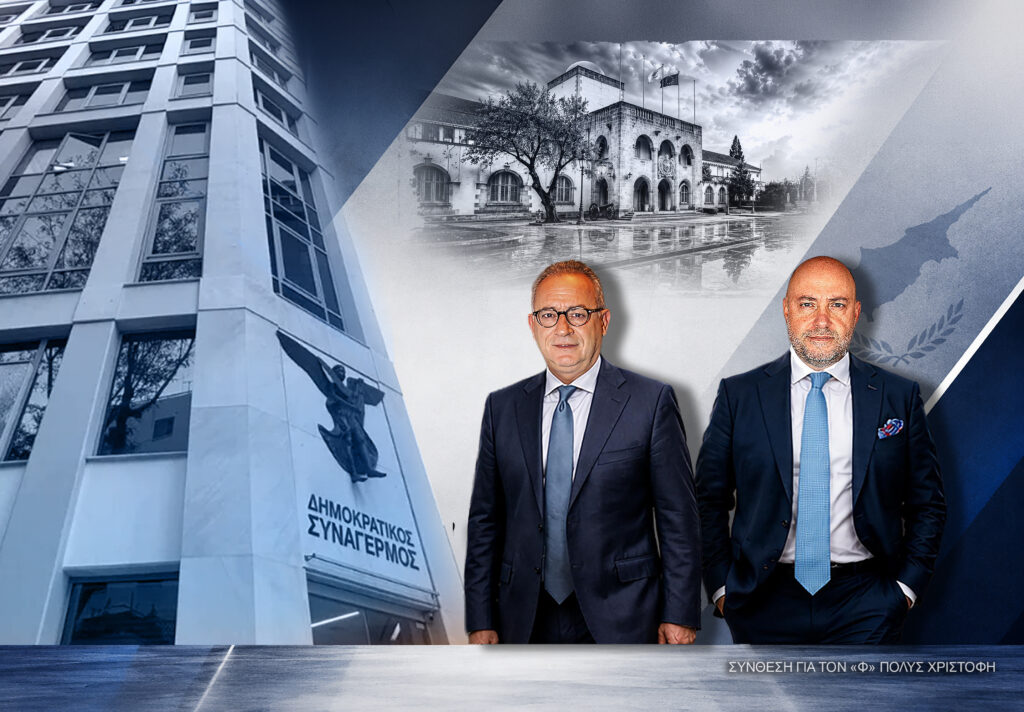
Averof Neophytou or George Pamboridis? For the Democratic Rally (DISY), the central question is what happens next. The outcome of the party’s presidential nomination contest remains an unknown factor in the wider political landscape ahead of Cyprus’s presidential election.
DISY is the country’s largest political party. Its 27.1% share of the vote in the last parliamentary elections confirmed its position as the strongest electoral force, meaning developments within the party have implications for the broader presidential race.
The first question is how DISY supporters will respond to this new situation. Can the party’s eventual candidate unite its voters, overcome internal divisions and problems, and enter the presidential election with the party’s substantial electoral base firmly behind them?
The internal situation within DISY will also be decisive, particularly how much personal rivalry, disagreement, and competing ambition can be contained.
The second question concerns how developments within DISY will shape the wider political landscape. Will agreements on electoral cooperation emerge?
Alliances, but with whom?
Averof Neophytou has encouraged speculation about possible cooperation with, and support from, Volt, Direct Democracy and the Democratic Alignment (DIPA).
DIPA certainly has officials who are dissatisfied with President Nikos Christodoulides. However, it also holds two important ministries: Marinos Mousioutas as Labour Minister and Vasilis Palmas as Defence Minister.
As for Direct Democracy, Neophytou is known to maintain good relations with Fidias Panayiotou. However, the party has a fluid electoral base, while Panayiotou himself has raised the names of other potential presidential candidates during meetings with leaders of other parties.
Neophytou could potentially secure Volt’s support because of their positions on the Cyprus problem, although different political currents exist within Volt. Cooperation between Volt and AKEL is also possible, given their shared positions on certain social issues.
The situation is different with EDEK and ALMA.
EDEK remains part of the Christodoulides government while also undergoing a period of internal transition. Even if it were to leave the government, cooperation with DISY’s presidential candidate would not be its first choice.
ALMA, meanwhile, has ruled out cooperation with DISY.
Could DISY go it alone?
Against this background, a scenario in which DISY enters the first round without electoral alliances appears plausible. This has already prompted discussion about possible second-round cooperation with Nikos Christodoulides.
Statements by former president Nicos Anastasiades, DISY deputy leader Efthymios Diplaros and party president Annita Demetriou have been interpreted in different ways.
Another question has now entered the equation: to what extent do the two contenders fully represent DISY’s grassroots supporters?
During a meeting on Thursday, 8 October, one of the two conditions Demetriou reportedly set for Neophytou before withdrawing from the race was that he commit to adopting, or jointly drafting, the party’s programme for government.
Last week, Neophytou caused controversy by urging President Christodoulides to propose lifting European Union sanctions against Russia in the energy sector as a way of tackling the rising cost of living.
DISY’s leadership was quick to distance itself from the proposal, opening a new debate about whether the eventual presidential candidate would be able to represent the party’s positions.
Party spokesman Onoufrios Koullas attempted to reconcile the differences, citing AKEL as an example and arguing that a party and its presidential candidate do not necessarily have to agree on every issue.
AKEL, of course, makes this argument while seeking cooperation with a centre-right candidate. Former minister Yiannis Karousos, meanwhile, defended Neophytou.
The former DISY president is now certain to contest the nomination through the party’s internal procedures.
For some, however, this does not necessarily mean he would operate entirely as a DISY candidate. Instead, he might adopt a more independent approach, carrying the party’s official endorsement while also pursuing his own positions, potentially placing DISY in difficult situations.
This is another important part of the equation. While Neophytou might reach voters beyond DISY’s traditional support base, he could simultaneously lose support among the party’s own electorate.
There also appears to be some hesitation among DISY’s grassroots supporters towards George Pamboridis, both because of statements he has made over the years and the speculation surrounding his name and AKEL during the 2023 presidential election.
DIKO, Nicolas Papadopoulos and Christodoulides
Monday should clarify the situation at DISY headquarters, at least regarding the contenders. Under the present circumstances, a last-minute surprise is not expected, meaning discussions about alliances and political calculations remain focused on the two candidates.
Annita Demetriou’s withdrawal from the nomination contest has undoubtedly changed the situation, both within DISY and across the wider political landscape.
Speculation about possible cooperation between DISY and the Democratic Party (DIKO) had centred on Demetriou.
The scenario involved a centre-right alliance and a power-sharing agreement under which DIKO would support Demetriou for president, receive half the cabinet positions and secure DISY’s support for DIKO leader Nicolas Papadopoulos to become president of the House of Representatives.
That scenario is no longer on the table.
It would not have been easy to implement, given Nikos Christodoulides’s strong support within DISY, but it was nevertheless a possibility.
There was also an alternative under which Nicolas Papadopoulos would contest the first round independently, with the two sides cooperating in the second round.
Another possibility involved the wider centre-right seeking a common presidential candidate, such as Constantinos Yiorkadjis.
Last week, Averof Neophytou attempted to send a political message to Nicolas Papadopoulos by sharing excerpts from a Papadopoulos interview on an AlphaNews podcast.
In the excerpts, the DIKO leader referred to their cooperation in parliament on economic matters. Neophytou has made similar references himself.
If Neophytou secures DISY’s nomination, he will undoubtedly explore any possibility of cooperation with DIKO.
However, the prospect of the two parties forming a pre-election alliance with Neophytou as their presidential candidate remains extremely remote.
There are two main reasons.
First, the latest cabinet reshuffle has strengthened Christodoulides’s ties with DIKO, making it more closely aligned with his government.
Second, such an alliance would be much harder to secure the approval of DIKO’s grassroots membership.
A similar arrangement was explored ahead of the 2023 presidential election, when Neophytou proposed a government in which DISY and DIKO would each hold half the positions.
The proposal met strong resistance from DIKO’s grassroots supporters, who favoured Christodoulides instead.
The circumstances are different now, of course.
Nevertheless, abandoning the Christodoulides government would represent a considerable political risk for DIKO generally, and Nicolas Papadopoulos in particular.
According to some information, these concerns appear to have been conveyed to DISY officials.
George Pamboridis has also argued publicly that DISY should seek cooperation with DIKO ahead of the next presidential election.
He has said discussions towards such an agreement should have begun immediately after the parliamentary elections.
“The natural alliance between the Democratic Rally and DIKO must be pursued,” he said, stressing the need for talks to begin in good time.
However, the prospect of cooperation with DIKO remains extremely remote even if Pamboridis becomes DISY’s presidential candidate.
Where does ELAM stand?
If ELAM is included in the wider right-wing political equation, could it cooperate with or support either Neophytou or Pamboridis from the first round?
Such a scenario is not even under discussion within ELAM.
In a second-round contest between candidates backed by DISY and AKEL, however, direct or indirect support for the candidate opposing the left-wing party’s nominee would be considerably more likely.
For the first round, even supporting Nikos Christodoulides would not be a straightforward option for ELAM, despite the good relationship between the two sides or what some describe as cooperation behind the scenes.
Within ELAM, the group of former DISY supporters would certainly favour an arrangement involving cooperation, but significant obstacles remain.
An independent first-round candidacy by ELAM, which currently appears to be the most likely scenario, would undoubtedly be more favourable to DISY’s presidential candidate.

