


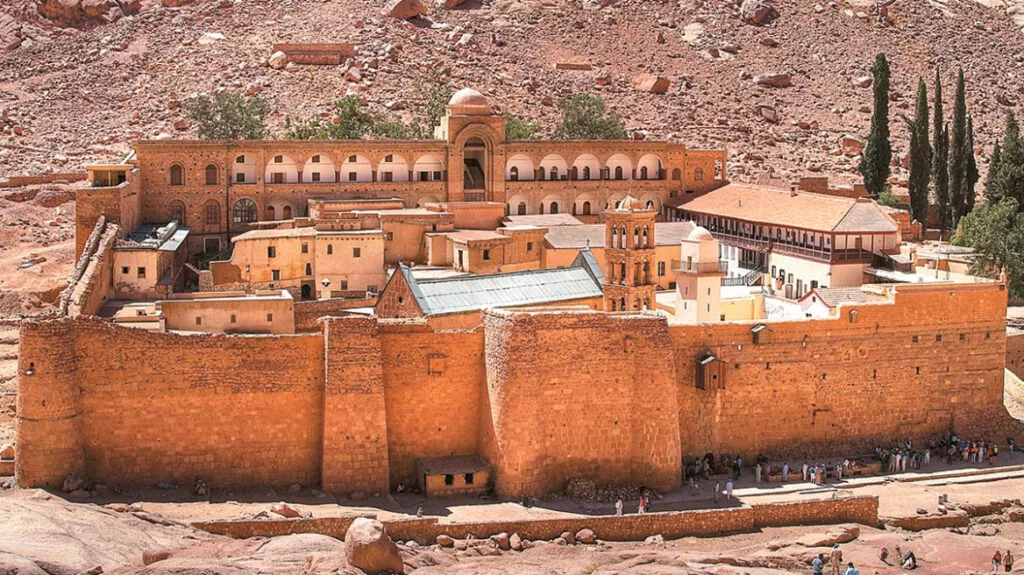
A new chapter is opening for St Catherine’s Monastery at Mount Sinai after an agreement was reached with the Egyptian state aimed at securing the historic monastery’s legal status and safeguarding its continued existence and operation.
The development provides an institutional framework for the monastery after more than a millennium of presence in the area.
Archbishop Symeon of Sinai announced in a letter that he intends to sign the agreement with the Egyptian state following consultations. His announcement came as a ruling by Egypt’s Supreme Administrative Court had been expected.
Symeon said the agreement had received the full support of the Ecumenical Patriarchate, the ancient Patriarchates and the Churches of Cyprus and Greece.
He said a specific date for signing would be agreed with the monastery’s fathers and the Egyptian government once his health allowed.
Archbishop Symeon announces agreement
In his statement, Symeon said the Greek Orthodox Monastery of Mount Sinai received a draft agreement from the Egyptian government about a year ago, following a 28 May 2025 ruling by the Ismailia Court of Appeal.
The proposed agreement sought to clarify aspects of that court ruling and how it would be implemented, while respecting arrangements that had existed for centuries. Its purpose, he said, was to safeguard the monastery’s uninterrupted monastic life and clarify its position and operation within Egypt’s modern legal system.
The monastery entered negotiations while bound by Egyptian law and court decisions, Symeon said, while also bearing responsibility for a spiritual heritage stretching back centuries and towards the Egyptian authorities in the country where it has flourished for 15 centuries.
The monastery asked for sufficient time to study the proposal thoroughly and submit suggested improvements concerning its practical implementation. Additional explanatory documents were subsequently added, while a detailed study was prepared documenting the monastery’s status quo and the properties under discussion.
Symeon said the Egyptian government and President Abdel Fattah al-Sisi had shown understanding, allowing negotiations to continue for more than a year. His recent health problems had also contributed to the length of the process.
The Greek state and other supporters of the monastery around the world also assisted in the effort.
Symeon noted that the monastery has historically enjoyed a special status of ecclesiastical autonomy, while also describing it as an important institution for Orthodox Christianity more broadly.
The Sinai Brotherhood therefore sought the views of the Orthodox churches.
The monastery first approached the Patriarchate of Jerusalem, which, after being briefed on the proposed agreement, referred the issue to Ecumenical Patriarch Bartholomew, Patriarch Theodore of Alexandria and the autocephalous Churches of Cyprus and Greece.
Symeon said all the churches, after being fully briefed, welcomed the agreement through patriarchal and synodal letters and expressed their “full fraternal support” for its signing.
The agreement, he said, was expected to help resolve outstanding issues safely and safeguard the monastery’s historic and legal rights.
Symeon said this support had given both him and the Sinai Brotherhood the confidence to proceed with signing the agreement once his health permitted.
He also described the response as an expression of unity among the Orthodox churches of the East.
Symeon said the strengthened climate of trust between Egypt and the monastery meant there was no longer a reason for Egypt’s Supreme Administrative Court to issue its anticipated ruling.
He added that during implementation of the agreement, the same climate of trust would allow any outstanding issues concerning the agreement and its accompanying documents to be finalised.
Symeon concluded by assuring the public that Mount Sinai remained “in its place”, with the fathers continuing to serve the monastery and welcome pilgrims, visitors and travellers.
Mitsotakis calls agreement a ‘historic turning point’
Greek Prime Minister Kyriakos Mitsotakis subsequently spoke with Archbishop Symeon about safeguarding the monastery’s uninterrupted presence at Mount Sinai and expressed the support of Greeks for its decisions.
Mitsotakis congratulated the archbishop and said the common position taken by the Ecumenical Patriarchate, the Patriarchates of Alexandria and Jerusalem, and the Churches of Cyprus and Greece sent a strong message of unity.
He described the agreement between the monastery and Egypt as a “historic turning point” that establishes the monastery’s legal position and safeguards its existence and Greek Orthodox character in perpetuity.
Mitsotakis and Symeon also referred to the personal interest shown by Egyptian President Abdel Fattah al-Sisi and to the relationship between the Egyptian people and the monastery.
Gerapetritis: ‘Deeds, not empty words’
Greek Foreign Minister George Gerapetritis described the development as a “historic day for Hellenism and Orthodoxy”, saying the monastery was gaining a “solid legal foundation”.
He said the agreement would safeguard the monastery’s religious character and that of its ecclesiastical properties, as well as its continuity through the granting of long-term residence permits to its monks.
Gerapetritis thanked al-Sisi, saying his personal intervention had made the agreement possible, as well as Egyptian Foreign Minister Badr Abdelatty.
He said the agreement reflected the strategic and close relationship between Greece and Egypt and sent a message of Orthodox unity.
The Ecumenical Patriarchate, the Patriarchates of Alexandria and Jerusalem and the Churches of Cyprus and Greece all backed the agreement, he said.
“The Greek government stood and will continue to stand alongside our ancient Patriarchates and the Holy Monastery of St Catherine, with deeds that break centuries of inertia and not with empty words,” Gerapetritis said.
Abdelatty also welcomed the agreement.
“I welcome the approval of the agreement concerning St Catherine’s Monastery and reaffirm Egypt’s pride in it and its history,” he wrote in a post on X.

