


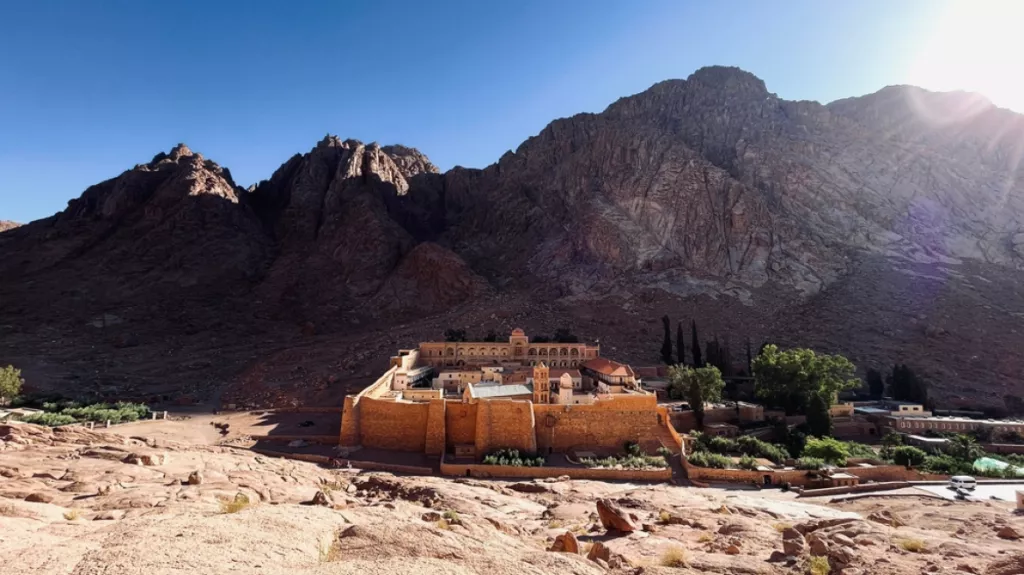
According to a detailed article by the BBC, the Egyptian government’s plan to transform Mount Sinai—one of the world’s holiest sites—into a luxurious tourist resort has sparked widespread criticism. The report highlights concerns about the alteration of cultural and religious heritage, points out the reactions of the Jebeliya Bedouin tribe, who see their homes and traditions threatened, and documents Greece’s involvement due to the Holy Monastery of Saint Catherine. At the same time, it presents pressure from international organizations such as UNESCO, on the need to protect a place that is a spiritual beacon and a monument of global importance.
As the BBC points out, Mount Sinai, one of Egypt’s holiest sites—revered by Jews, Christians, and Muslims—is at the center of an intense dispute over plans to turn it into a new mega-tourism project. Locally known as Jabal Musa, Mount Sinai is considered by the faithful as the place where Moses received the Ten Commandments. Many also believe that it is where, according to the Bible and the Quran, God spoke to the prophet from the burning bush.
The 6th-century Monastery of Saint Catherine is also located in the area and operates under the jurisdiction of the Greek Orthodox Church. It seems the monks will remain there, as the Egyptian authorities, following Greek pressure, have denied that they intend to close it. However, intense concerns remain about how this isolated desert site—a UNESCO World Heritage Site that includes the monastery, the settlement, and the mountain—is soon to be transformed. Luxury hotels, villas, and markets are already under construction, the BBC reports.
Changes for the Jebeliya
The area is also the ancestral land of a Bedouin community, the Jebeliya tribe. Its members, also known as the “Guardians of Saint Catherine,” have already seen their homes and tourist eco-lodges demolished with little or no compensation. They have even been forced to relocate bodies from the local cemetery to make room for a new parking lot.
The project may have been presented by the state as a necessary step for sustainable development that will boost tourism, but it was imposed on the Bedouins against their will, emphasizes British travel writer Ben Hoefler, who has worked closely with the Sinai tribes in the past. “This is not development that the Jebeliya asked for, but something that was imposed on them by people in power to serve the interests of foreigners at the expense of the local community,” he told the BBC. “A new urban world is being built around a Bedouin tribe of nomadic origin. A world from which they always chose to remain detached, to whose creation they did not consent, and that will forever change their place in their homeland,” the expert adds.
Greece’s Reaction
The locals, who number about 4,000, avoid speaking openly about the changes. So far, Greece is the foreign country that has most strongly expressed its concern about the Egyptian plans due to its connection to the monastery. Tensions between Athens and Cairo escalated when an Egyptian court ruled in May that the Monastery of Saint Catherine—the oldest continuously operating Christian monastery in the world—is on state-owned land. After a decades-long dispute, the judges ruled that the monastery has only a “right of use” of the land on which it is located and the surrounding archaeological and religious sites.
Archbishop Ieronymos II, head of the Church of Greece, was quick to condemn the decision. “The property of the Monastery is being usurped and confiscated, and this spiritual beacon of Orthodoxy and Hellenism now faces a real issue of survival,” he said in a statement. In a rare interview, the Archbishop of Saint Catherine, Damianos, told a Greek newspaper that the decision was a “heavy blow for us… and a disgrace.” The way he handled the case caused a dispute among the monks and led to his recent decision to resign.
The Greek Orthodox Patriarchate of Jerusalem recalled that the holy site—over which it has ecclesiastical jurisdiction—had received a document from Muhammad himself ensuring its protection. It emphasized that the Byzantine monastery—which also houses a small mosque from the Fatimid era—is a treasure of peace between Christians and Muslims and a refuge of hope for a world mired in conflict. While the controversial court decision remains in effect, a marathon of diplomatic contacts ultimately resulted in a joint statement from Greece and Egypt ensuring the protection of the Greek Orthodox identity and cultural heritage of Saint Catherine.
“Gift to the World” or destructive landscape intervention?
In 2021, Egypt launched the state-funded Great Transformation Program for tourism. The plan includes the construction of hotels, eco-lodges, and a large visitor center, as well as the expansion of the small nearby airport and the creation of a cable car to Mount Sinai. The government promotes these development projects as a “gift from Egypt to the entire world and all religions.”
“The project will provide all tourist and recreational services for visitors, promote the development of the city [of Saint Catherine] and the surrounding areas while maintaining the environmental, aesthetic, and cultural character of the pristine nature, and will provide housing for those who work on the Saint Catherine projects,” Housing Minister Sherif El-Sebrini said last year.
Although work seems to have been temporarily halted due to funding problems, the El-Raha Plateau—overlooking the Monastery of Saint Catherine—has already changed dramatically. New roads are being built in the area. It is said that Moses’ followers, the Israelites, waited for him there during his stay on Mount Sinai. Critics of the projects warn that the area’s unique natural features are being destroyed.
Describing the site’s outstanding universal value, UNESCO notes that “the wild mountainous landscape around it forms the perfect backdrop for the Monastery.” As it states: “The placement of the monastery shows a conscious effort to create a close link between natural beauty and isolation on the one hand, and deep spiritual devotion on the other.”
As early as 2023, UNESCO had expressed its concerns and called on Egypt to halt the interventions, assess the impacts, and develop a protection plan. This has not happened so far. In July, the World Heritage Watch organization sent an open letter asking the UNESCO World Heritage Committee to add the Saint Catherine area to the List of World Heritage in Danger. Calls for intervention also reached King Charles, as the honorary patron of the Saint Catherine Foundation, which raises funds for the preservation and study of the monastery’s heritage with its collection of valuable ancient Christian manuscripts. The king has called the site “a great spiritual treasure that must be preserved for future generations.”
The tourism plans and how the Bedouins are left out
This project is not the first in Egypt to be criticized for a lack of sensitivity to the country’s history. However, the government considers its series of ambitious plans key to boosting the fragile economy. Egypt’s once-booming tourism sector had just begun to recover from the effects of the COVID-19 pandemic when it was hit by the bloody war in Gaza and a new wave of regional instability. The government has set a goal of attracting 30 million visitors by 2028.
Under successive Egyptian governments, the commercial development of Sinai has proceeded without any consultation with local communities. The peninsula was occupied by Israel during the 1967 Middle East war and was only returned to Egypt after a peace treaty was signed in 1979. Since then, the Bedouins have complained that they are treated like second-class citizens. The construction of popular Red Sea destinations, including Sharm el-Sheikh, began in South Sinai in the 1980s. Many today see similarities to what is happening in Saint Catherine.
“The Bedouins were the people of the area, the guides, the workers, the ones you rented accommodation from,” says Egyptian journalist Mohannad Sabri. “Then industrialized tourism came and drove them out—not just from work, but also physically, moving them from the sea to the margins.”
As happened with the Red Sea destinations, it is expected that Egyptians from other parts of the country will flock to work in the new infrastructure around Saint Catherine. However, the government claims to be “upgrading” Bedouin residential areas at the same time.
The Monastery of Saint Catherine has endured many upheavals over the last millennium, but when the first and oldest monks settled there, it was still a remote place of prayer and isolation. That began to change when the expansion of Red Sea resorts brought thousands of pilgrims on day trips during peak seasons. In recent years, large crowds have passed in front of what is said to be the remnants of the burning bush or visited the museum where pages from the Codex Sinaiticus—the oldest surviving, almost complete, manuscript copy of the New Testament—are displayed.
Even if the monastery and the site’s deep religious significance ultimately remain untouched, the surrounding environment and traditions of life seem to be heading for an irreversible change, the BBC report concludes.

