


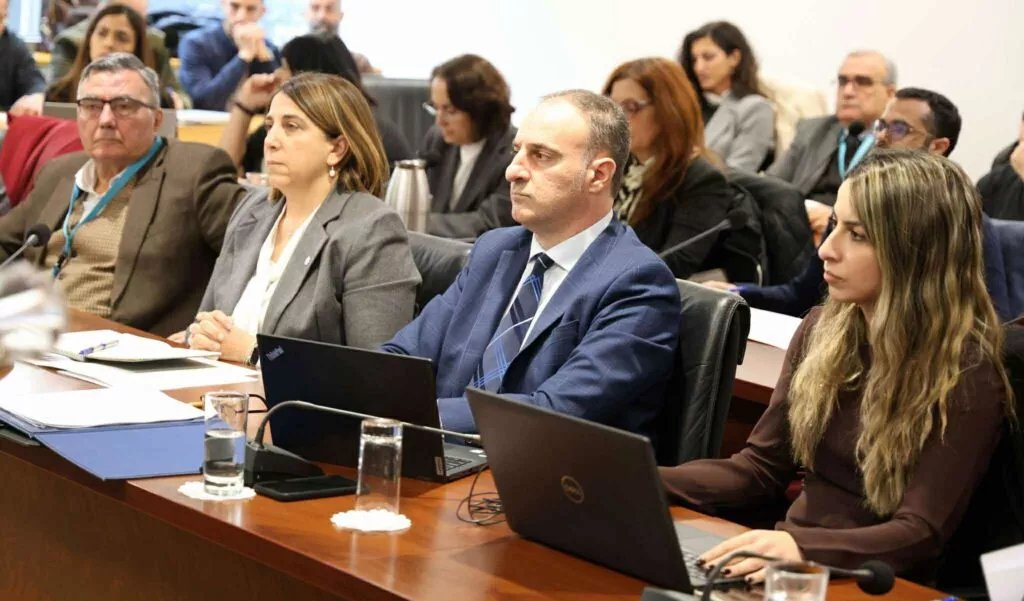
State revenue rose to 10.05 billion euros in 2025 from 9.57 billion in 2024, driven mainly by taxes and boosted by inflation, Accountant General Andreas Antoniades told the House Audit Committee on Thursday.
Presenting the 2025 Fiscal Report and the review of the state payroll, Antoniades said most of the rise in revenue was due to inflation. Higher VAT receipts reflected both greater consumption and higher prices, he said. Spending rose to 10.15 billion euros from 9.89 billion. The state budget deficit, before net borrowing flows, narrowed to 100 million euros from 320 million, and the budget was almost balanced, Antoniades said.
ELAM parliament member Polys Anogyriatis said it was positive that the deficit remained low. Direct Democracy Cyprus parliament member Dimitris Baros asked about the 100-million-euro gap between revenue and spending and the reasons for the rise in spending.
Revenue
Revenue from indirect taxes rose to 4.39 billion euros from 4.22 billion, while revenue from direct taxes reached 4.21 billion, up from 3.83 billion. Of the outstanding revenue owed to the state, 31 per cent relates to income tax, 15 per cent to pay for seconded nursing staff, 12 per cent to VAT and 10 per cent to the special defence contribution. The State Health Services Organisation (SHSO) owes the state about 1 billion euros, largely relating to nursing staff, Antoniades said.
AKEL parliament member Christos Christofides said the main conclusion of the report was the significant rise in revenue due to higher prices and indirect taxation. Tax revenue reached 8.6 billion euros in 2025, he said, up 538 million euros and accounting for 86 per cent of state revenue, with 3.16 billion euros from VAT alone. Speaking after the session, he said that while government revenue was soaring because of high prices, “money is not being returned to citizens” to support the middle class and lower-income groups.
Although social spending rose by 99 million euros, Christofides said, the increase came mainly from health. Welfare spending fell by 23.5 million euros and spending on the Guaranteed Minimum Income also fell, while 114 million euros of approved social funds went unused.
Development projects lag
Although development spending reached record levels in 2025, major projects are still being delayed, Antoniades said. The development budget’s implementation rate rose to 81 per cent from 69 per cent in 2024, but four percentage points of that came from a 67.1-million-euro cut to the original budget. Actual development spending was 1.19 billion euros, up from 1.02 billion, and accounted for 13 per cent of total state spending. Development spending is expected to fall in the coming years because there are not enough projects ready to proceed, he said.
The implementation rate of the New Cyprus Museum was 36 per cent at the end of 2025 and 42 per cent by 30 June 2026. For the ‘KtiZO’ scheme, the rate went from 6 to 8 per cent over the same period, and for the Astromeritis-Evrychou motorway from 77 to 96 per cent. The Paphos-Polis Chrysochous road stood at 26 per cent at the end of 2025. Nothing had been spent by then on the Deneia-Akaki-Astromeritis section, the new Nicosia courthouse or the new Central Prisons building.
Antoniades said delays in the Recovery and Resilience Plan had affected inflows from EU funds. Christofides said about 289 million euros of development funds had gone unused and that EU funds absorption was only 52 per cent.
Committee vice-chairman Chrysanthos Savvides, a DIKO parliament member, criticised the low implementation of development projects and said the public procurement framework was problematic. He proposed creating a specialised technical service, saying understaffing and a lack of expertise in ministries were causing problems. He also questioned the gap between spending on education and learning outcomes, and the problems that persist despite spending on IT systems.
Emissions revenue
The state’s net annual revenue from emissions allowance auctions was 109.9 million euros in 2025, compared with 94.67 million in 2024 and 112.7 million in 2023. By law, the money is used to fund emissions reduction and environmental protection, but data on the actions funded in 2025 are not yet available.
DISY parliament member Giorgos Pamborides described the management of emissions revenue as “chaotic and dangerous”. He said not even 10 per cent of the money was being used for its legal purpose. Instead of the roughly 100 million euros being reinvested, he said, it was being managed in ways that in his view amounted to squandering.
Debt and payroll
Public debt continued to fall, Antoniades said. It went from 62.7 per cent of GDP at the end of 2024 to 52.3 per cent at the end of 2025, and to 49.8 per cent on 30 September 2026, when it stood at 18.49 billion euros. Replying to DISY parliament member Nikos Georgiou, he said internal borrowing from state funds is not included in the public debt figure.
Savvides said the reduction of public debt to 50 per cent showed “sensible economic management” that allowed the government to take targeted support measures when needed.
Payroll costs rose to 2.93 billion euros in 2025 from 2.77 billion in 2024. Antoniades linked the rise to pay adjustments and the restoration of the cost-of-living allowance (COLA) to 100 per cent, among other factors. Since 2022, payroll costs have risen by an average of about 7 per cent a year in nominal terms and 4 per cent in real terms. Between 2022 and 2029 the total increase is expected to reach 60 per cent in nominal terms and 32 per cent in real terms.
ALMA leader Odysseas Michaelides said the state payroll was rising rapidly, out of proportion to private sector wages, and that state budget deficits were being covered by Social Insurance Fund surpluses. He also pointed to the roughly 1 billion euros owed to the state and repeated failures in delivering development projects.
Foot-and-mouth and wildfire support
Of a 45.7-million-euro budget to support livestock farmers affected by foot-and-mouth disease, 23.35 million euros had been spent by 30 June 2026. Nothing has been spent on state aid for affected farmers who resume their activity or on financial aid for farmers whose animals lost grazing.
Of a 56.1-million-euro budget to support people affected by wildfires in the Limassol mountain area, 17.4 million euros had been spent by 31 December 2025 and 23.2 million by 30 June 2026.
Information from Cyprus News Agency

