


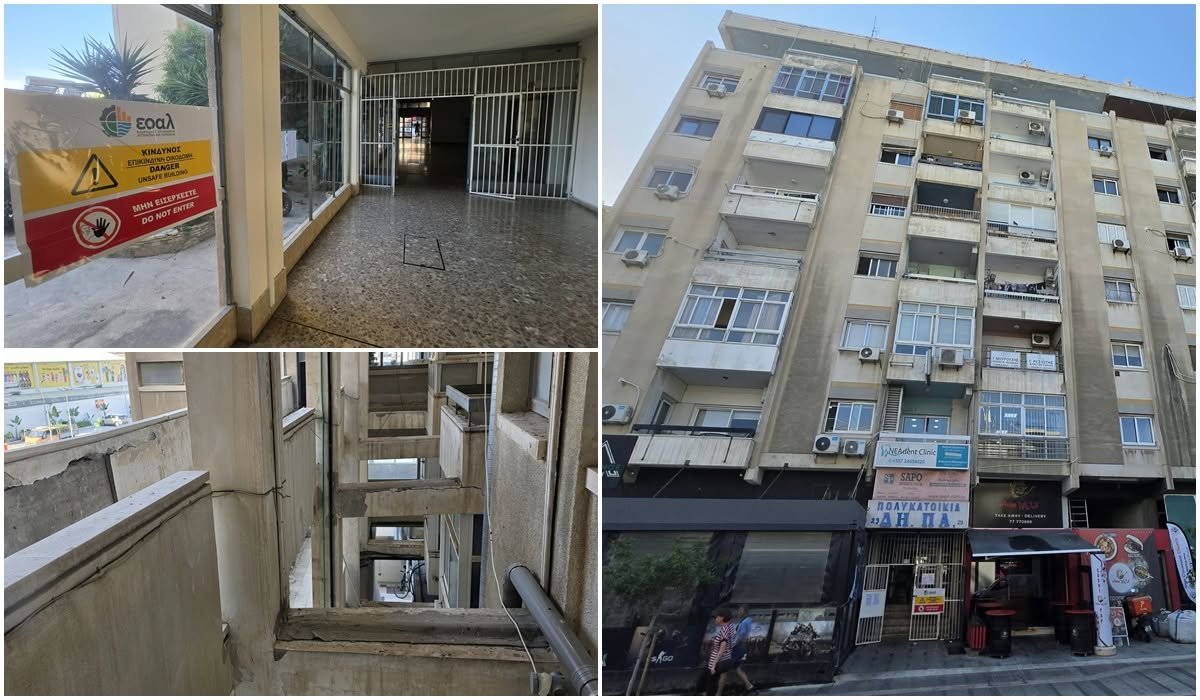
The Larnaca District Local Government Organisation (DLGO) has issued an evacuation order for the DIPA complex in the town centre after judging it highly dangerous, and is calling on residents to leave unless the owners appoint a structural engineer to remove the risk.
The building’s manager, Maria Lazaridou, said around 400 people would be affected and objected to the order. DLGO president Angelos Hadjicharalambous said the decision was based on two independent visual inspections and that the owners had not responded to notices.
Lazaridou, who heads the company that manages the building and owns two flats in it, told Phileleftheros that residents had received no letters warning of the danger since she took over in 2020. The complex, built in 1970, is one of the oldest in Larnaca. The management had asked for the structural study so it could find and fix the problems, she added, but had been told it was confidential.
According to Lazaridou, residents were told on Friday at 10am that they had to leave by Monday. Many are low-income pensioners, and some flats have residents receiving home care. “My aunt gets 700 euros a month, where is she supposed to go?” she said, adding that her parents receive a pension of 1,200 euros a month. Shop owners in the complex also had nowhere to go at such short notice, she argued, claiming that European law prohibits making a pensioner homeless.
Lazaridou also questioned why, if the building was dangerous, the Electricity Authority of Cyprus (EAC) had been given a permit three months ago to build a substation in its car park. She asked why a flat had been allowed to be sold for 200,000 euros a few days ago, and why a restaurant on the ground floor had been licensed for renovation.
Asked whether the owners would appoint an engineer, she said they had been working on it for six months. They had waited for the town hall to provide the plans, which arrived two weeks ago, leaving no time to act, and could not find a private engineer because those they approached were too busy. The DLGO should find a solution, she argued, adding that its officials had not even come to talk to residents and that it should draw up a relocation plan for them, as had been done for refugees.
The DLGO has also raised fire safety concerns over the closure of dangerous bridges linking the complex’s three buildings. Lazaridou said the bridges had been closed for six years without anyone raising safety issues. Hadjicharalambous said a Fire Service report had found that the footbridges had been sealed off, creating serious fire safety problems and leaving some residents unable to escape in an emergency.
Speaking on state television, Hadjicharalambous said: “We have a file with notices and there was absolutely no response.” He urged the owners to take measures immediately, like those taken at the Filanta complex, and to appoint their own engineer to carry out laboratory tests so the building’s stability could be secured first, followed by a series of other measures. The DLGO expected the engineer to begin work within three days.
DIPA was once a landmark in Larnaca but had been neglected and not properly maintained, he said, and the management committee now had to act. Each owner was responsible for their own accommodation in the event of an evacuation and for maintaining their flat.
Hadjicharalambous said all the longstanding problems had passed to the DLGOs from the previous authorities, the municipalities and District Administrations, and he did not know why they had not done what was needed. He described what the DLGO had inherited as something he stopped short of calling chaos. The Larnaca DLGO received 570 files from the previous authorities, most with no action taken to remove the danger, and now has 1,100 in total. DIPA is among the most important cases in Larnaca, he said. Asked whether illegal works had been found at DIPA, he said he did not know.

