


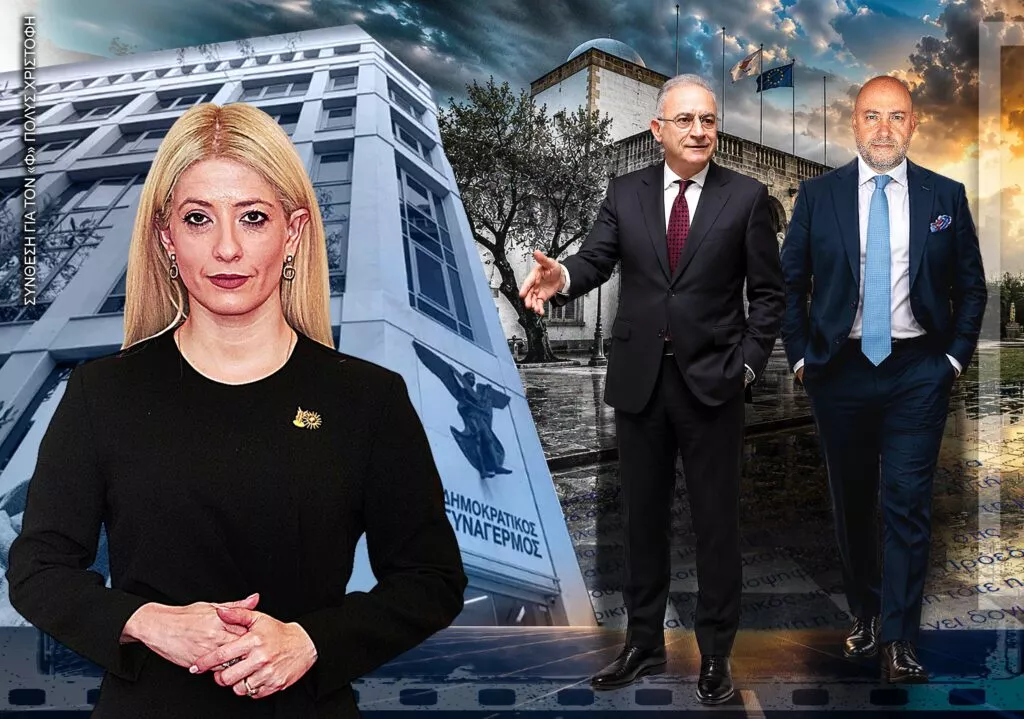
Annita Demetriou’s withdrawal from the race for DISY’s 2028 presidential nomination has dramatically reshaped the political landscape within the party, but rather than restoring unity, it has opened a new period of uncertainty, internal divisions and behind-the-scenes manoeuvring.
Thursday’s developments were rapid and shocking. Demetriou’s decision to step aside, citing the need to preserve party unity, has created a new situation both within DISY and beyond it.
It has also sparked another round of debate over what comes next for the party founded by Glafcos Clerides. The stakes are enormous, and the coming days could bring further developments.
The first certainty is that Demetriou’s withdrawal has not prevented an internal contest, or the prospect of a bitter campaign. Both Averof Neophytou and George Pamboridis insist they are determined to remain in the race until the end.
The second is that opinions within DISY are sharply divided.
One camp welcomes Demetriou’s withdrawal. Another is deeply unsettled, with consultations and political manoeuvring taking place both publicly and behind the scenes. The possibility of a third candidate emerging cannot be ruled out.
Several scenarios are being discussed, particularly following reports that former minister Ionas Nicolaou has obtained the nomination forms and the emergence of other names as potential contenders.
What is clear is that some party officials are working to put forward an alternative candidate with a realistic prospect of securing support. Whether such an initiative can succeed, however, will depend on the existing balance of power between Neophytou and Pamboridis.
Many consider the former DISY president the leading contender in the internal contest.
Yet his statement on Thursday evening did not fully clarify whether he intended to participate in the party’s official selection process, despite Demetriou’s public assertion that both men had committed to doing so and to respecting the result.
At the same time, there are indications that some within DISY are seeking to build a united front against Neophytou’s candidacy.
Does that mean those opposed to Neophytou will rally behind Pamboridis?
Not necessarily.
According to information obtained by Phileleftheros, party officials have held, and continue to hold, discussions with both contenders.
Some officials are also raising questions about the party leadership itself, blaming Demetriou for the handling of the situation.
Demetriou, for her part, has repeatedly insisted that her decision was intended to preserve unity and prevent developments that could damage DISY.
People close to the party president say she was particularly concerned by Neophytou’s intentions, or the signals he was sending, about potentially running for president outside the party’s official process.
Such a development would have been disastrous for DISY.
On Friday, Demetriou appeared across television channels to explain Thursday’s decision.
But the party remains stunned by what has happened, with uncertainty and concern still hanging over its headquarters on Pindarou Street.
Unity: Collapse or pressure?
The central question now troubling DISY and the wider political right is what actually happened and why Demetriou ultimately decided to withdraw her bid for the party’s presidential nomination.
Preserving party unity provides a political explanation for her decision. But it leaves several reasonable questions unanswered.
Was Demetriou herself the obstacle to DISY’s unity?
Would selecting the party president as its candidate for the presidency of the Republic not have guaranteed unity?
And was the real objective behind the initiative to reach a consensus to avoid holding an internal party vote altogether?
That objective, in any case, has not been achieved.
Of the three contenders, only the party president has withdrawn.
Many within DISY are therefore left wondering whether Demetriou’s candidacy really was the obstacle to unity.
Was her withdrawal a personal sacrifice for the party, or was she the victim of political pressure amounting to blackmail?
And if stepping aside was necessary for unity, should the same principle not have applied in 2023?
Some may consider the comparison extreme, but certain party circles argue that Demetriou’s decision sends a contradictory message concerning Neophytou.
Why did he not step aside in 2023 for the good of the party?
There is, of course, a personal dimension to any decision to seek the presidential nomination, just as there is to a decision not to stand.
Thursday’s developments, however, go well beyond an individual’s personal choice. They have wider political consequences for DISY.
A number of party officials argue that Demetriou should have informed the leadership or the party’s collective decision-making bodies before announcing her withdrawal, allowing the decision to be discussed and managed collectively.
According to these officials, that did not happen either before the announcement or afterwards, when the party leadership and collective bodies could have been briefed directly.
What happened before the withdrawal?
According to Phileleftheros’s information, DISY’s leadership discussed the presidential election at its scheduled meeting on Monday, 28 September, the day after Neophytou announced his intentions.
The meeting took place with the former party president’s candidacy already part of the political equation.
Among those attending were longstanding party figures, including Ioannis Kasoulides and former minister Haris Georgiades.
Sources say Demetriou was asked in front of those present whether she wanted to stand and felt ready to do so.
She answered yes.
At least a majority of those attending encouraged her to announce her intentions immediately, allowing her to shape the political landscape herself.
Some reportedly warned that any further delay would give Neophytou time to campaign as a declared candidate, leaving Demetriou struggling to catch up with developments.
What happened next is largely known.
Demetriou left the meeting and announced her interest in DISY’s presidential nomination to journalists already gathered in the corridors of the party’s Pindarou headquarters.
What changed in just one week?
The controversial references to the now much-discussed dinner at a fish restaurant had already surfaced on the Phileleftheros vidcast and in television appearances on the morning of Demetriou’s announcement.
Neophytou’s remarks about the dinner therefore preceded her public declaration that she wanted to seek the nomination.
The dinner itself, and the alleged commitment made to Neophytou over the presidential election by Demetriou’s purported close associate Chris Panayiotou, had been raised by the former party president during a meeting with Demetriou.
That meeting was attended by Onoufrios Koullas, who accompanied Demetriou, and Vasilis Rologis, who accompanied Neophytou.
The controversy subsequently grew, and the way it was handled proved entirely misguided.
Reports of interventions in DISY affairs by figures outside the party’s formal structures angered numerous party officials.
Beyond that, the lingering questions and suspicions contributed to a broader atmosphere of concern and uncertainty.
Some had believed the controversy might eventually lose momentum and be forgotten.
At last week’s Political Bureau meeting, however, several officials strongly criticised Demetriou.
It was perhaps the first time the party leadership began to feel the full pressure of internal opposition.
This was followed by rumours of opinion polls allegedly showing a collapse in Demetriou’s support.
Doubts and mistrust surrounding her leadership and handling of the situation were becoming increasingly widespread.
Meanwhile, the possibility of Neophytou launching an independent presidential bid continued to hang over DISY, putting pressure on both Demetriou and the party.
The risk was not simply another electoral defeat but a permanent split within the party.
Of course, we will never know whether Neophytou would actually have contested the presidential election independently, outside DISY’s procedures, had Demetriou insisted on remaining in the race.
Was there something else?
What is known is that Demetriou appeared deeply troubled by developments over the previous weekend, according to DISY officials who encountered her at social engagements.
Sources close to her say she had made her decision by Wednesday.
On Thursday morning, following a meeting of the Executive Bureau that discussed the thinking behind Pamboridis’s proposal the previous day for a consensus initiative, Demetriou reportedly voiced concerns about her own candidacy.
She contacted Pamboridis, who was at parliament, and asked to meet him.
She also contacted Neophytou, and two separate meetings were arranged.
At around 2 pm on Thursday, Neophytou arrived at DISY headquarters accompanied by businessman and Alithia newspaper publisher Frixos Koulermos, a longstanding party figure. (Editor’s note: The print edition had already gone to press before Koulermos issued a statement clarifying that Demetriou herself had invited him to DISY headquarters.)
Precisely what was said during that meeting remains unknown.
Nor is it clear what role Koulermos played in the subsequent developments or why all three prospective candidates were not brought together from the outset.
According to additional information obtained after the print edition was prepared, Onoufrios Koullas and Haris Millas were also present at DISY headquarters.
Pamboridis arrived about an hour later, as previously arranged.
Demetriou informed the two men that she was willing to withdraw her candidacy for the sake of party unity.
Both Neophytou and Pamboridis replied that they intended to remain in the race until the end.
According to Pamboridis, Koulermos subsequently urged him to withdraw as well, after Demetriou had told them of her intention to step aside.
Pamboridis refused.
Koulermos also reportedly encouraged him to think about his political future.
At some point, the publisher left, and the three politicians continued their discussion alone.
The exchange was heated at times but did not change the outcome.
The meeting ended relatively quickly, although the final announcement took longer to issue.
There were two reasons for the delay.
First, Demetriou was telephoning other senior party officials to inform them of the developments.
Second, considerable consultation was needed to finalise the wording of the announcement.
Senior officials contacted by Demetriou said they sensed that she was emotionally affected by the situation.
Some immediately expressed disagreement with her decision, in certain cases quite forcefully.
According to other information, Demetriou also sought support from various individuals to remain as party president.
Haris Georgiades enters the picture
The name of former DISY deputy president and Glafcos Clerides Institute chairman Haris Georgiades entered the debate over the party’s future on Friday.
According to Phileleftheros’s information, Georgiades is facing strong appeals from party officials and members to intervene in the unfolding developments.
Such appeals have also reportedly come from Athens, where Georgiades maintains close relations with figures in Greece’s New Democracy party and the European People’s Party.
Georgiades himself is deeply dissatisfied with the latest developments in DISY and has made little effort to conceal it.
He is not, however, someone known for making hasty decisions.
Sources say he remains in contact with Pamboridis, a relationship that could have implications for what happens next.
The two men have good personal relations and mutual respect, although they also differ on some political issues.
Georgiades represents DISY’s more right-wing tendency, with clearly defined positions on economic and foreign policy.
None of this necessarily means that another dramatic change is imminent.
What is clear is that political consultations are continuing as the reaction within DISY to Thursday’s decision becomes increasingly apparent.
Demetriou and Pamboridis take to television
The day after Demetriou announced her withdrawal, she and Pamboridis appeared on almost every television channel to explain their positions.
Demetriou largely repeated the arguments set out in Thursday’s statement, insisting that her decision had been made to preserve unity.
Pamboridis adopted a much sharper tone, making pointed references to political guardians.
His remarks appeared to be directed at Neophytou over Koulermos’s presence at DISY headquarters.
What attracted particular attention, however, was a social media post in which Pamboridis appeared to express support for Demetriou.
Only days earlier, he had strongly criticised the party leadership over its handling of the nomination process.
For many observers, his subsequent show of support suggested that he believed Demetriou had faced a campaign against her behind the scenes and possibly some form of pressure that influenced her decision.
Neophytou, meanwhile, made no television appearances or further public statements.
He confined himself to a written statement issued on Thursday evening, praising Demetriou’s decision and adopting a distinctly campaign-focused tone.
He ended with the appeal: “Together we move forward.”
Has the door closed on cooperation with DIKO and ELAM?
Another question increasingly occupying DISY officials concerns potential political alliances following the latest developments.
For some time, including in the days immediately preceding Demetriou’s withdrawal, speculation had circulated about possible cooperation between DISY and DIKO as part of a broader centre-right alliance.
An alternative scenario involved DIKO fielding its own candidate in the presidential election.
Both possibilities, however, had been considered remote, with little prospect of materialising because of the internal balance of power within DIKO and the strong support President Nikos Christodoulides enjoys within the party.
Following the latest cabinet reshuffle, which strengthened DIKO’s representation in government, and the closer coordination now taking place between the Presidential Palace and the party, there is little compelling reason for DIKO to leave the administration.
Nevertheless, according to Phileleftheros’s information, informal channels of communication had existed between some DIKO circles and DISY headquarters.
One scenario involved a political disagreement with Christodoulides escalating to the point where cooperation between DIKO and DISY might become possible.
Since Thursday evening, however, suggestions have circulated that Demetriou’s withdrawal has effectively closed that door.
Any future cooperation, according to this line of thinking, would depend in part on who ultimately becomes DISY’s presidential candidate.
Some within the party are also considering the position of ELAM.
During the parliamentary election campaign, ELAM had made clear that it would not support Demetriou for president of the House of Representatives.
Their relationship has reportedly improved since the election.
Nevertheless, certain DISY circles believe neither Neophytou nor Pamboridis offers much prospect of attracting votes from ELAM supporters.
In Neophytou’s case, their concerns relate to his positions on the Cyprus problem and rumours that he supported Andreas Mavroyiannis in the second round of the previous presidential election.
In Pamboridis’s case, they point to the continuing discussion surrounding a possible presidential candidacy in 2023 that might have received AKEL’s backing.
Beyond these considerations, some within DISY are uneasy about speculation that Neophytou could secure cooperation or support from either Fidias Panayiotou or Volt.
Both possibilities have prompted considerable discontent within party circles, although for different reasons.
Read more:

