


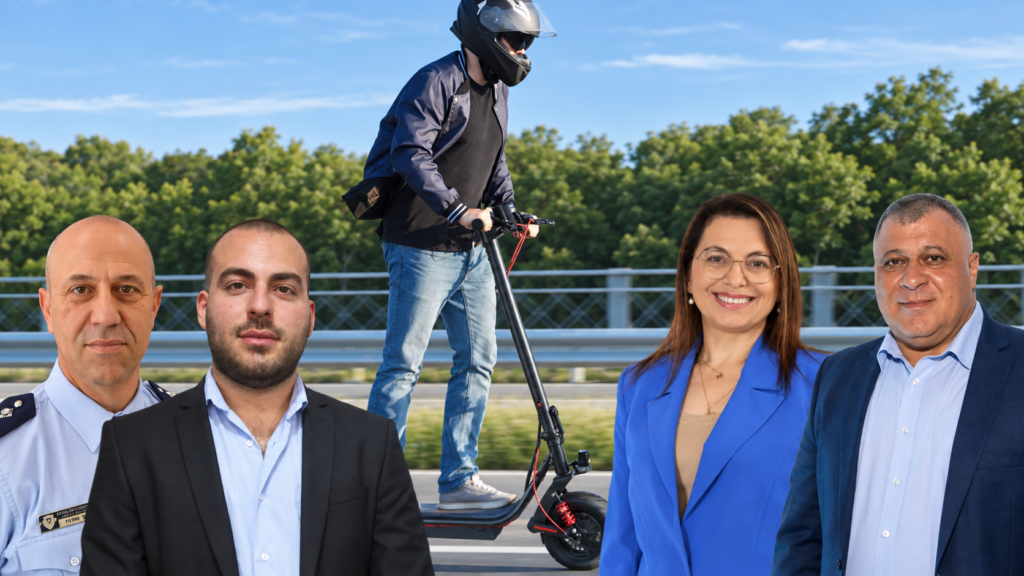
Cyprus could introduce mandatory registration of electric scooters, including number plates, owner identification and technical inspections, if new measures to tackle widespread traffic violations fail to improve road safety, Transport Minister Evi Tsolaki has told Phileleftheros.
The minister acknowledged that existing legislation is not being adequately enforced and that police face significant difficulties monitoring the use of electric scooters across the island.
Her comments come amid renewed concern over deaths and serious injuries involving e-scooters, particularly following the death of 16-year-old Aris Papacharalambous, who died on 26 September from injuries sustained when a car struck the scooter he was riding in Aglantzia on 7 August.
Road accidents and frequent violations of traffic regulations have raised questions about inadequate infrastructure, the effectiveness of existing legislation and the difficulties of enforcing the rules.
Speaking to Phileleftheros, Tsolaki said the government was preparing a decree allowing authorities to impound electric scooters when riders break the law.
She believes the measure could deter dangerous behaviour but has not ruled out stricter regulations if it proves ineffective.
“We believe this will act as a deterrent, but if we find that it does not, we may bring the discussion about registering scooters back to the table,” she said.
Under such a system, electric scooters would be registered in a manner similar to motor vehicles, with identification numbers, records of ownership and inspections to ensure they meet the necessary technical specifications.
The minister said registration could also pave the way for insurance coverage, which she said was not currently available for these vehicles.
“Just as motor vehicles are registered, scooters could also be registered, carry a registration number, have an identifiable owner and undergo inspections to ensure they meet the requirements,” she said.
She added that registration would also make it easier for insurance companies to provide coverage.
However, Tsolaki believes a complete ban on electric scooters should be considered only as a last resort.
Widespread violations and enforcement difficulties
The transport minister acknowledged that breaches of the rules remain common despite recent efforts to tighten the law.
“It is clear, and we can all see it, that the roads are full of scooters and the provisions of the law are not being followed,” she said.
Tsolaki noted that police cannot continuously monitor every road and public area where scooters are used, pointing in particular to cases of people riding them on motorways.
She stressed that the legal framework had already been tightened, introducing specific obligations for riders and technical requirements for the vehicles.
Under the rules described by the minister:
- Riders must be at least 17 years old.
- Wearing a protective helmet is compulsory.
- Electric scooters must meet specified technical standards, including appropriate lighting.
- Their speed must not exceed 25 km/h.
- They may be used only on roads meeting the relevant legal requirements, including restrictions relating to roads with a 30 km/h speed limit.
Despite these requirements, violations continue to be reported across Cyprus.
New decree to allow police to impound scooters
The Transport Ministry is proceeding with a decree that will allow electric scooters to be impounded when violations are detected.
According to Tsolaki, work on the measure began during her predecessor’s term, while the public consultation process was completed at the end of September.
She expects the possibility of losing access to a scooter through impoundment to discourage riders from breaking the rules.
However, the minister made clear that additional measures could follow if the situation does not improve.
The effectiveness of the decree will therefore be a key factor in determining whether the ministry moves towards mandatory registration.
Minister raises e-scooter safety at EU level

Tsolaki said she had also raised the issue of electric scooters at an informal meeting of European Union transport ministers.
Discussions with her European counterparts revealed that other member states were experiencing similar problems, with some having gone as far as banning electric scooters entirely.
“Some countries have dared to ban them completely. I believe that should be the last measure,” she said.
The minister also approached European Commissioner for Sustainable Transport and Tourism Apostolos Tzitzikostas, asking him to consider the issue at EU level.
She proposed examining the possibility of a common European legislative framework, binding on member states, to regulate the circulation and use of electric scooters.
Tsolaki concluded by urging riders to comply with the law and behave responsibly on the roads.
“I would like to ask users themselves to demonstrate proper road behaviour and comply with the provisions of the law, for their own safety and that of others,” she said.
Former MP accuses authorities of bowing to commercial interests

Former DIPA MP Alekos Tryfonides, who previously led an initiative in parliament to ban electric scooters in Cyprus, has sharply criticised the authorities for failing to address the risks.
Speaking to Phileleftheros, Tryfonides said efforts made during the previous parliamentary term had failed to prevent further deaths.
He accused former parliamentary colleagues of giving in to commercial interests instead of introducing a complete ban, arguing that the measures they adopted were never capable of solving the problem.
He specifically referred to businesses selling electric scooters and tourism operators in coastal areas, whom he accused of exerting pressure to allow their continued use.
Tryfonides also questioned why coastal municipalities had not built dedicated lanes if they wanted scooters to remain available for tourism purposes.
His position remains that, without suitable infrastructure, the dangers associated with electric scooters will remain high, regardless of how many additional restrictions are imposed.
He said he received messages almost daily from mothers worried about their children’s safety, asking him to do everything possible to have scooters banned.
“They tell me, ‘Save our children’,” he said.
Although he is no longer an MP, Tryfonides said he had contacted Sotiris Ioannou, chairman of parliament’s Transport Committee, and asked him to reopen the debate on a ban.
He accused the responsible authorities of failing to act since 2022.
“They did nothing,” he said.
“Municipalities did not build dedicated lanes, registration did not move forward, nor did insurance. The police are unable to enforce the law properly.”
Tryfonides argued that passing legislation to abolish or prohibit the use of electric scooters could force the relevant authorities to take the steps needed to create conditions for their safe use on public roads.
“That’s Cyprus for you. Zero results,” the former MP said, expressing his frustration.
Police report continued violations of safety rules

Police spokesperson Vyron Vyronos acknowledged that violations remain widespread, despite targeted traffic enforcement operations across all districts.
“The use of personal mobility devices has now become part of everyday life. However, their safe use depends on compliance with the law, responsible behaviour by users and respect for everyone using the road network,” he said.
Vyronos stressed that police take illegal and dangerous scooter use seriously and conduct targeted checks throughout Cyprus.
Recent operations have continued to uncover violations involving scooters being used in prohibited areas, riders failing to wear helmets and breaches of traffic regulations.
“Checks continue daily, and the police enforce the law, taking the measures provided for in each case of violation,” he said.
“Our aim is not to impose penalties simply for the sake of punishment, but to prevent road collisions, deter dangerous behaviour and protect human life.”
The police spokesperson also emphasised the importance of informing riders, parents and guardians about their legal obligations, particularly the minimum age requirement, compulsory helmet use and restrictions on where scooters may be ridden.
“Compliance with road safety rules is not optional and applies to everyone without exception,” he said.
Police regularly organise awareness campaigns through direct contact with the public on roads and in schools, as well as through social media and traditional news outlets.
However, Vyronos acknowledged that enforcement alone could not resolve the problem.
He called for closer cooperation between the police, the Transport Ministry, local authorities and other relevant bodies to assess existing infrastructure, identify high-risk locations, improve road signs where necessary and introduce measures supporting safe and lawful scooter use.
He also stressed that the effectiveness of safety measures should be assessed not simply by the number of checks or fines issued, but primarily by whether they reduce dangerous behaviour and road accidents.
“Road safety is a collective responsibility. The police will continue to carry out their duties consistently through enforcement, prevention and education,” he said.
“However, meaningful improvement requires cooperation among all the relevant authorities and, above all, responsible behaviour by everyone using the roads.”
Parliament ready to consider tougher restrictions

Sotiris Ioannou, chairman of parliament’s Transport Committee, warned that stricter measures could follow if enforcement of existing rules fails to improve road safety.
“The uncontrolled use of electric scooters on roads and pedestrian walkways cannot continue,” he said.
“Road safety, the protection of pedestrians and drivers, and the proper functioning of our cities are not issues that can be met with tolerance or delays.”
Ioannou recalled that parliament had passed tougher legislation in April 2026, introducing clearer restrictions on scooter use.
Under the rules he outlined, scooters may be used only on roads with speed limits below 30 km/h and on cycle paths, while riders must be over 17 years old.
Their use on other roads and pedestrian walkways is prohibited.
“What matters today is not passing more laws but enforcing the ones that already exist,” he said.
Ioannou identified the publication and immediate implementation of the decree allowing authorities to confiscate illegally used scooters as a priority.
He described it as an important enforcement tool that had been delayed for months at the Transport Ministry without justification.
Although he welcomed the new minister’s decision to advance the decree, he said it now needed to be published and implemented.
He also called on the relevant authorities to carry out systematic checks and targeted enforcement campaigns to ensure that offenders face the penalties prescribed by law.
The parliamentary Transport Committee examined the issue in September and established strict deadlines, according to Ioannou.
He said the committee would revisit the matter shortly to assess progress.
“If there is no meaningful improvement, we are ready to proceed with more drastic measures,” he said.
“Public safety cannot wait for the next fatal accident. The law must be enforced, and responsibility must be taken.”

