


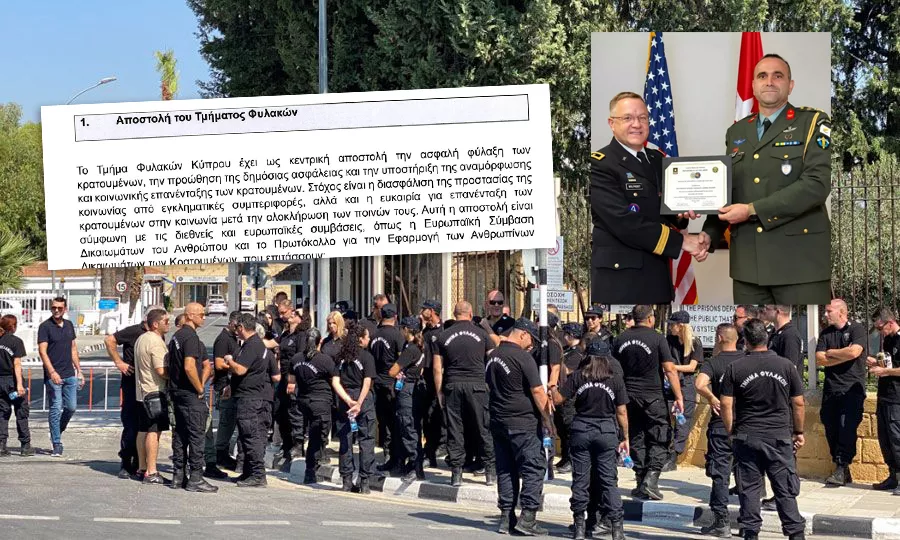
George Ioannou, Cyprus’s former military attaché to the United States, will take over as director of the Central Prisons on 2 November, inheriting a prison system struggling with overcrowding, staff shortages and a reoffending rate among Greek Cypriot former inmates that exceeded 43% in the first eight months of 2026.
It is a position that could hardly be described as anything other than an electric chair.
Just days before the Public Service Commission announced Ioannou’s appointment, figures released by the Justice Ministry exposed the scale of the challenges awaiting him.
Responding on 28 September to a parliamentary question from MP Andreas Constantinou, the ministry disclosed that the proportion of Greek Cypriot former prisoners who had been convicted again and returned to prison stood at 43.69% as of August 2026.
The figure concerns Greek Cypriots who were released after serving a prison sentence but subsequently returned to custody following another conviction.
Put simply, Cyprus’s correctional system appears to be correctional in name only.
People are going in and out of prison without demonstrating any lasting change in their behaviour. For a system that describes itself as rehabilitative, the figures represent a resounding failure.
Reoffending and overcrowding
In its response to the parliamentary question, the Justice Ministry acknowledged the importance of helping prisoners reintegrate into society and employment as a means of reducing reoffending.
It also linked the problem directly to prison overcrowding.
The ministry said it recognised the critical importance of prisoners’ social and professional reintegration in tackling reoffending.
It added that the effectiveness, reach and practical impact of existing programmes were severely undermined by the longstanding problem of overcrowding at the Central Prisons.
“This situation inevitably creates a series of negative consequences for the proper functioning of the correctional system and the individualised approach required for meaningful rehabilitation,” the ministry said.
The irony of the prison system’s own mission
There is a further irony, beyond the timing of Ioannou’s appointment and the release of these troubling statistics.
Phileleftheros obtained one of the prison system’s official protocols, which sets out objectives that the latest figures call seriously into question.
Under the heading Mission of the Prisons Department, the document describes the department’s central responsibilities.
“The Cyprus Prisons Department’s core mission is to ensure the secure custody of prisoners, promote public safety and support their rehabilitation and social reintegration,” it states.
“The aim is to protect society from criminal behaviour while also allowing prisoners to reintegrate into society after completing their sentences.”
The document adds that this mission is consistent with international and European conventions, including the European Convention on Human Rights and the protocol concerning the implementation of prisoners’ human rights.
The contrast between these stated ambitions and the official reoffending statistics is difficult to ignore.
European report raises alarm over prison overcrowding
The reoffending figures become even more troubling when considered alongside another set of findings: a report by the Council for Penological Co-operation (PC-CP), which documents overcrowding in Cyprus’s prisons.
The PC-CP is a Council of Europe body dealing with prison policy, detention conditions, prisoner reintegration and the development of European standards for prison systems.
Its report places Cyprus among the European countries facing severe prison overcrowding.
According to the findings, the number of prison systems reporting serious overcrowding increased from six in January 2024 to nine in January 2025.
Prison overcrowding in January 2025
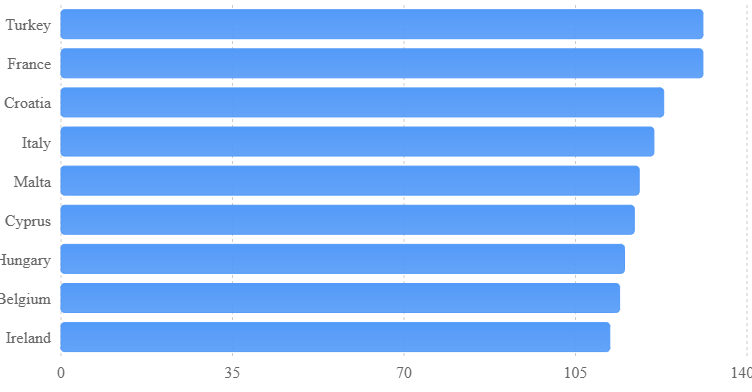
Cyprus recorded 117 prisoners for every 100 available places, placing it among the nine prison systems identified as severely overcrowded.
These findings are even more concerning when the large number of people being held in police detention facilities is taken into account.
Some of these detainees should ordinarily be accommodated at the Central Prisons.
Instead, police-operated detention facilities have been designated as prisons through ministerial decrees to relieve pressure on the Prisons Department.
Phileleftheros has examined this practice repeatedly, publishing reports supported by documentary evidence.
More than half of prisoners are foreign nationals
The same Council of Europe report, published on 19 May 2026, contains two further significant findings concerning Cyprus: the proportion of foreign prisoners and the average age of the prison population.
Cyprus was among the European prison systems with particularly high proportions of foreign nationals in custody.
At 54%, foreign nationals accounted for more than half of Cyprus’s prison population.
The report also examined the average age of prisoners across Europe.
The European average was 39, although significant differences existed between countries.
Italy and Portugal recorded the highest average age, at 42, followed by Montenegro, Estonia and Serbia at 41.
The youngest prison populations were recorded in Moldova, where the average age was 30, Sweden at 34, and France, Cyprus and Denmark at 35.
Construction of new prison targeted for late 2027
Justice Minister Costas Fitiris signalled his determination to tackle the prison crisis and build new facilities soon after taking office.
But the project is proving far from straightforward.
His announcements have prompted objections from affected communities, and he acknowledged the difficulties when speaking to the media on Thursday.
Asked about the possibility of building the new prison at Agios Sozomenos, Fitiris said three locations had initially been considered, with Mathiatis the preferred option.
However, the government had set Mathiatis aside because of the substantial cost of providing infrastructure.
“Because of the extremely high financial cost, as there is no infrastructure whatsoever, we have put Mathiatis aside and are examining Agios Sozomenos,” he said.
Fitiris explained that studies, supported by the European development bank, would determine whether Agios Sozomenos would ultimately be selected.
“I have committed to the affected municipalities that, as soon as we have the master plan, I will present it to them so they can give us their views and tell us what they would like changed,” he said.
Asked whether there was an alternative plan, the minister confirmed that there was, although he stressed that the process was difficult.
“For now, we are focusing on examining the advantages and disadvantages, with a final decision to be taken after the master plan and studies are completed,” he said.
As for the timetable, Fitiris made clear that the new prison would not be finished next year.
“The correctional facility will not be completed next year. The aim is to have bulldozers on site before the end of 2027,” he said.
The proposal to locate the prison at Agios Sozomenos has already encountered local opposition.
In mid-September, the municipalities of South Nicosia–Idalion and Latsia–Geri called for the immediate reversal of the decision to locate the new Central Prisons in the area.
They publicly accused the government of bypassing local authorities in the decision-making process.
The minister subsequently held talks with representatives of the two municipalities on Tuesday in an effort to establish a constructive dialogue.
Prisoners forced to urinate in bottles and defecate in bags
Damning findings from European anti-torture watchdog
On 10 December 2025, the European Committee for the Prevention of Torture (CPT) published a deeply critical report following an ad hoc visit to Cyprus from 1 to 4 April.
Although the committee acknowledged improvements in some areas, its findings showed that little meaningful progress had been made on the most serious problems affecting the prison system.
Among its findings were chronic overcrowding, degrading sanitation conditions, violence between inmates and inadequate facilities for young prisoners.
Chronic overcrowding: The CPT found that overcrowding continued to seriously undermine prisoners’ living conditions and treatment.
Degrading sanitation conditions: Cells measuring less than six square metres were holding as many as four people instead of one. In some cases, prisoners were forced to urinate in bottles or defecate in bags because insufficient staff were available to unlock toilets at night. The committee described these practices as degrading.
Violence between prisoners: The CPT expressed serious concern about violence among inmates and the inability of prison staff to guarantee everyone’s safety.
Children and young prisoners: The committee documented inappropriate and unhygienic detention conditions, with inadequate access to education and meaningful activities. It called for their urgent transfer to suitable facilities.
Women prisoners: The committee called for a specialised approach to the management and treatment of female prisoners, taking account of their particular needs.
The CPT also noted that, compared with 2023, it had received very few allegations of physical ill-treatment of prisoners by staff.
However, its findings on staffing and the control of the prison environment were particularly serious.
The committee found that chronic shortages of frontline personnel had allowed stronger groups of inmates to gain dominance and impose informal punishments on other prisoners.
It urged the Cypriot authorities to recruit and train additional staff, regain control of the prisons and review their approach to preventing violence.
The CPT also identified shortcomings in healthcare provision and called for stronger medical confidentiality protections and a comprehensive suicide prevention policy.
Reoffending among Greek Cypriot prisoners
The parliamentary question submitted by MP Andreas Constantinou specifically sought figures on the number of Greek Cypriot convicted prisoners released from the Central Prisons over the previous five years and how many were subsequently convicted again of a criminal offence.
The Justice Ministry’s response provided figures covering the period from 2020 to August 2026.
According to the ministry’s tables, the percentages of Greek Cypriot prisoners who were convicted again and returned to prison after their release were as follows:
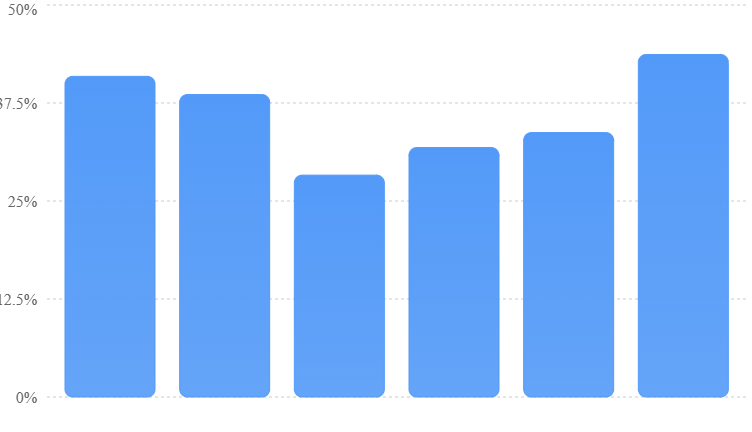
The figures show that the reported percentage fell to 28.3% in 2023 before rising again in subsequent years, reaching 43.69% by August 2026.
Prison officers face longstanding problems
The incoming prison administration will also have to address the problems faced by prison officers.
Concerns have repeatedly been raised about inadequate support for staff, leaving them unable to carry out their duties effectively.
A letter written in 2014 by Savvas Christou, then commander of the police’s Mobile Immediate Action Unit (MMAD), illustrates how longstanding these problems are.
In January that year, the unit under Christou’s command intervened at the Central Prisons and remained there for approximately a month.
The intervention came amid a series of prisoner suicides, with five having occurred by that point, and a case involving the alleged rape of a 22-year-old inmate, in which four fellow prisoners were suspects.
Christou was subsequently asked to make recommendations concerning conditions at the prison.
What is striking is how closely the problems he identified resemble those being raised today.
Christou concluded that the prison lacked sufficient senior officers.
He noted that the number of officers responsible for supervising staff was too low, meaning inspections and oversight were inadequate.
He also found that staff meetings were not being held, leaving problems unresolved.
According to the letter, there was a lack of cooperation, coordination and information-sharing.
Training in responding to emergencies was described as minimal or virtually non-existent.
Christou also highlighted the heavy workload facing prison staff, which he said contributed to tension and stress.
He reported low morale and poor communication between colleagues.
Staff shortages, he added, created difficulties in granting annual leave, with employees instead taking sick leave either as an alternative or as something they had come to regard as an entitlement.
The same concerns appear to persist more than a decade later.
At a meeting with Justice Minister Costas Fitiris in mid-September 2026, prison officers’ trade unions again raised a series of longstanding problems.
According to the ministry’s official announcement, the discussions covered:
- Staff shortages and incentives to attract new prison officers.
- Starting salary scales and professional development.
- Staff protection and training.
- The establishment of a maximum-security wing and an Immediate Response Unit.
- Changes to the prison system’s administrative structure.
Mobile phone blocking system still failing to deliver
Another problem that has dragged on for years is the system intended to block mobile phone signals inside the Central Prisons.
Despite repeated announcements and recent efforts to address the issue, the technology has still not delivered the expected results.
The most recent development came on 31 July, when Justice Minister Costas Fitiris discussed prisoners’ use of mobile phones during an appearance on ANT1 television.
“I do not want to present the situation as ideal. The problem will be eliminated when the third system for blocking mobile phone signals within the prison is installed. I estimate that it will be in place by the end of the year,” he said.

