



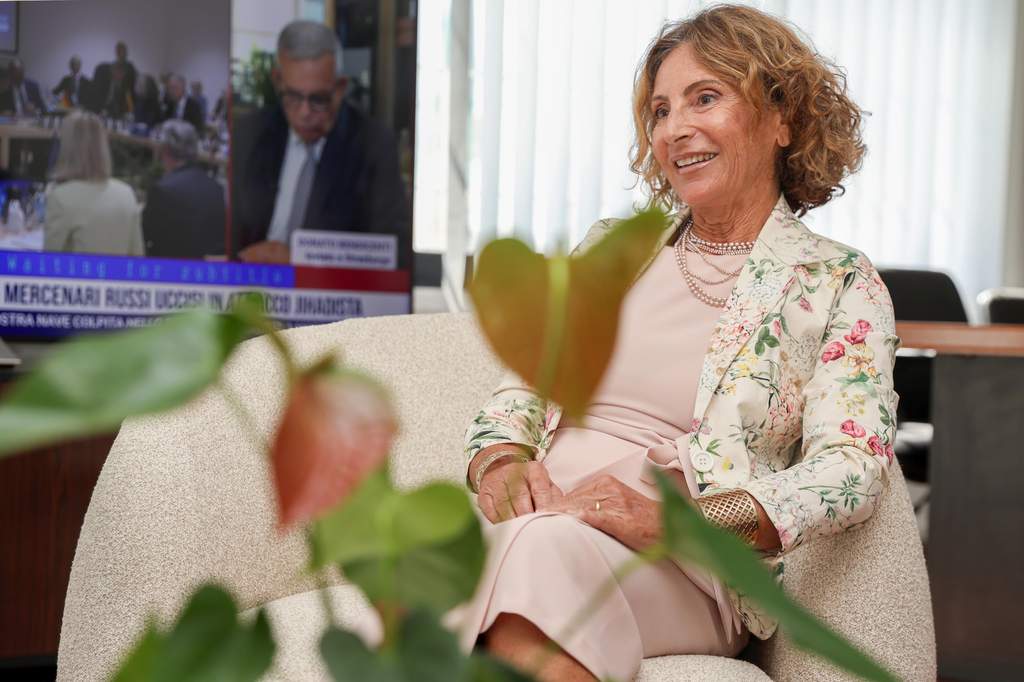
Italy’s Ambassador to Cyprus, Antonella Cavallari, has downplayed the risk of Turkish interference in the Cronos gas field, which is about to start operating in Cypriot waters. Speaking to Phileleftheros, she also discussed the strategic framework Italy and Cyprus are drawing up, European defence solidarity under the EU’s Article 42.7 mutual-assistance clause, the state of the Cyprus problem, and the growing Italian community living and working on the island.
Interview with Andreas Bimbishis and Stelios Marathovouniotis
On the Italy-Cyprus framework agreement
Italy and Cyprus are drawing up a document outlining a number of strategic agreements. Can you tell us how that process is going?
The idea is to build a framework covering all the sectors of mutual interest, into which we can fit new joint initiatives. Italy and Cyprus already cooperate closely, and that’s nothing new — it’s a long and friendly relationship. The aim now is to make that cooperation more structured, more continuous and more productive: to identify specific sectors and deliver concrete results in each.
The idea came up during President Christodoulides’s visit to Rome, given his close personal relationship with Prime Minister Meloni. When the Prime Minister later came to Cyprus for the EU summit, she was due to return for a bilateral visit, but events beyond Italy’s control forced her back to Rome, so the visit didn’t happen. The relationship remains very close, though, so this will likely be picked up again. In the meantime, we’re not waiting for a document to be signed — the priority is to work together, which we’re already doing, especially in the economic and business sphere.
On the Akrotiri drone strike and EU defence solidarity
After the drone strike at Akrotiri, we saw Italy sending help to Cyprus. Is this part of a move to formalise Italy’s military presence here in some way?
No, it’s not part of any special agreement. It was a gesture of friendship, a response to a request from the Cypriot side — European solidarity is measured by being present when a member state needs support, and that was the case here. Our presence, alongside other countries’ forces, also acts as a deterrent.
I was pleased to be publicly recognised at the ceremony for the National Guard’s anniversary, where I — together with colleagues from France, Spain and the Netherlands — received recognition for this presence. It was a very warm gesture and one that was much appreciated on the Cypriot side, and another sign of the depth of our friendship.
Could EU countries work out a framework so that when one of them needs that kind of help, the others step in?
You’re referring to Article 42.7 of the EU treaty. That was one of the main topics discussed when heads of state and government met here in Cyprus. The question is how to make that article effective in practice.
This display of solidarity from a military point of view is itself a demonstration of how it can work, though the details of implementation still need to be discussed and developed further at the level of the Council of Ministers and heads of state and government. I think we’re moving in that direction. The idea is to build a common strategy and common defence that reinforces NATO rather than competing with it — European defence is a pillar of NATO. A stronger European defence makes NATO stronger too, especially on its southern flank and the eastern European flank. We need to develop our own capacity for self-defence in order to be better allies within NATO.
On the Mediterranean’s place on the EU agenda
For many years the EU dealt mainly with issues affecting Central and Northern Europe rather than the south — the area that concerns Italy, Cyprus, Greece, France and Spain. In the last few years that’s started to change. Was this an achievement of the Mediterranean countries?
It depends a great deal on who holds the rotating presidency. Many Mediterranean member states — including Italy, Spain and France — have held it, and we’ve always tried to focus on issues of Mediterranean interest. The Cypriot presidency in particular has been very effective, and I want to say how pleased all member states are with how it’s been run: it put the Mediterranean at the centre of the European agenda even before the war in Iran, because the presidency was prepared well in advance with these priorities already in mind. That’s a real achievement — and I don’t mean only on security, though that’s the obvious point now, but across a lot of shared agenda.
Migration is one example: the Pact on Migration and Asylum was approved and launched here in Nicosia on 12 June. Shipping and maritime affairs are another — I recently took part in a four-country meeting, with Cyprus, Italy, Malta and Greece, to build a common view on maritime and shipping strategy. We use formats such as MED5 and MED9 to build common strategy in various sectors and bring Mediterranean priorities into the European conversation, and internationally too — in Limassol, for instance, we discussed a common position within the IMO, which matters because the four of us together account for 75% of the EU’s entire fleet; we need a common voice there.
On migration, we’re launching an initiative at the UN General Assembly at the end of September, in which Cyprus will also take part. The MED9 presidency is currently co-shared with Croatia, and we’re organising a meeting on food security, given the impact of the war on the fertiliser trade — fertiliser being fundamental to food security. It’s an area where we share a great deal of common ground with our Cypriot friends.
Ultimately, what happens in the wider Middle East and North Africa affects the EU as a whole, not just its neighbouring countries.
Yes — migration is the clearest example, but shipping is too. If shipping costs rise too sharply, that affects prices for citizens right across Europe, not only in the countries directly involved. In today’s interconnected world, you can’t isolate your own interests from everyone else’s. We need allies based on shared interests, priorities and values — that’s what makes a country a genuine ally and friend, and Italy and Cyprus share those things. That matters more than any document we might sign; it’s the real basis of our political common ground.
On EU strategic autonomy and enlargement
What about EU strategic autonomy — an issue that comes up from time to time? My impression is that EU leaders aren’t yet ready for that step. What’s Italy’s position?
There’s a common understanding at European level that we need greater cohesion now, particularly given growing concern about Russian hybrid warfare. It’s genuinely worrying, and it’s clear we need to be more united.
There’s also a shared determination to preserve our values — we are profoundly democratic countries, we believe in human rights and freedom of movement, and those things matter to us. Democracy is our pillar. We share these values in Europe and we don’t want to give them up, so we need to protect them.
How could this be achieved? There’s been talk of a European army, or a common defence, for a few years now. How could that happen?
My own view is always “more Europe, not less” — but a better Europe. We have to build a Europe that can answer new challenges. History moves, it doesn’t stay frozen, and our model of Europe can’t be the same as it was fifty or sixty years ago. It has to adapt to new realities.
We need to be stronger and more united, and there’s also the question of enlargement — opening the Union to new member states. That’s a major challenge, but one we have to face, because we need other countries that share our values. I don’t see many alternatives — it’s a dangerous world.
Is enlargement realistic for a number of countries in the near future?
Not all candidate countries are moving at the same pace — some are further ahead than others, and the Council of Ministers is examining the process carefully. During the Cypriot presidency there were a number of meetings on enlargement, and it became clear that a few countries, including Ukraine, are quite advanced. The situation is fluid, and the right moment has to be judged carefully, but progress isn’t uniform — each candidate has to meet the requirements for EU membership.
Do you think each country that’s ready should join, rather than everyone waiting for a whole group to be ready together — as happened with Cyprus and the other nine countries that joined together?
It will depend a great deal on the circumstances. I don’t know whether Ukraine can be separated from the wider group, but it is very advanced. In any case, whoever joins has to meet all the criteria and requirements for membership — the process might be adjusted to allow as many countries as possible to join together. The goal is to enlarge to include as many as are ready.
But some countries don’t fully agree with that — Turkey, for instance, among our neighbours, reacts against being expected to meet all the EU’s accession requirements.
I don’t think that’s currently in discussion. Turkey’s accession request has been frozen for a long time, for a number of reasons, so it isn’t part of this current process. We’ll see.
On the Cyprus problem
What role can Italy, or the EU, play in the Cyprus problem? Could we see something different from what we’ve seen in past years?
The process is in the hands of the United Nations, and we fully support the relevant Security Council resolutions and UN positions — that goes for us and for other EU member states. We support the negotiations both as a country and as part of Europe, mainly through good offices: we have very good relations with all the parties involved — Cyprus, Greece and Turkey alike — and that can help through moral suasion.
But the process itself rests with the UN. We can help create the conditions and opportunities for dialogue — we should never give up on dialogue, which is the essence of diplomacy, and we need to keep demonstrating that lasting results come through dialogue rather than force. A durable solution in Cyprus — a bi-communal, bi-zonal federation, which is what we’d all like to see — has to be carefully designed to last, not something that unravels within a year. That’s what we want to support: we can observe, offer our opinion and encourage dialogue, but the final decision lies with the parties directly involved.
There’s also an interesting Italian connection on the European side of this process.
Yes — that’s part of what makes me a little optimistic: two very experienced politicians are involved. One is María Angela Holguín, the UN Secretary-General’s Personal Envoy on Cyprus, who has a long record and is a very capable politician. On the European side, the EU envoy is Raffaele Fitto, a very experienced Italian politician and an important figure in the European Commission — not a former Commissioner, but a sitting Vice-President of the Commission, which shows how seriously the Commission is taking this process.
He’s known for good judgement, and for listening carefully to all sides before offering suggestions — exactly what’s needed in this kind of negotiation. I’m confident he can help, and I hope he’ll be back in Cyprus soon to resume his visits. President Christodoulides has consistently underlined his willingness to support this process, and we have to back that.
On the Cronos gas project and the risk of Turkish interference
An Italian company [ENI] is about to extract gas off Cyprus. How do you assess the risk of Turkish interference, and what could disrupt the extraction process?
First of all, Cyprus is fortunate that most of the gas fields lie in undisputed waters. The Cronos block, which is about to start operating, is entirely within Cyprus’s territorial waters and exclusive economic zone, so I don’t expect any problem there. The same applies, as far as I know, to the Glaucus and Aphrodite fields, which are also in Cyprus’s waters. Something might happen if gas is found elsewhere, but Cronos itself is safe — we don’t foresee any issue there.
So the risk is very low?
For Cronos, I don’t see much risk, because it’s recognised as being within Cyprus’s Exclusive Economic Zone. I can’t speak with the same certainty for the other fields, but Aphrodite and Glaucus are still at an early stage — they haven’t even reached the final investment decision — so that will take years, and by then the Cyprus problem may well be resolved.
I think a solution would benefit everybody, because it would unlock this island’s great potential. Cyprus is in a strategic position and holds strategic resources, which matter for connectivity, electricity and gas — especially given the problems affecting other routes, such as the Bab-el-Mandeb strait. A resolution of the Cyprus problem would unlock enormous potential, though these resources would have to be developed carefully. Cyprus has real potential to become an important hub.
What role does Italy, as a state, or your embassy, play in the negotiations between the Cypriot state and the company developing the gas fields?
They [ENI] handle that themselves — they simply keep us informed, and we have a good relationship. But the negotiation is conducted directly by the company. We can help in other ways, for instance passing on requests for permits or authorisations to the relevant authorities, as we do in other cases — but the negotiation itself is the company’s.
On the Italian community in Cyprus
There’s been a slight increase in the number of Italians living in Cyprus in recent years — I was at a football match recently and there was a group of Italian supporters there every time. What do you think is driving that: personal reasons, intermarriage, economic reasons?
It’s not really migration, since the numbers are small. I’d call it more of a movement. We’re talking about roughly 2,000 Italians living here, a fairly mixed community. Some retired here, finding Cyprus attractive for tax, climate and security reasons — I’d say many fall into that category. Others are in mixed marriages with Cypriot partners.
A growing group, and the one that interests me most, is businesspeople relocating or setting up companies here — which is harder to track, since they don’t usually approach the embassy unless they need something. I try to meet as many as I can, mostly through word of mouth. Recently I’ve met a businessman in real estate, another working in corporate compliance, and another in finance. There’s also growing interest from technology, digital and AI businesses, where Cyprus is developing quickly, alongside the more traditional Italian businesses — restaurants, hotels, shops.
I want the embassy to focus on these newer sectors. That’s why we’re organising a business forum on shipping — not just the large shipping lines, but the whole chain of related businesses, large, small and medium-sized, to encourage investment across the sector. We’re also planning something on space: I’ve been in talks with the Eratosthenes Centre of Excellence about organising Cyprus-Italy Space Days, to grow cooperation in space technologies. Satellite monitoring affects daily life across many sectors — agriculture, health, protection of infrastructure. The idea is to take an innovative approach and look at new sectors, alongside the traditional ones. Italian restaurants and cultural events will always be there and don’t need the embassy’s help — we’ll keep supporting those too, of course — but I want to focus on what I see as the future.
I’d also mention the importance of involving young people — training them together, helping them build new skills. That’s another way to cooperate with a friendly country like Cyprus.
Editor’s note: According to figures supplied separately by the Italian Embassy, bilateral trade in goods between Italy and Cyprus reached approximately €1.29 billion in 2025, the latest full year for which figures are available, with Italy remaining one of Cyprus’s main trading partners. That represents an increase of approximately 7% on 2024.

