


When people think of expatriate communities in Cyprus, the UK, Russia and Israel are often among the first countries that come to mind. One community that tends to attract less attention, however, is the Italians.
But the numbers suggest that is beginning to change.
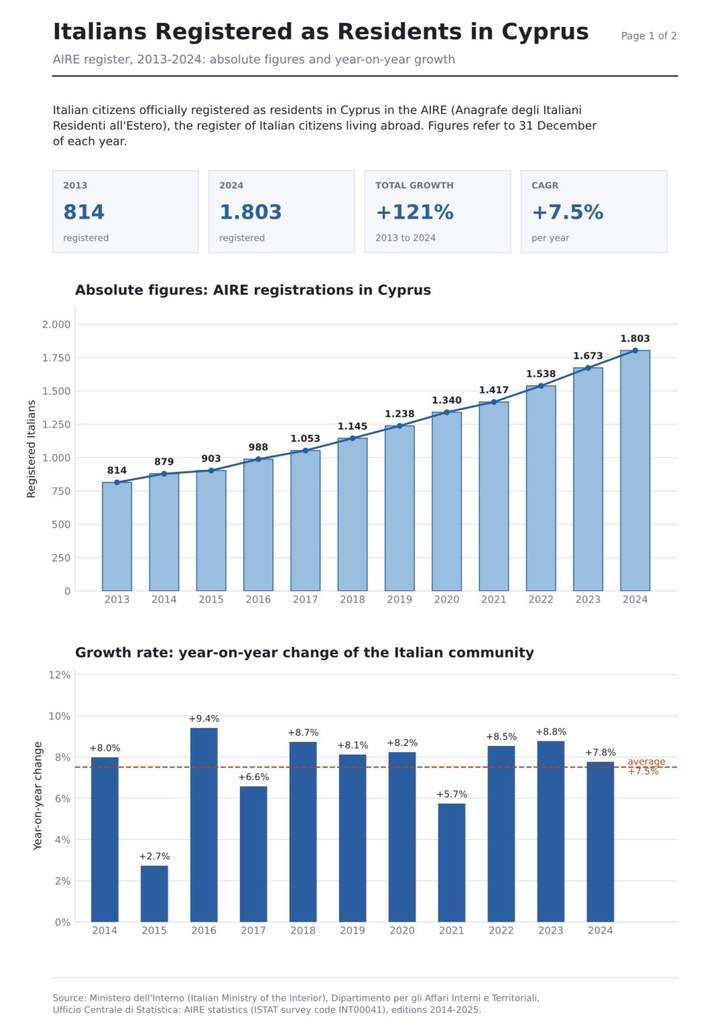
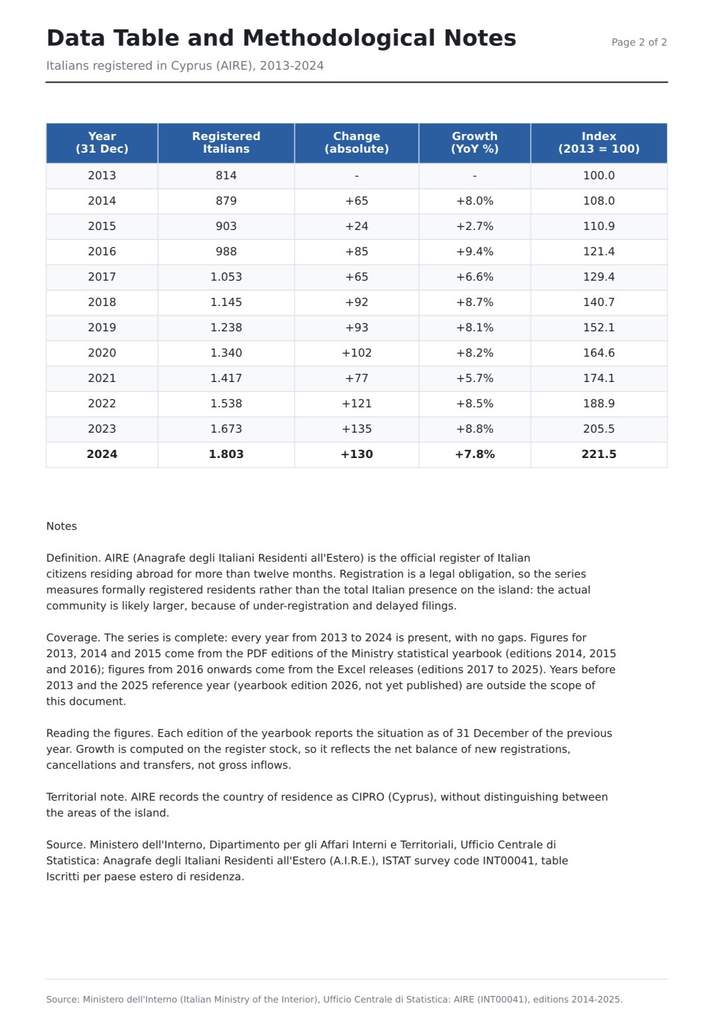
The number of Italian citizens officially registered as residents in Cyprus more than doubled between 2013 and 2024, rising from 814 to 1,803, according to AIRE, Italy’s official register of citizens living abroad. That represents total growth of 121%, equivalent to an average annual growth rate of 7.5%. The number increased every year over the period, including by 7.8% in 2024 alone.
The figures refer to Italians registered as residents in Cyprus as of 31 December each year. AIRE registration is a legal obligation for Italian citizens residing abroad for more than 12 months, although the figures do not capture the entire Italian presence on the island, as under-registration and delayed filings mean the actual community is likely to be larger.
Against that backdrop, Cyprus appears to be attracting a steadily growing Italian community. En.philenews spoke to Italian financial influencer Pietro Michelangeli about what is attracting Italians to the island, and the challenges involved in making the move.
Who is Pietro Michelangeli?
Pietro Michelangeli is an Italian financial influencer with more than 360,000 YouTube subscribers. He moved to Cyprus in November, frustrated by what he describes as Italy’s administrative burden, frequently changing rules and tax system.
In April, he launched SoluzioneCipro.com, a platform aimed at helping Italian professionals, entrepreneurs and investors relocate to Cyprus.
Michelangeli says he identified a gap in services tailored specifically to Italian clients, particularly when it comes to navigating the tax and legal implications of moving abroad. The platform aims to guide clients through both the Italian and Cypriot sides of the relocation process and reduce the risk of costly mistakes.
“It started as a hobby in 2017, with a few YouTube videos about money,” he tells En.philenews. “I soon realised the demand for personal finance content in Italy was enormous and largely unmet, so I tried to do the subject justice.
“Nine years later, I think people follow me for two reasons. First, I explain difficult topics in simple terms without making them shallow, which is the opposite of what most short-form content does today. Second, I’ve always treated it as a craft rather than a business to optimise: I built an approach that entertains as well as informs, but I never turned the channel into a money machine.”

Why Cyprus?
The steady rise in AIRE registrations suggests that Cyprus has become a more significant destination for Italian residents over the past decade. The number registered increased from 814 in 2013 to 1,238 in 2019, before continuing to rise to 1,803 by 2024. The community has therefore more than doubled in the space of 11 years.
Spain and Dubai have traditionally been popular destinations for Italians moving abroad, Michelangeli says, but Cyprus is increasingly entering the conversation, helped by its lifestyle, EU membership and tax environment.
“Italians are finally starting to consider Cyprus: a welcoming tax system, very little paperwork, EU presence, same currency, and above all a relaxed way of living. And there’s almost no cultural shock — we’re all Mediterranean people; in some ways I feel we’re cousins.
“My feeling is that Italy has yet to discover Cyprus properly, but it has definitely started.”
What the Italian Embassy says
The Italian Embassy in Cyprus offers a separate, more recent snapshot of the community. According to figures provided by the Embassy, 1,983 Italian citizens are currently registered as residents in Cyprus, up from approximately 1,600 in 2023. This is a different measure from the AIRE year-end figures cited above, which recorded 1,803 registered residents as of December 31, 2024; the Embassy’s count reflects a more current tally rather than the same annual snapshot. The community is spread across the island, with a particularly significant presence in Limassol and Larnaca, the Embassy said, and mostly comprises pensioners, spouses of Cypriot citizens and workers, with entrepreneurship comparatively limited and concentrated in the restaurant and catering sector.
The Embassy also reported a recent rise in interest from Italian businesspeople and companies, with a growing number approaching it directly over the past two to three months to discuss their activities or plans to establish a business in Cyprus. It linked the trend to a Business Forum it organised in Limassol at the end of May, and said it is compiling a more detailed list of resident Italian companies with support from the Italian Chamber of Commerce.
The administrative challenges
While Cyprus may offer several attractions, relocating is not without its complications. Michelangeli says many of the biggest difficulties arise on the Italian side rather than from Cypriot rules.
“The hard part is Italy, not Cyprus. We constantly deal with shareholdings in Italian companies, property that was bought years ago, and other ties that have to be cleared before making the move. Local accountants here will simply overlook them, not out of bad faith — they aren’t required to know Italian law — but the result is the same: mistakes that only surface years later, when they’re expensive to fix.”
“And this is why the two sides can’t be handled by two separate professionals working in parallel,” he added.
“Somebody has to see the whole picture, or things fall between the cracks, and that’s what we’re doing with SoluzioneCipro.”
For Italians considering a move, the growing numbers do not necessarily mean that relocation is straightforward. The AIRE figures record people who are officially registered as living in Cyprus, but they do not explain why they moved, their occupations, income levels or whether they came for work, business, retirement or investment.
What does the influx mean for Cyprus?
The increase in registered Italian residents is part of a broader question facing Cyprus as the island attracts more foreign residents and businesses.
Michelangeli sees the impact of a growing expatriate population as a mixed picture. While foreign residents and businesses can bring money into the economy, he says rising housing costs are becoming an increasingly sensitive issue, particularly in Limassol and Paphos.
“Expats need to be respectful of Cyprus,” he said.
“Sometimes I see foreigners offering €3,000 a month for a two-bedroom simply because it’s easier than looking properly, and they don’t realise what that does to the local market. You’re not arriving in a resort, you’re joining a country. The supply problem is ultimately for Cyprus to solve, but how each person behaves still matters.”
Read more:

