


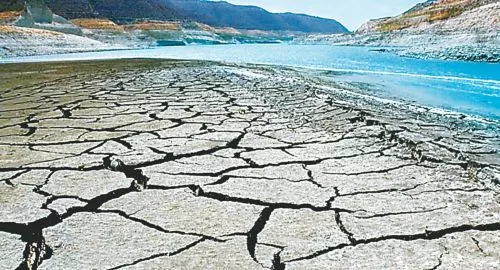
Cabinet decisions paint a stark picture of the country’s water future and effectively place Cyprus in a state of emergency. Reservoir levels have fallen to a critical 13%, inflows remain virtually zero despite recent rainfall, and the government has triggered a sixth package of measures worth €168 million to avert cuts to household water supply.
At the same time, the Cabinet has ordered a blanket 10% reduction in domestic water supply, while farmers face the heaviest blow, with cuts reaching 33%. The decision comes as domestic water consumption has risen by about 5% a year over the past few years, despite persistent drought.
Data from the Water Development Department is alarming. Cyprus is living through its fourth consecutive year of drought. From 1 October to today, total inflow into reservoirs reached just 16 million cubic metres, only 5.5% of their total capacity.
Hydrological records show that the 2024–2025 water year has delivered rainfall at roughly 65% of the long-term average, ranking among the eight driest years since 1902. Reduced inflows to reservoirs and the heavy strain on surface and groundwater systems impose objective limits that no policy can fully remove.
Based on current data, 2026 is shaping up as a year of high water risk. Starting reserves will be low and pressure on the supply system will intensify unless substantial inflows occur. The Water Development Department is acting under the Drought Management Plan, with continuous assessment of both quantitative and qualitative data.
The Ministry of Agriculture, Rural Development and Environment warns that without immediate action, reserves under the Southern Conveyor Project will run out before next August. That would make cuts to household water unavoidable in 2026 and the years that follow.
Given the severity of the situation, and in an effort to limit the impact of drought, delay or even avoid the depletion of reservoirs, and prevent water cuts under current conditions, the authorities say measures must focus on three fronts: increasing available water quantities, reducing demand, and cutting losses in supply networks.
The stated aim is to secure full coverage of drinking water needs in all areas served by the Southern Conveyor Project, while allocating as much water as possible for irrigation in areas supplied by government systems. Priority for irrigation will go to professional growers with permanent crops and greenhouses.
To avoid chaotic water interruptions during the summer, the Ministry of Agriculture has proposed strict planning. For 2026, 103 million cubic metres will be allocated for domestic use, down from 114 million cubic metres in 2025. The 10% reduction is described as precautionary, with the ministry estimating that proper conservation will spare households any impact on daily life. Irrigation supply will fall to 22 million cubic metres from 33 million cubic metres in 2025, a 33% cut that directly threatens production.
The government leaves a narrow window for revisiting the measures after April, but only if exceptionally heavy rainfall over the next three months delivers more than 32 million cubic metres of inflow to the Southern Conveyor. On current evidence, that scenario appears remote.
“The reduction in supply is necessary to ensure uninterrupted water provision throughout the year,” the proposal states, calling on citizens and district authorities to work closely together to avoid waste.
The decision has not come without friction. Agricultural organisations voted against the proposal at the advisory committee, arguing that the burden falls disproportionately on professionals in the sector. They are calling for deeper cuts in urban centres and immediate financial compensation for income losses caused by water shortages in their fields.
The government’s strategy now centres on rapidly increasing water production, after earlier efforts to attract private investment and conclude negotiations failed. The overall plan includes storage, supply, and irrigation works, desalination projects, and nationwide infrastructure upgrades.
Five urgent projects are currently under consideration by the Water Development Department. They include a floating desalination unit in Germasogeia with a capacity of 20,000 cubic metres per day at an estimated cost of €60 million. A new mobile unit with a capacity of 40,000 cubic metres per day is planned for Mazotos for €64 million. The mobile unit operated by the Electricity Authority at Vasilikos will be expanded from 10,000 to 20,000 cubic metres per day for €32 million. The mobile units at Episkopi and Ayia Napa will also be expanded from 10,000 to 15,000 cubic metres per day, each costing €25 million, with contracts lasting seven years.
Once completed, these projects will raise Cyprus’s desalination capacity by 66%, creating what officials describe as a protective shield for the domestic water supply. In total, and together with projects already underway, nine mobile desalination units will be added, providing 157,000 cubic metres per day. Combined with the 235,000 cubic metres per day produced by permanent plants, this will lift overall capacity by 66% and strengthen supply security. The completion of at least two new permanent desalination plants by 2029, along with expansions of existing plants through ongoing negotiations, is expected to cover total drinking water needs nationwide.
Authorities note that the option of operating mobile units permanently, or further expanding their capacity, will be examined later as part of a feasibility study for desalination projects serving the districts of Paphos, Limassol, Larnaca, Nicosia and Famagusta. The review will take into account problems exposed by the current water crisis following the removal of mobile desalination units installed in 2008–2009 and later dismantled in 2012–2013.
Despite awareness campaigns, water demand continues to rise by 5% a year. Acknowledging that appeals have failed, the government is moving to more targeted measures. It will allocate €6 million to supply water-saving fittings for homes and premises. In the public sector, equipment will be installed immediately in military camps, schools and government buildings. At the same time, a committee will be set up to cut hotel water consumption by 10%, offering incentives for private desalination.
A significant part of the problem lies in ageing networks. The Cabinet has approved an additional €1.5 million grant to the five District Local Government Organisations, instructing them to set up rapid-response crews to repair faults within 12 hours.
Following a Cabinet decision of 26 March 2025, €10.5 million has also been approved for the five district organisations through the THALEIA 2021–2027 programme. Although the funding was intended for mature projects to be completed within 2026, current projections show completion stretching into mid-2027, meaning there will be no immediate benefit in reducing domestic water demand to help cover the shortfall in 2026.
For that reason, the Water Development Department has asked the district organisations to submit fully documented proposals for immediate actions deliverable within three to six months. These include replacing ageing household connections, deploying rapid-response repair teams within 12 hours, using leak-detection services and technology, and other measures to cut losses in areas supplied by government water systems with high leakage rates. The total amount earmarked for 2026 stands at €1.5 million.

