


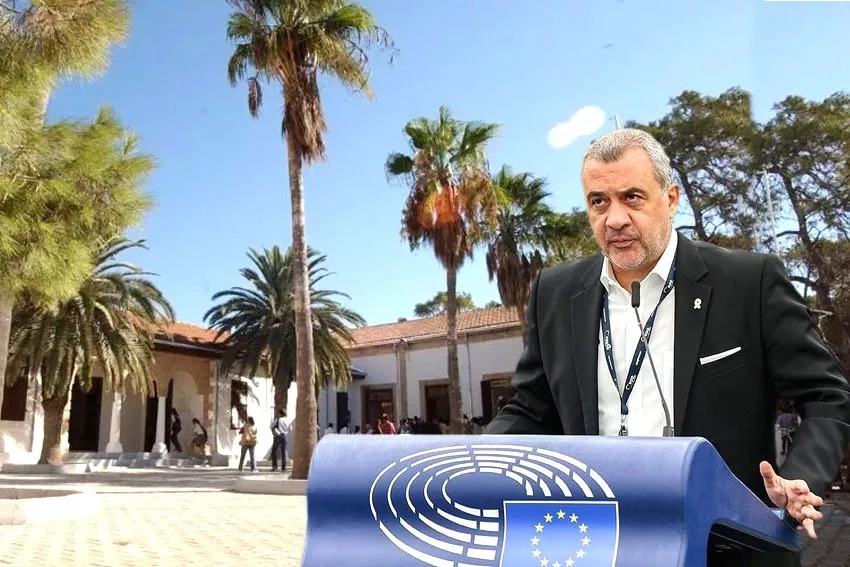
Only 15 students attend secondary school in occupied Rizokarpaso this year, where Greek Cypriots live under conditions of unfreedom and the Turkish Cypriot side continues to reject teacher placements and ban textbooks, according to a European Parliament Research Service report documenting decades of educational restrictions.
The report, titled “Enclaved students in Cyprus”, marks the first time an EU institution has formally investigated how Turkish occupation affects the enclaved community’s right to education. MEP Loukas Fourlas requested the investigation to establish human rights violations at the Rizokarpaso school.
The findings confirm that individual, educational and religious freedoms remain restricted by occupation authorities. UNFICYP continues to facilitate delivery of school books and teacher appointments to primary and secondary Greek Cypriot schools in the Karpasia peninsula, but the Turkish Cypriot side refused the use of seven Greek school books this year and rejected the appointment of seven teachers, creating problems for smooth operation.
Around 20,000 Greek Cypriots initially remained enclaved in Karpasia after the 1974 invasion. Their number gradually decreased over the years. Fewer than 500 now live in the occupied areas under enclaved status.
The report traces Cyprus’s history from the Republic’s establishment in 1960 through the Turkish invasion, noting Turkey’s occupation of approximately one-third of the island in the north.
It provides historical context on education for enclaved Greek Cypriots: no secondary school operated in Rizokarpaso until 2005, and for many years no lyceum existed for enclaved students.
Rizokarpaso secondary school first operated in 1917 but closed in summer 1974. It remained closed for 31 years until 2005, when classes resumed. A primary school has operated in the community since 1840. After the invasion, education took place under adverse conditions. Teacher Eleni Fokas remained enclaved to teach the area’s children.
Currently, 18 students attend primary school and 16 attend kindergarten, according to the latest recorded data.
The report references the Third Vienna Agreement and its violation by the Turkish side, which had committed to provide Greek Cypriots with all assistance to lead a normal life, including facilities for education, healthcare and religious duties.
Based on the findings, Fourlas has requested an on-site delegation from the European Parliament’s Culture Committee to witness conditions first-hand.
He made reference to the research last week to journalists in Strasbourg, stating it would be made public on 30 January and would provide a strong foundation for future reports and resolutions.
The report will serve as a permanent reference tool whenever the issue arises in the European Parliament.
It also addresses Turkish Cypriots living in the free areas, noting UNFICYP cooperates with the Republic of Cyprus government for their education and a request exists for a Turkish-language school in the free areas.
On the broader Cyprus problem, the report notes substantive negotiations have been suspended since 2017 following the Crans-Montana collapse. It makes particular mention of the 2004 Annan Plan referendum.
After its rejection, the Greek Cypriot side initially lost its moral advantage. However, the plan satisfied most Turkish demands and the majority of Greek Cypriots believed its implementation would lead to the dissolution of the legitimate state and a worsening of their position.
The report adds that the European Union did not show solidarity with the Republic of Cyprus, whilst its tolerance towards Turkey remains almost unlimited. This is attributed to Euro-Turkish relations and complex political and economic interests superseding solidarity and other fundamental EU values.
The Turkish Cypriot community will receive €33.7 million from the EU Aid Programme for 2025, aimed at supporting socioeconomic development and facilitating the Cyprus reunification process. From 2006 to present, the EU has allocated approximately €760 million under the same programme.
The investigation also addresses illegal universities in the occupied areas, noting corruption in the education sector in the “north” and that degrees from these universities are illegal and not recognised by any state except Turkey.

