


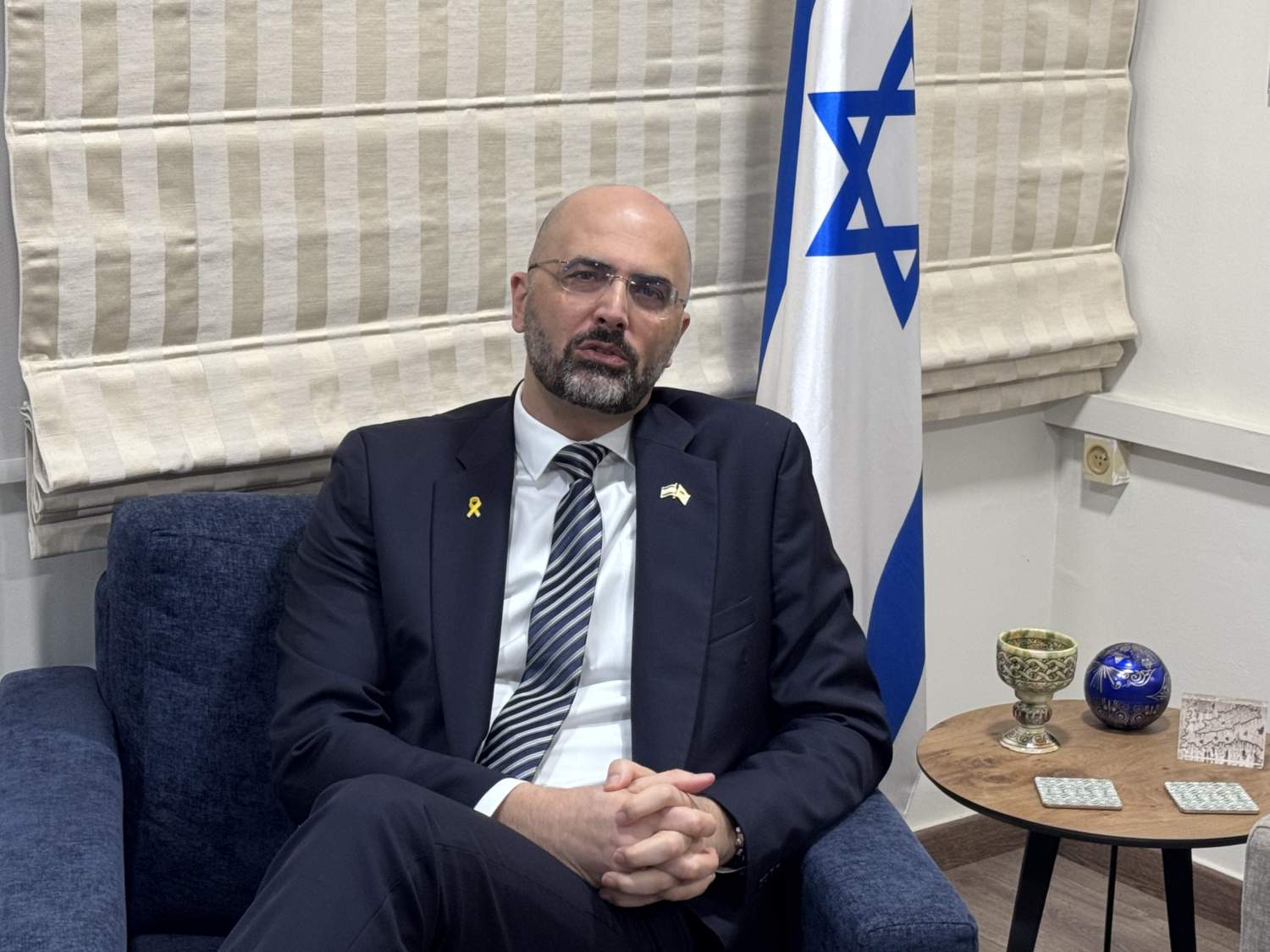
Israeli Ambassador to Nicosia Oren Anolik has signalled a breakthrough in the long-standing energy dispute between Cyprus and Israel over the Aphrodite and Yishai gas fields, predicting signatures by the end of March at the latest.
In an interview with Phileleftheros, Anolik acknowledges that progress has been slower than anticipated but emphasises that the finish line is now in sight. Representatives of the companies participated in the last negotiating round, which proved instrumental in advancing discussions, though one additional round may still be required.
The ambassador clarifies that whilst signing the agreements will not conclude the entire process, it will establish the fundamental principles of the solution. A special envoy is to be appointed for the division of resources, and whilst implementation will take time, the main obstacle will have been removed.
Beyond energy, Anolik addresses the escalating crisis over Iran, the future of Gaza, and EU-Israel relations. He underlines that Cyprus, now holding the EU Presidency, can play a constructive role by emphasising common ground rather than divisions. The EU, he argues, must re-examine its positions and engage with Israel as it would with friends and partners—through dialogue, not threats.
Considering that US military action in Iran appears to be imminent, what does Israel expect from Cyprus in a crisis scenario?
“Imminent” remains a hypothesis. Personally, I have no information. What we can examine is what is happening in Iran itself and how this brutal regime has treated its citizens. The numbers are unclear, but Iranian Health Ministry officials have already reported more than 30,000 deaths in three cities. It is now clear that the regime has brutally butchered its own citizens. This is what should be at the center of any discussion. The international community is horrified. The US appears to be preparing for different scenarios; everyone, as President Trump says, is “waiting and seeing.”
Iran’s capabilities, intentions, and its own perception of the threat will determine its response. We are preparing for different scenarios, both defensive and, if necessary, offensive. Our relations with the Cypriot government are excellent. There is room for consultation and communication, and I believe this will also be the case in the event of a new crisis.
Speaking of expectations, Cyprus holds the presidency of the Council of the European Union for the coming difficult months. How can Nicosia help to restore EU-Israel relations?
I will answer your question, but first let me say this, based on our good bilateral relations with Cyprus, and taking into account that our relations with the EU are complex and complicated, to put it mildly, we believe that the European Union needs to re-examine them, see the benefits it has from them, and talk to us as friends and partners. There are times when we feel that we are being threatened, which is not the kind of discussion we would like to have. We are open to dialogue with the EU and to criticism. We are willing to explain our positions and policies and we expect our partners to engage in this discussion without threats. We believe that this rhetoric, which until recently was still in the air, must be withdrawn. In this context, Cyprus can play a positive role as the Presidency, showing how this discussion can take place — with criticism, but with an emphasis on what unites us rather than what divides us.
A segment of public opinion in Cyprus considers that the relationship with Israel is not balanced, that Cyprus offers more than it receives.
In any relationship between two countries, there is an element of shared values and interests. And for both, in all relationships, there are certain elements that one side considers more important. So, Israel, for example, sells defense equipment to Cyprus. Is this “balanced” or the opposite?
On the one hand, it is right that Israel sells and Cyprus pays for what it receives. But Cyprus does not just receive weapons. Along with the necessary defense equipment, it receives connections, training, and know-how, elements that are particularly important. There are joint exercises between Cyprus and Israel. Both countries reap benefits. And not only in defense and security. In trade and investment, for example, Israel is Cyprus’s main source of refined fuels. In tourism, it is Cyprus’s second-largest market. There is also cooperation in health, with Cypriot patients being treated in Israel.
Overall, if you look at almost every aspect — climate, environment, defense, security, energy, economy, trade, medicine, human contacts, society, culture — you will find that there is cooperation in all of them. As a diplomat, I try not to say things that sound too firm, but I must tell you that I categorically reject this claim. I believe that it comes from a different starting point and that it is politically motivated. It is not based on facts or reality.
On the energy front, it seems that we are close to a final agreement on Aphrodite-Ishai issue. The question is how close.
We are close… And I know you have heard this before.
Yes, that is exactly what I was about to say. A few months ago, in early autumn, we were “close,” and then there was a setback.
No, I don’t think we ever had a setback. Just a delay. We are close. There has been progress, albeit slower than I would personally like. Representatives of the companies participated in the last round, which was very helpful. We may need one more round. I am more optimistic than ever and hope that by the time I complete my term in August, the agreement will be finalized.
You hope so. Do you also believe so?
The answer is yes, but we need to clarify what “finalised” means. Signing the agreements does not end the process, but it does establish the basic principles of the solution. A special envoy is to be appointed for the division, without his decisions being known from the outset, but the process will be known. Thus, the agreement will be final as a framework. It will take time to implement, with the main obstacle having been removed.
However, you expect the signing to take place before August. Is that the case?
I don’t want to make predictions. But from what I can see, much earlier than that.
Approximately? At the end of the day, you are just making an estimate. You are not the one conducting the negotiations.
Well, that’s a good argument. Look, from what I can see, I hope it will happen by the end of the first quarter. At the latest. I don’t want to hide behind diplomatic niceties. It’s just not in my hands. I cannot guarantee that it will happen. That is how I assess the situation from my point of view.
How much does the issue of the illegal sale of Greek Cypriot property in the occupied territories affect bilateral relations? Especially in light of the Aykut case.
First of all, I don’t want to downplay the importance of this issue for Greek Cypriots. It is fully understood. However, in the context of bilateral relations, it is not a major issue. Visit the website of the Israeli Ministry of Foreign Affairs. The Israeli government tells Israeli citizens: We advise you to refrain from purchasing real estate in the occupied territories. That is our policy. The two governments are almost on the same page. I say “almost” because the difference is that this violates Cypriot law, but it does not violate Israeli law. We can make recommendations to our citizens. And we do.
Is Jerusalem indeed in discussions with Nicosia to transfer Shimon Aykut to Israel to serve his sentence there?
I don’t think I can go into details about an individual. I can only say in very general terms, without referring to a specific case, that it is common practice in cases where we have Israelis in foreign prisons to try to bring them to Israel to serve their sentences. This is common practice with the EU; there is a treaty that regulates this issue. The individuals themselves must apply and request this, and we will try to facilitate the process. However, it is a decision that must first be made by the local government.
Yes, but that is punishable by law here, not there. So?
It doesn’t matter. It’s not a simple matter (the Aykut case). I’m not a lawyer, but as far as I understand, the issue is that he must serve the sentence handed down to him in the country where he is located. We are not substituting for the court.
Israel announced on Monday that the Rafah crossing would reopen, even though the remains of Hamas’s last hostage, Staff Sergeant Major Ran Givli, had not yet been found…
That is not correct. You know that, according to the agreement, Hamas had to return all the hostages. Nevertheless, we said that even if the body was not found, under very clear restrictions and conditions, the crossing would be opened.
But again, why should the opening of a crossing for humanitarian aid depend on something like that?
There is a misunderstanding here: Rafah is not about the flow of humanitarian aid. Aid has been flowing into Gaza since the agreement was reached; an average of 600 trucks enter per day, which is sufficient for the needs of the population, and that is why we do not see as much as we did before. The opening of Rafah is only about allowing people to enter and exit. You ask why it should depend on that? But that is what was agreed. The agreement provided for Phase A: a ceasefire, the IDF’s withdrawal to what is called the yellow line, the release of hostages, the return of all the dead, and the flow of humanitarian aid; all of these must be fulfilled in order to move from Phase A to Phase B. We complied with all of them.
But you know, Rafah is not the issue. Any future for Gaza depends on the “three Ds”: disarmament of Hamas, demilitarization of Gaza, and deradicalization of Palestinian society. This is the key to a better future for the people of Gaza — and Israel. In the past, Rafah has been misused for the transfer of weapons and for smuggling goods into Gaza, so it must operate with reliable security controls and in a framework that prevents arms smuggling and the strengthening of Hamas.
Israel does not accept Hamas for Gaza’s “day after” —, and that is understandable. But it does not accept the Palestinian Authority there either. So what is your proposal? Is there one?
Most people understand why Hamas cannot be part of the future, as it is a terrorist organization that has brought the greatest destruction to Gaza and does not believe in coexistence or peace. As for the Palestinian Authority, we do not currently see it as a credible partner due to corruption, weakness, and policies such as “pay to slay” and the incitement of hatred in the education system. To be a partner, you have to believe in it and be able to live peacefully.
What was discussed was a committee of technocrats — recently set up by the Americans — along with serious reform of the Palestinian Authority, which might put us on the right trajectory. I return to the “three As” because they are crucial: the disarmament of Hamas, the demilitaridation of the Strip, and real deradicalization of Palestinian society, because there is often a misconception, quite often, by many people (who don’t understand the situation. And they feel that the Gazans and Hamas are two completely disconnected entities, like somebody came from Mars and took over the poor population. It is not as if everybody in Gaza is a Hamas supporter.
But it also needs to be understood that there is a large portion of the population in Gaza that actually supports Hamas, the same way, unfortunately, that there was a large portion of the German society during the Second World War that was supporting the Nazi regime. You have to remove this fundamentalist, extremist ideology that is guiding the current leadership in Gaza, namely Hamas, and replace it with a more rational leadership that believes in coexistence and peace.
Is that possible?
It’s very difficult. It has been done in the past, but it’s not easy. A large part of the Palestinian population believes that “the Hamas way” is the right way, and ultimately, we have to deal with them.
What about the West Bank? Hamas seems to have higher support there than in Gaza today.
I am very cautious about any kind of opinion polls under undemocratic regimes. I don’t trust them. But yes, the Palestinian people as a whole, the last time they went to vote for anything, in 2006 in the elections for the Palestinian parliament, voted for Hamas. Hamas won both in Gaza and the West Bank. So that showed, at least at that time, that Hamas is part and parcel. It is not an external element. It comes from the Palestinian people.
Its policies are disastrous for the Palestinian people, and they are bad for us. Without that changing, without people realizing that this is destructive for the Palestinian people, it would be very difficult to make any kind of change. That is why we will not allow Judea and Samaria (editor’s note: the West Bank) to become a refuge for terrorists. That is why we act when necessary, sometimes in cooperation with the Palestinian authorities, because we will not allow what we saw in Gaza to develop so close to the center of Israel.
I was in Gaza two weeks ago, and I must say that the reality on the ground seems very distant from the peace plan. Do you think it will work, or does it need adjustments?
Israel supports President Trump’s plan for peace in Gaza because having a vision is extremely important. When you look at the situation on the ground, it is difficult to see how progress can be made, yes. And it is disheartening. It is not certain that the vision will be implemented as presented; there are doubts. However, it is important to say that there is a possibility and a choice. With the right choices, a positive course can be followed. Those who formulated it are not naive, they understand the difficulties and challenges. But they intend to show that there is hope. I am the ambassador of a country where, if one had seen Israel as it was several decades ago, it would have been impossible to imagine what it would look like today.
Is there any chance that Israel would accept a Turkish military or humanitarian presence in Gaza under any circumstances?
Prime Minister Netanyahu has stated very clearly: there will be no Turkish soldiers in Gaza. That is where we disagree with the US. It is also a matter of the composition of the advisory mechanism. That is as far as I can go. Unfortunately, Turkey has adopted a hostile stance toward Israel. Its statements and policies toward Israel, the policies it is implementing, e.g., banning trade, are not good signs. We would like a more functional relationship with Turkey, but that is its own decision. I challenge anyone to look up whether Turkey condemned Hamas on October 7. Can anyone really believe that this country, under the current circumstances, can help the Palestinian population of Gaza move towards a future that we consider better for both peoples?
Where do Israel and Cyprus actually stand in their relations?
Israel and Cyprus have excellent relations and are partners with common positions on many issues. I was fortunate enough to attend the Jerusalem Trilateral and its bilateral meetings, which demonstrated not only what we say, but how we communicate and understand each other. The joint statement includes tangible and achievable steps for cooperation, which are particularly impressive. Just last week, I dealt with four different delegations on aspects related to what was agreed at the Trilateral. I am optimistic: significant progress has been made, but we still have much more room.
What does the fact that such significant progress has been achieved even during these challenging years tell us?
I think the fact that we have managed to maintain this and continue, even during the difficult years, says something very important about the basis of these relations. These are real relationships. They are based on the genuine needs and interests of both countries.As I said before, I think both parties truly understand that this is beneficial. There is a genuine interest in continuing this. Again, that doesn’t mean we agree on everything. But because we see each other as partners and friends, we know how to work together even in more difficult times.
Read more:

