


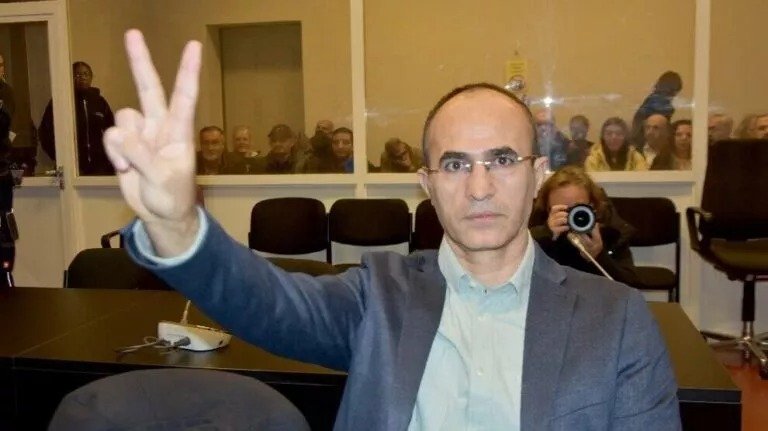
Kenan Ayaz‘s return to Cyprus faces obstacles due to negligence by German authorities, despite the Cypriot Ministry of Justice requesting his immediate transfer under Article 4(5) of Council Framework Decision 208/909/JHA.
The delay also constitutes a serious violation of Article 51 of the Charter of Fundamental Rights of the European Union.
Talking to Phileleftheros, he expresses heartfelt condolences to the family of Efstathios Efstathiou, who recently passed away, noting that he “dedicated his life to the struggle for the freedom of the Cypriot people, defending the values of Cypriot Hellenism”.
He also expresses gratitude to the Cypriot people, who “viewed this historic case as a matter of historical honour and approached it on that basis”.
Once again, he explains how the case was constructed against him to satisfy Erdogan. He denounces the German penitentiary system, expresses impatience for his return to Cyprus, and takes a position on developments in the Kurdish struggle.
He emphasises that the Cypriot government played a role in the theatre of absurdity that culminated in his conviction. He concludes, as always, with wishes for the liberation of Cyprus and Kurdistan.
Kenan, are you ready to return to Cyprus after the rejection of your appeal by the Federal Court of Germany?
The case concluded after two years, and the result was predictable. It was a case conducted by German justice to please Erdogan.
It resulted in a heavy sentence (4.5 years imprisonment) without any legal basis, and in reality, Germany and Europe betrayed democratic legal rights in order to please Erdogan.
I was tried for my thoughts in a political case. I am a victim of the German-Turkish strategic partnership, and if I weren’t Kurdish, I wouldn’t be on trial.
The decision in the case confirmed once again that Germany stands on the side of the Turkish state in the ongoing genocide of the Kurds. It arrests, deports, and torments Kurds while providing all kinds of political, military, and economic support to the Turkish state.
If Germany wanted to, it would have already initiated a peace process, and if it had recognised the democratic rights of the Kurds, we wouldn’t be talking about such an outcome today.
What are conditions like in German prisons?
I didn’t address my imprisonment conditions because I didn’t consider it ethical to place them above the serious problems facing our peoples in Cyprus and Kurdistan. Germany has a penal system that needs to be investigated.
It is inspired by the penitentiary system in Turkey, and because I was imprisoned there too, I realised that the real centre of the Turkish penitentiary system is located in Germany.
Even ordinary prisoners refer to German prisons as “white death” or “white torture”, with obvious isolation and separation methods designed to force a person to change their convictions.
This has been happening from the 1970s until today. For example, at every visit I received, there was an interpreter and a police officer. They wanted to make me feel like a criminal, dangerous.
I should add that the prison where I’m held has the highest number of suicides, but nothing is reported in the media. Just as in Turkey, so too in Europe, prisons do not comply with European law.
It’s difficult to survive, to live, to continue being human, but I try to draw inspiration from the historic resistance in the prisons of Diyarbakir (Amid). After all, when I came here, I said, “You can imprison me physically, but you can never imprison my heart and spirit”.
What do you think about during this entire period?
Under these difficult conditions, I reinterpreted the world through the window of truth, trying to understand it even more. I understood well the tragedy of the Cypriot people, focusing extensively on Hellenism.
I thought about the pogrom against the Greeks of Constantinople in 1955, analysed better the causes of the Asia Minor Campaign and Catastrophe, and wondered why the genocide of the Pontic Greeks is not recognised by everyone as genocide, like those of the Armenians and Assyrians.
I am ready to meet the people of Cyprus again with a big heart, spirit, mentality, and consciousness and to be an honourable child of both the Kurdish and Cypriot peoples. I was deeply moved by the images of the liberation of Palestinian and Israeli prisoners and wonder if I too will experience such moments.
What is your view on the news coming from Kurdistan and Turkey, particularly regarding the Kurdish issue?
The Kurdish people have taken their position by defining a new paradigm and a new roadmap.
Our people managed to create opportunities and promote alternative solutions to the existing chaos and did not hesitate to take risks and make moves, even though the Kurdish issue is based on the mentality and system of genocide and even though regional and global powers have created a framework in which Kurds cannot achieve anything whether they fight or not—a framework in which not even the right to survival is provided for the Kurdish people.
Kurds refuse to play the role assigned to them by the genocide system any longer. They want to escape the conflict situation, break the trap created by the forces of capitalist modernity, and free themselves from the grip of genocide.
This new movement will be difficult, but it must be done to subject Turkey and the Middle East to a process of change and reformation.
This includes Cyprus, because we are both part of a plan devised by similar forces. Neither did the Cypriot people manage to break and overcome the trap, and thus the fifty-year Turkish occupation is perpetuated.
In short, the Kurdish people developed a movement that will promote both their own freedom and that of other peoples, such as the Cypriots. By accepting the existence and democratic rights of Kurds, the policy based on genocide will be overcome.
How will this new process succeed? How is Cyprus involved?
Just as Kurdish renaissance was achieved in the early 1990s through armed struggle, now we must move to Kurdish freedom, and this movement will open the way for the freedom of the peoples of Cyprus and the Middle East, for the democratisation of Turkey, and for a system based on women’s freedom, social justice, and emancipation that will spread through Kurdistan.
It is a very ambitious effort, but it can succeed. The Turkish state can no longer delay or deceive the Kurds by pursuing the Ottoman agenda as it did in the past.
With fifty years of struggle behind us, the Kurdish people have gained significant experience, and the people of Cyprus should know that Kurds now constitute a strategic force in the region.
Finally, what is your message to the people of Cyprus and Kurdistan?
I have sent many messages to the people and government of Cyprus throughout this period.
The Cypriot government should explain this process against me to the people, although I understand that in the first stage, there was a significant manipulation campaign by Germany and events were distorted.
Now the trial has concluded and explanations are expected for aspects of the process in Cyprus and Germany.
The Cypriot people must know that the case against me has no basis.
From a legal perspective, I defend the values that the European Court of Human Rights also defends, while from a humanitarian perspective, I am Kurdish; my country was invaded and suffers genocide.
I have endured torture and believed that the oppressed would not oppress the oppressed. I did not invade Cyprus; I did nothing wrong. On the contrary, I sought refuge and was given it.
I was in mortal danger; I trusted Cyprus, and for some reason I was extradited to Germany. But because I believe in Socrates’ philosophy of virtue, I struggle for the truth to be revealed.
Unfortunately, it has become clear that the Cypriot government played an active role in the theatre of absurdity and owes an apology to the Cypriot people. It sacrificed me to look good to Turkey and Germany.
In conclusion, in light of everything I have stated, I embrace the precious people of Cyprus with great longing and love, send my greetings, love, and respect, and insist: Freedom for Cyprus, freedom for Kurdistan.

