


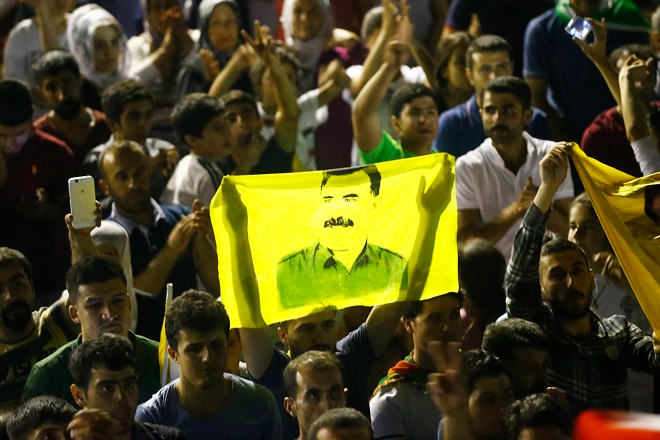
Duran Kalkan, a member of the Executive Committee and one of the current leaders of the Kurdistan Workers’ Party (PKK), has described the decision to end armed struggle and dissolve the organisation as “a new beginning”.
Kalkan was speaking at the 12th Extraordinary Congress, held between 5-7 May in Iraqi Kurdistan. This historic congress was convened in response to the “Call for Peace and Democratic Society” issued by imprisoned leader Abdullah Ocalan on 27 February 2025.
The congress was attended by 232 delegates, including members of the PKK’s Executive and Central Committee, co-chairs and members of the Kurdistan Communities Union (KCK) Executive Council, members of the HPG Military Council, and others.
The congress began with a minute’s silence in memory of fallen revolutionaries, followed by Kalkan’s opening speech, in which he paid tribute to Haki Karer, Ali Haydar Kaytan (Fuat), Riza Altun and Sirri Surreyya Onder. Fuat and Altun were among the PKK’s founders (1978) and were killed in 2018 and 2019 respectively.
Kalkan compared the 12th congress to the first, speaking of a new beginning that would “properly position” the PKK. “The goal is to create space for new initiatives and opportunities,” he said. He referred to a strong determination to historically complete the party’s role, before the PKK Central Committee’s political report was read. This included an assessment of political and military processes, highlighting the impact of the PKK’s actions over the past fifty years and noting how these had revived a Kurdish identity that had been on the brink of extinction.
“The PKK marks a new era in Kurdish history and the birth of a new, free Kurdish identity in Kurdistan. The official founding of the party at the First Congress was a radical intervention against historical extinction and the declaration of a new era of freedom. The 12th Congress also completes the phase carried out through the PKK and aims to pave the way for a new era in this freedom history,” the report stated, adding that “the dissolution of the PKK’s organisational structure and the termination of its armed struggle as a fundamental strategy means opening the way for advancing the Kurdish freedom struggle and efforts for democratic society with new strategies and organisational forms.”
Today, Kurdish people are stepping forward again, exposing the Turkish regime and compelling the world to turn its attention there to lay foundations for a political solution to the Kurdish issue. The PKK is still considered a “terrorist organisation” by the US, NATO and the EU, and in the name of this absurdity, many Kurds are persecuted for their origin and political beliefs—our thoughts and hearts are with our brother Kenan Ayas, who is awaiting his appeal hearing in Germany.
The PKK has written a new history in the region, and if Ocalan had not been imprisoned in 1999—through that unbearable conspiracy—the map of the Middle East would be different today. The guerrillas created a new proposal, the foundations for Rojava, discussions about democratic confederalism, women’s liberation, social emancipation, and recognition of Kurdish identity.
Cyprus and Greece, even at an institutional level, should speak about this process, as a thank you to the PKK that has fought for more than 40 years on our behalf as well. Its heroes and guerrillas deserve a special place in the pantheon of history. Nothing has ended.

