


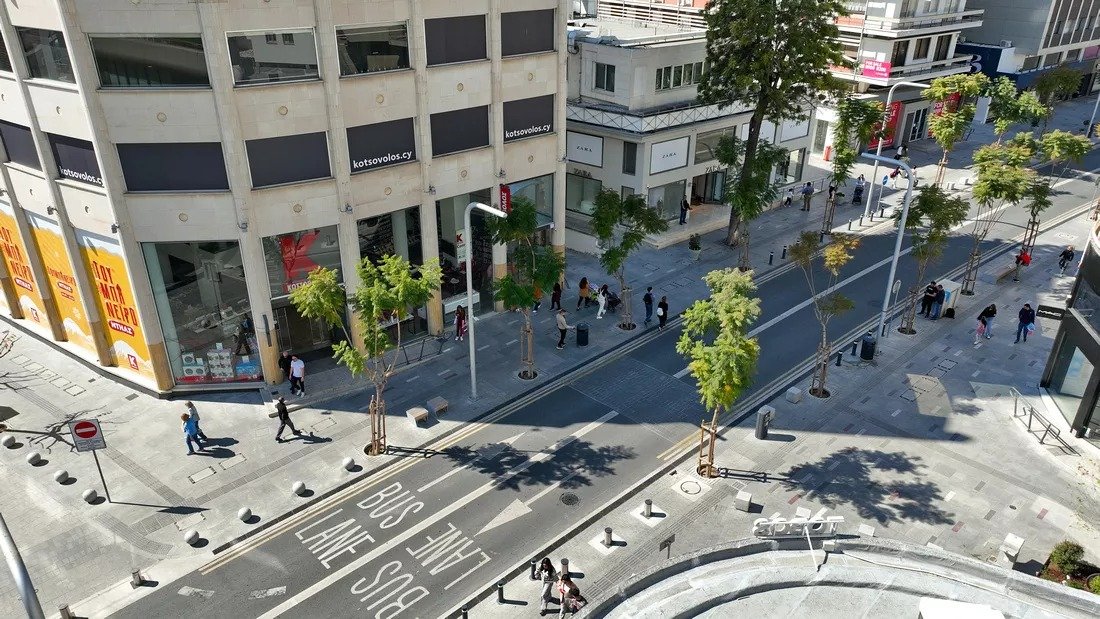
The reopening of Makarios Avenue in Nicosia to all vehicles has triggered significant concerns over EU funding and potential financial repercussions for Cyprus.
According to information obtained by philenews, the Nicosia Municipal Council’s decision has immediately drawn attention from the Presidential Palace, primarily because the project received EU co-financing, potentially exposing Cyprus to criticism from the European Union.
The Presidential Palace’s involvement may prove to be “the lesser evil,” as Phileleftheros has learned that the EU itself has already been informed through private individuals who had collaborated with EU bodies.
Financial implications
Beyond damaging Cyprus’s credibility, the decision is expected to have economic consequences. In similar cases involving other countries, the EU has demanded the return of provided funds. According to a reliable source, the EU contributed approximately €21 million to the Nicosia Municipality project.
The repercussions could extend further, as the Municipal Council’s unilateral decision might lead the EU to label the Nicosia Municipality as an “unreliable partner” for any future funding.
This means future municipal projects would not be eligible for EU co-financing, with grants coming solely from the Republic of Cyprus and indirectly from all Cypriot taxpayers.
A government source indicated that because the project was co-financed, it cannot be altered, reversed, or have its purpose changed in a way that distorts its original philosophy before five years have elapsed from the EU’s last payment/contribution.
Based on payment dates, the five-year period is considered to end after 2028.
If these conditions apply, the question remains where the Municipality will find the money to repay the EU and how it will be able to operate or implement infrastructure projects in the future.
Decision details
Government officials believe the decision serves individual interests. They estimate that with the reopening of Makariou Avenue, the number of vehicles will surge, returning the avenue to its pre-project state.
The avenue appears to be becoming car-friendly again rather than pedestrian-oriented, with many believing the negatives will outweigh the positives.
The complete reversal of the Makariou Avenue project came through a majority decision of the Municipal Council, adopting a proposal submitted by DISY. Besides DISY, the municipal groups of DIKO, EDEK, and ELAM voted in favour, while AKEL and the Greens voted against.
Nicosia Mayor Charalambos Prountzos opposed allowing all vehicles access to Makariou Avenue, essentially differing on the road’s weekend use, favouring its use as a pedestrian zone with only residents permitted to drive.
Prountzos had submitted a proposal that was not passed. Regarding weekday hours for all vehicles, the Mayor had proposed opening the road to all from 9am until 7pm.
According to the Municipal Council’s decision, all vehicles are permitted on weekdays between 7am and 9pm. From 9pm until 7am, the avenue will only be used by authorised vehicles, which are limited in number.
Given the limited traffic at night, the road will effectively be open 24 hours. Even if the night hours are considered “restricted,” the absence of surveillance cameras monitoring who enters and exits the road means enforcement by traffic wardens is unlikely.
For weekends, the Municipal Council decided to continue allowing buses, taxis, delivery vehicles, residents, and shopkeepers to use the avenue. Again, due to the lack of enforcement, the current situation is likely to continue, with almost all vehicles using the road 24 hours a day.
These regulations apply from the Lykavitos Police Station (Makariou and Spyrou Kyprianou junction) to Solomou Square.
Additionally, the Municipal Council decided to permit left turns on Mnasiadou and Bouboulinas streets, reasoning that large car parks operate there to serve the public.
Approval process
Implementation of the Municipal Council’s decision requires approval from the Chief of Police. When Phileleftheros contacted Police Headquarters for information on the Chief’s intentions, they were told there was nothing to announce at present.
The Municipality is expected to apply to the EU, which co-financed the project for environmental and related reasons, to secure its consent. Some had warned that changing the status would lead to recovery of funds approved by the EU.
However, municipal officials downplayed this aspect, believing at most a limited fine might be imposed.
It is worth recalling that the Nicosia Municipality, in promoting the redevelopment of the Makariou-Stasikratous-Evagorou Commercial Triangle (currently in progress), aimed “to make the urban commercial centre of the capital competitive, attractive, and friendly to people and the environment.”
The Minister of Transport, in an article dated November 17, 2023, indicated that “northern Makariou Avenue, after the correct intervention by the Nicosia Municipality, gives priority to people, walking, and the needs of pedestrians, to social life instead of cars.”
“Now, calm and relaxed pedestrian movement is promoted here, creating more attractive spaces for both commercial use and dining with outdoor seating, as well as for social events,” Vafeadis added.

