


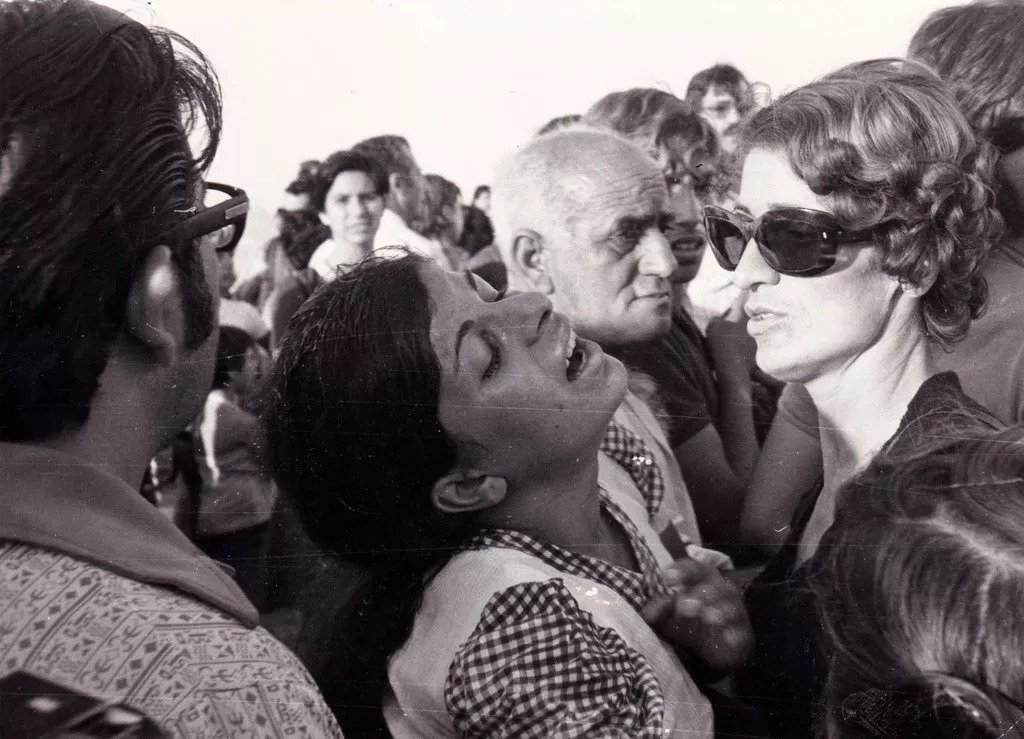
Yesterday marked another… anniversary, distant and forgotten by many. On 28 October 1974, the final prisoner exchange took place. On that day, fifty years ago, the last bus carrying the final Greek Cypriot prisoners arrived at the reception area at the Hotel Institute of Nicosia.
At that moment, for some, hope faded that their loved one would return through the prisoner exchange. For many families, that day marked the beginning of their long calvary searching for their missing person. From then on, the photograph they carried would never be “lowered”. They would no longer question released prisoners but would wander everywhere, seeking information, a truth that would sustain their hope.
In the 29 October 1974 edition of Phileleftheros, the reporting describes scenes of ancient tragedy that, even with the passage of time, touch those who remember: “Many who went to the Hotel Institute of Nicosia yesterday left with lightened hearts. They departed with their loved ones, whom fate had decreed would be the last to be released… We witnessed scenes of frenzied joy at the Hotel Institute. But ultimately, we left with a lump in our throats and hearts full of bitterness. For beside us, mothers, siblings, fiancées, spouses, and fathers walked towards the exit with trembling steps. Their loved one hadn’t arrived yesterday either. All they wanted was to reach home, isolate themselves in a small room, and grieve away from strangers’ eyes.
All these grief-stricken people were the relatives of thousands of missing persons who had gone to the Hotel Institute during prisoner exchanges, carrying a photograph and asking just one question with trembling lips: Have you seen him? Yesterday they went again – for the last time – with hope deep in their hearts that they wouldn’t need to show the photograph and ask. They stood to one side, and when the first bus approached, they fixed their gaze on the descending prisoners, struggling to contain their pounding hearts and the tears that flowed ceaselessly. Hope was the only thing keeping them standing…”
Other reports made special mention of then-Captain Andreas Fotiades and APOEL footballer Takis Antoniou, who inquired about his teammates whom he had heard in Turkish dungeons had been killed in battle. That day, 251 Greek Cypriots were released. By 28 October, under the Clerides-Denktash agreement, 2,448 Greek Cypriots and 3,319 Turkish Cypriots had been released. Of these, 550 Greek Cypriots chose to remain in their homes in the occupied areas, and 84 Turkish Cypriots stayed in the free areas. The agreement included the release of fewer Greek Cypriots and more Turkish Cypriots.
The final prisoner exchange had fully “opened” the chapter of the missing persons. Undeclared prisoners who didn’t return that day were recorded on a long list of missing people. Their families had begun the difficult and harsh struggle, an uphill journey, to find them. The state kept and still keeps files, with some soldiers’ testimonies of what they had seen or heard. Some files to this day contain not the slightest information. The story of the missing, five decades later, remains tragic, an open wound that continues to bleed.
Some relatives have passed away. Others received, decades later, some bones for burial. Some still wait for their loved ones. All still seek the truth. How were they lost, what happened to them? Most who were captured by the occupying forces were murdered. With a bullet to the head.
Yesterday was another… anniversary. A pivotal anniversary both for those who returned carrying a harsh, torturous history, but primarily for those who weren’t on the last bus.
Read more:

