


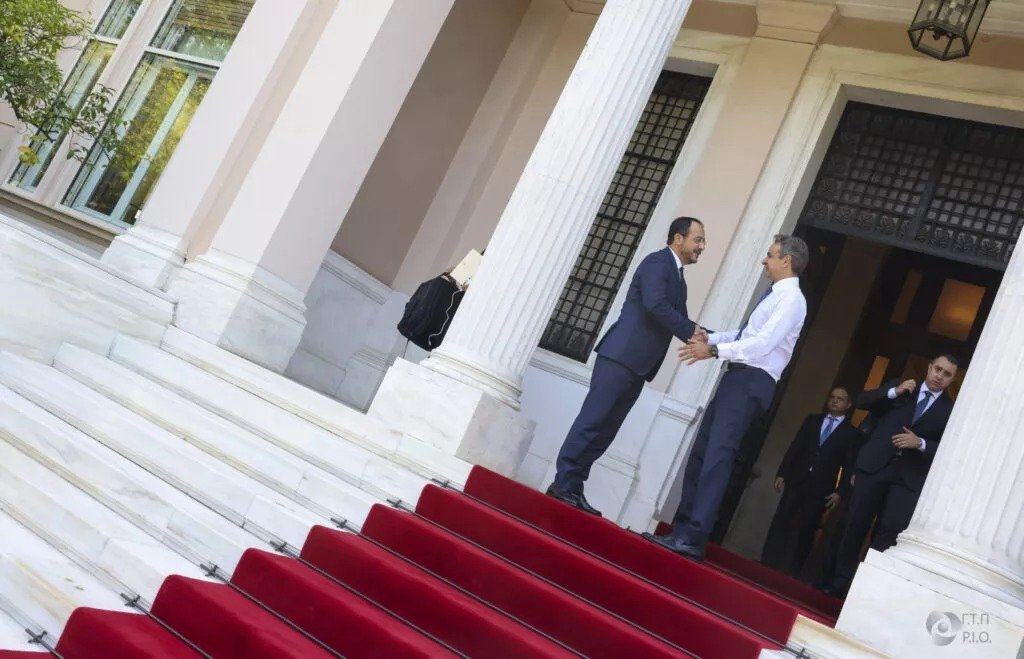
President Nikos Christodoulides and Greek Prime Minister Kyriakos Mitsotakis agreed that the inability to restart efforts on the Cyprus issue is due to the Turkish side and that the key to unlocking the situation lies with Ersin Tatar.
The Cypriot President and the Prime Minister of Greece had an initial exchange of views yesterday ahead of their trip to New York, where they will have meetings on the sidelines of the UN General Assembly.
Further coordination and discussions will take place during their stay, as most of their conversation yesterday focused on the electrical interconnection project.
During their brief interaction in front of cameras, President Christodoulides mentioned that they will be together in New York next week, which he described as a critical period.
He stated, “We will continue on the path we are demonstrating through actions, not words, to create the conditions for the resumption of talks.”
He continued, “For us, as I have said many times, the current situation is not a solution to the Cyprus issue. I am sure that through the normalisation of Greek-Turkish relations, we will contribute even more to what Greece and Cyprus have proven: that they are pillars of security and stability in this region of particular geostrategic importance.”
The Greek Prime Minister, welcoming the Cypriot President, emphasised the coordination between Athens and Nicosia ahead of developments on the Cyprus issue and the UN General Assembly.
“We will once again have the opportunity to conduct a comprehensive review of open issues at a time when, unfortunately, there is increasing concern about the escalation of conflict in the Middle East. Greece and Cyprus are two countries that are pillars of stability in a very turbulent geopolitical region of the planet. Especially at this juncture, our coordination is more necessary than ever,” Prime Minister Mitsotakis concluded.
In a statement, the Presidency of the Republic mentioned that the two leaders discussed the prospects of resuming talks to resolve the Cyprus issue, developments in Greek-Turkish dialogue, and regional developments, with an emphasis on the role played by Greece and Cyprus as pillars of stability in the region.
The leaders also talked about their upcoming trip to New York, where they will participate in the High-Level Week of the 79th UN General Assembly, as well as their meetings with the UN Secretary-General and foreign leaders.
In this context, the President of the Republic “reaffirmed his readiness and political will to restart negotiations for the resolution of the Cyprus issue, always based on UN resolutions and decisions, EU principles and values, and utilising the existing dialogue framework,” the statement said.
Meanwhile, on Wednesday evening, President Christodoulides, speaking at an event organised by the Federation of Cypriot Organisations in Greece, emphasised that the Republic of Cyprus, fifty years after the Turkish invasion, is not only not a defunct state but is an EU member state with a significant role in the Eastern Mediterranean.
President Christodoulides stressed that the messages sent by this event are that fifty years later, despite the wishes of some, the Greek people have not forgotten.
He emphasised that fifty years later, despite the efforts of some, the Republic of Cyprus is not only not defunct but is a proud member state of the European Union, taking on significant initiatives in the Eastern Mediterranean and the wider Middle East, demonstrating its role as a pillar of security and stability in practice.
He then dedicated the event as a token of gratitude from the Republic of Cyprus to the “Greek brothers” who came to Cyprus in 1974 and to all those who defended the independence and territorial integrity of the Republic of Cyprus.
“To all those who lost their lives on the front lines, to all those who are still missing fifty years later,” he added.
Concluding, President Christodoulides assured that as long as there is still an occupation, “we have an obligation, Cyprus and Greece, to do whatever is possible to achieve liberation and prove in practice that there are no lost homelands.”

