


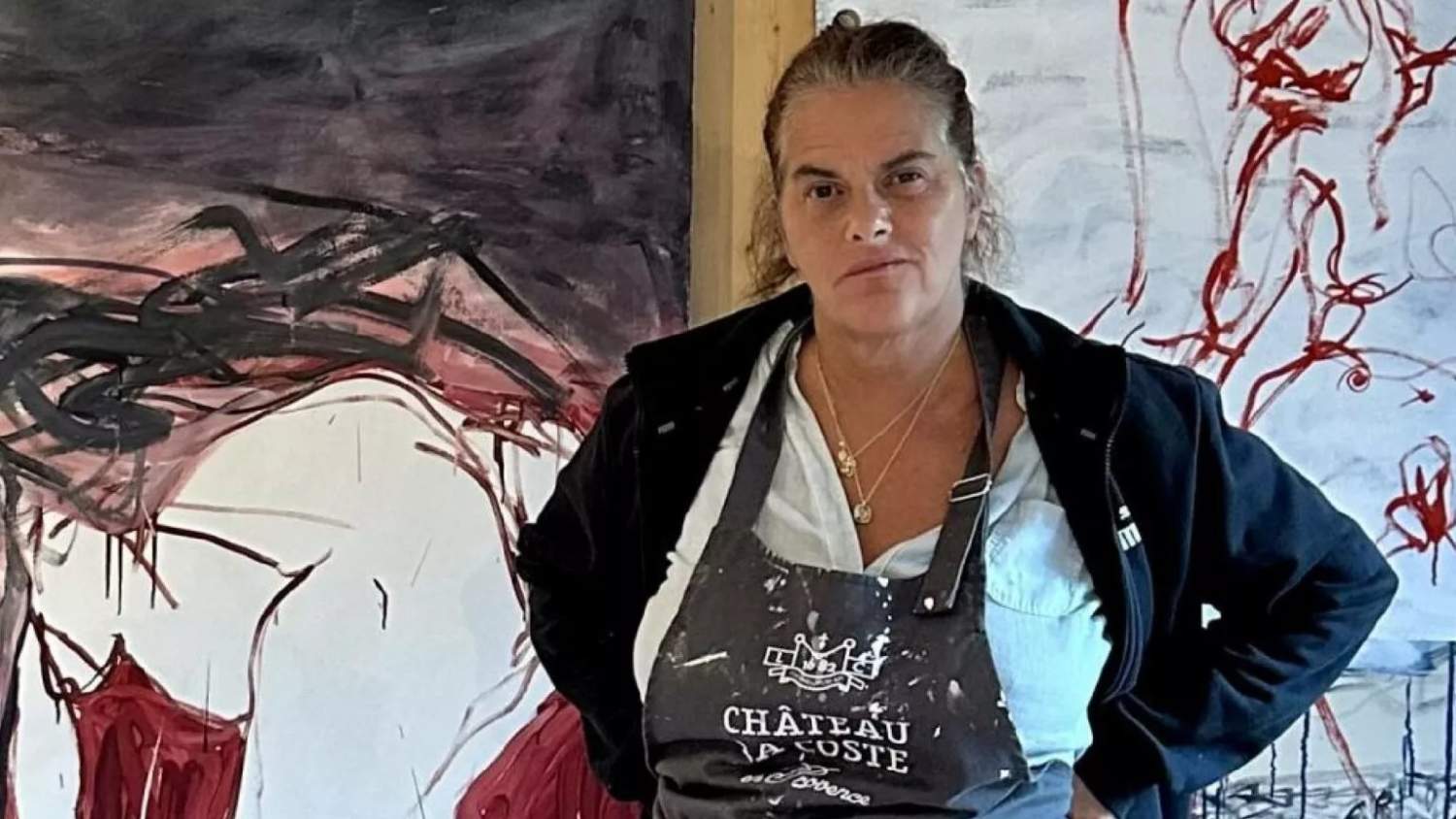
A landmark exhibition in London charts four decades of Tracey Emin’s groundbreaking career, bringing together defining works alongside pieces never before shown in public.
A conversation with two of the curators behind the Tate Modern retrospective reveals how the artist — of Turkish Cypriot heritage — continues to push the boundaries of art, using the female body as a powerful vehicle to explore passion, pain and healing.

“I feel that this exhibition, titled ‘A Second Life’, will be a landmark moment for me. A point in my life where I look back and move forward. A true celebration of life.” With these words, Tracey Emin — one of the most recognisable figures in contemporary art — returns to Tate Modern with a show spanning her 40-year career.
From the defining installations of the 1990s to recent paintings and bronze works making their public debut, the exhibition brings together more than 90 pieces, tracing the key events that shaped Emin’s journey and transformation. At its heart is her unflinching confessional approach to depicting experiences of love, trauma and personal growth.

Emin’s experience of cancer, surgery and disability is confronted directly in the exhibition, underscoring her refusal to separate the personal from the public. The show culminates in her exploration of a second life through painting — ambitious, large-scale works that, despite ongoing pain and heart disease, offer a sense of spiritual transcendence and an unambiguous determination to live in the present. International art curator Alvin Li and assistant curator Jess Baxter discuss the thinking behind the exhibition and their collaboration with one of art’s most uncompromising voices.
How was the decision made to title the exhibition A Second Life? What does this title mean to Tracey Emin on a personal level?
Tracey Emin came up with the title ‘A Second Life’, which naturally introduced a narrative structure to the exhibition that marked her cancer diagnosis, treatment and recovery as a crucial turning point. Following her experience of illness and surgery, Emin considers herself living what she describes as her ‘second life’, and she’s in the best place she’s ever been. The exhibition is very much Emin on Emin from a present-day vantage point; she revisits her entire trajectory as an artist from the point of view of now, having gone through a slew of traumatic events in life.

Emin’s deep connection to her hometown of Margate has been a recurring thread throughout her career. Do you know whether her background — both in England and her Cypriot heritage — has influenced her work in any way?
Tracey’s background has certainly influenced her work. The third room of the exhibition is centred on her relationship to her hometown of Margate and her family history. We want to shed light on oftentimes overlooked aspects of Tracey’s art and life, one being her engagement with her Turkish-Cypriot heritage from her father’s side. In much of Emin’s work, Margate becomes a metaphor for her hybrid identity. In the third room, the sound of the Mediterranean Sea, heard in the video Emin & Emin, overflows to permeate adjacent works such It’s Not the Way I Want to Die – an installation based on Emin’s memory of a rollercoaster she once rode as a teenager in Margate.

In what ways does the exhibition trace or embody the transition from her “first” to her “second” life?
Tracey Emin: A Second Life is the first exhibition to look at both ‘lives’ that Emin has lived and is living – the first before her cancer diagnosis, and the life after. The fracture she talks about is more than the disease she survived. The first life was replete with many hardships, whether that was overcoming the pain of sexual abuse, romantic heartbreak, or the traumatic abortion she had in 1990. Beating all of that – as well as cancer – has fuelled her art-making and absolute commitment to living every day to its fullest potential, now sharing this love for art and life in her school in Margate.

The Tate Modern exhibition tells these stories by contrasting newer works with earlier ones, spotlighting how Emin has always been preoccupied with those big, universal themes like love, sex, and death. This transhistorical way of looking also allows us to see much-loved and much-debated classics like My Bed 1998 in new light.
Emin’s experience with cancer, surgery, and disability is addressed directly in the exhibition, underscoring her refusal to separate the personal from the public. How did you collaborate with Tracey Emin in shaping this aspect of the exhibition?
Emin has been hugely outspoken about her cancer and the reality of living with a stoma bag. She has done a huge amount for charities, both locally and internationally. In terms of her art-making, you can see that the female figures in her works used to have high heels, stumbling around, shouting or lying on a bathroom floor, such as Keep your Darkness Away 2011. They had much more of an anguished charge to them, usually with an implication of abuse. They are harrowing and heartbreaking, the ambiguity leading you to fill in the blanks. As Emin returned to painting – she is first and foremost a painter, as this exhibition will show – the paintings still burst with emotion, but perhaps more reflective or spiritual, as in I watched Myself die and come alive 2023 or Your Beautiful Soul 2024, both in the final room of the show.

How does it feel to present her most intimate and vulnerable works to the public?
The vulnerability and intimacy of Emin’s groundbreaking work My Bed 1998 shocked people when it was first shown and it really changed the way we think about what art can be. Emin wasn’t trying to be controversial or confessional, she just painted or sculpted or wrote to reflect her true lived experience and way of being. And people who love Emin’s work can see and understand that, and they can learn more about themselves by looking at her art. In the exhibition, we’ll see My Bed in a new light, with the artist’s recent experiences of living with a sick body, or more generally in a world an age of bedrot or doomscroll. It will be exciting to see how Gen Z audiences will respond to the work – the heartbreak and bone-deep longing in Emin’s neons and paintings continue to be deeply relevant, particularly for women. Emin teaches us that ‘emotional’ parts of ourselves, regardless of gender, should not be diminished, but fully embraced.
Info: “Tracy Emin A Second Life”, is being exhibited at Tate Modern, London, from February 27 to August 31.

