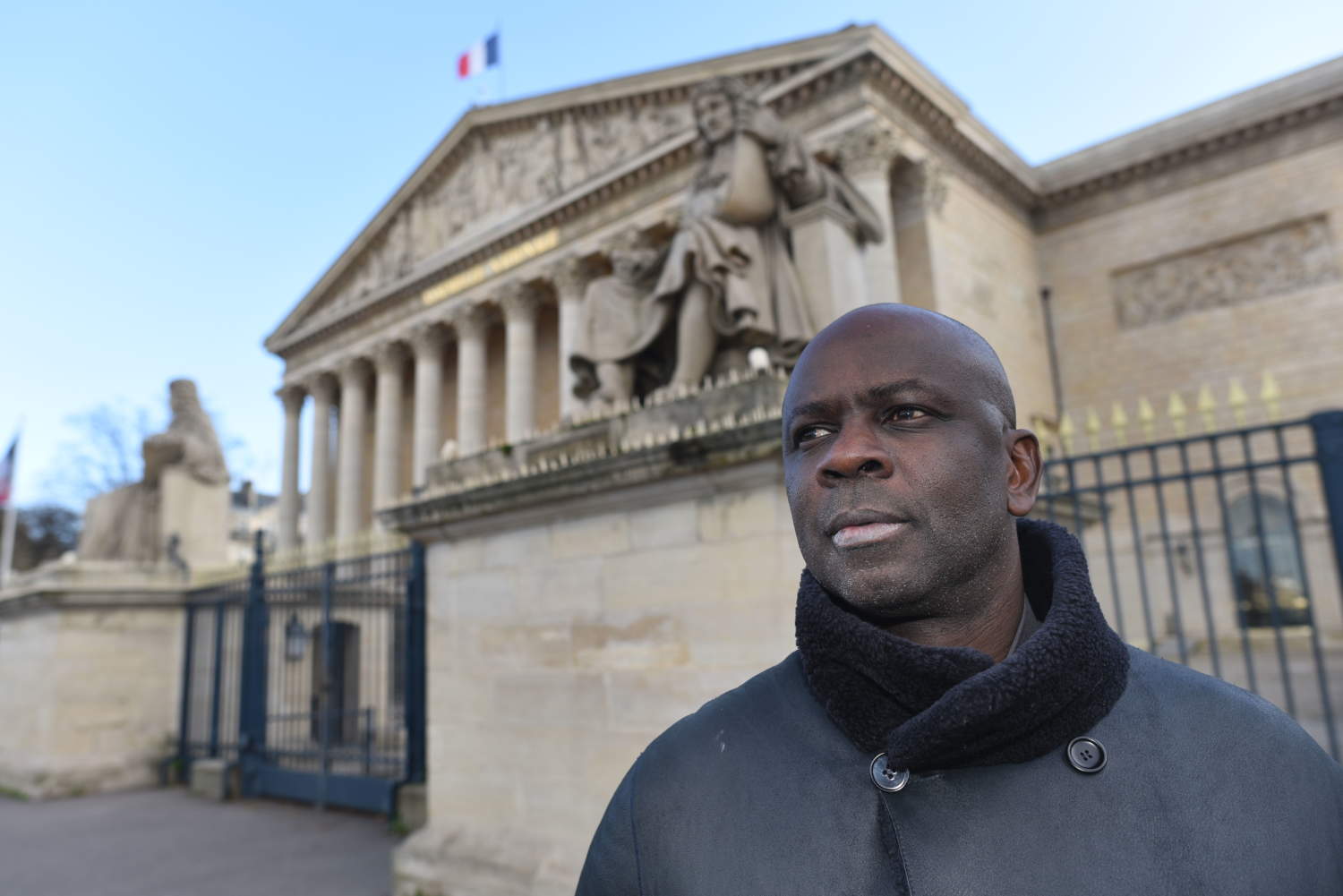
World Cup and European champion, author and activist. The man who became a global symbol of multicultural France as a member of its national football team is now determined to confront the darker chapters of that same national story.
Lilian Thuram was one of the most iconic defenders in football history. In 142 appearances for France, he scored just two goals – both in the unforgettable semi-final of the 1998 World Cup, securing his place in footballing history. Today, however, he has turned his attention to the fight against racism and inequality.
After retiring from football in 2008, he established the Lilian Thuram Foundation – Education Against Racism, for Equality. In his book White Thinking (La Pensée blanche, 2020), published in Greek by Antipodes, he challenges the notion of white supremacy and examines the historical forces that created and perpetuated racial inequalities.
Ahead of his visit to Cyprus for the 5th Limassol International Book Fair, Thuram speaks to Phileleftheros about the systemic and structural nature of racism, the importance of collective action and the struggle for equality.
When did you first realise that the racism you were experiencing was not an isolated incident, but part of a wider social phenomenon?
From the very first time it happened. I was born in Guadeloupe and moved to Paris when I was nine. In my final year of primary school, a child in my class called me a “filthy Black”. When I got home, I told my mother what had happened. She explained that this was simply how things were: racism existed and there was nothing we could do to change it.
What she was trying to tell me was that racism is systemic, that it exists throughout society. So, from that very first experience, I understood that racism was a reality I would inevitably have to confront.
In White Thinking, you examine how a belief in racial superiority, constructed over time, became a dominant system of values. What do you consider its most dangerous manifestation today?
Violence. Racism is directed against people who are regarded as inferior, and it continues to manifest itself through violence. But that violence is not always visible. It can be subtle, almost imperceptible to those who have never experienced racism or who fail to recognise it.
Last night, for example, I was with my niece. She told me she had gone to a restaurant with some friends and that they had been treated badly. She was very upset. I told her that when something like that happens, we need to find the courage to go and explain to people what happened.
So we went to the restaurant together and I spoke to the owners. Their first reaction was to refuse to listen to me.
That is precisely the problem: we do not want to confront the violence of racism. But my niece had experienced that violence, and she had every right to stand up for herself.
Beyond these everyday experiences, how is racism connected to more extreme forms of violence and to economic exploitation?
The violence inflicted on people is not always visible, particularly to those who do not understand what racism means.
There is violence that can go as far as murder. Just a few days ago in France, a white man took a gun and opened fire indiscriminately at black people. One person was killed and many others were injured. Racism is here. It is real, and it is visible.
But there is another form of racism, just as real, that is much harder to recognise. We live in a world where we can communicate through Zoom, where we have mobile phones and batteries, yet we rarely stop to think about what lies behind their production.
You can see this other form of violence, for example, if you go to the Congo. There, capitalism creates conditions in which people are exploited and raw materials are plundered.
This is one of the fundamental mechanisms that sustain racism. That is why I insist that when we talk about racism, we must also question the economic system that depends on it and keeps it alive.
The far right is gaining ground in several countries. Do you believe racism is making a comeback, or has it never really ceased to be a structural feature of our societies?
Racism has shaped our societies for centuries, and it continues to do so. It is an integral part of the modern world. You can see this, for example, in the way we tell history.
People all over the world are fascinated by the United States, aren’t they? It is held up as a model country, with a globally dominant culture. Yet that country has a terrible history to tell.
We are told that Christopher Columbus discovered the American continent. That is an enormous lie. There were already people living there. Those who subsequently arrived wiped out 90 per cent of the indigenous population.
So this supposed model country was built on the ashes of a genocide. There was a process of population replacement, which was also connected to the forced transportation of men and women from Africa to be enslaved.
Another population replacement followed with the arrival of Europeans, and ultimately we came to think of it as a white country.
How does Europe’s colonial history influence the way we understand Western values today?
This narrative shapes how we approach world history: Western colonial expansion, the seizure and exploitation of people and territories. My country, France, colonised many parts of the world. French colonial rule came to an end in the 1960s. That was practically yesterday.
I often think about the fact that my grandfather was born in 1908, just 60 years after slavery was abolished in France. My mother was born in 1947, at a time when my country, France, was still colonising other countries. A year later, in 1948, apartheid was introduced in South Africa.
The very countries that accepted and supported apartheid also helped draft the Universal Declaration of Human Rights. So this declaration is, above all, a declaration of the rights of white people. Do you see what I mean?
Apartheid did not finally come to an end until the early 1990s. Racism, therefore, has always been with us.
How do you explain the resurgence of racism in today’s societies?
The resurgence of racism we are witnessing today, which we tend to regard as something new, is linked to the fact that non-white people have become integrated into Western societies and are now seeking senior professional positions.
That is what some people find intolerable: their success, and their determination to move beyond the lowest rungs of the professional ladder. As long as they stayed at the bottom, there wasn’t much of a problem.
My mother was a cleaner. A black woman working as a cleaner is acceptable. What makes people uncomfortable is a black woman who wants to advance professionally, to become an executive, a lawyer, a doctor or to seek high political office.
Can the universality of human rights ever become a reality when the value of human life and international solidarity are not recognised equally for everyone?
There is a desire to make this principle more widely applicable, and I believe that is extremely important.
But we must recognise that it is not yet a reality, and that we have to work to make it one.
I am French, and my country’s motto is “Liberty, Equality, Fraternity”. That does not mean these values have been fully realised. It does mean, however, that there is an aspiration to make them a reality.
That is why we must stand alongside those who challenge inequality, so that one day these values can acquire real substance.
Has liberal Europe genuinely come to terms with its colonial history, or does it continue to avoid a meaningful confrontation with its past?
The hardest thing for any human being is to find the courage to look in the mirror and confront who they really are. That is particularly difficult for people in the West.
I would liken the Western world to a deeply narcissistic person: someone who invents stories about themselves, inflicts violence on others, yet simultaneously demands their admiration and wants to be regarded as superior.
But it cannot face itself, because doing so would bring down the world it has built.
The West has cultivated an image of itself as the light of the world and the cradle of civilisation. Yet there is another reality: the Western world has inflicted extreme violence on other populations, as well as within its own societies.
That is why we need to tell the history of this violence, so that we can strip it of its legitimacy. After all, racism is a form of violence. The West has effectively legitimised the idea that violence is acceptable.
As long as we continue to reproduce it, encourage it and glorify it, what we are really glorifying is the death of others. And yet, men who committed massacres in the colonies are still regarded as great figures and honoured to this day. It is astonishing.
If we examine colonialism, can we also recognise its legacy in contemporary forms of economic exploitation?
It is difficult to confront the West’s colonial history because doing so forces us to examine what came afterwards and what is happening today. We then realise that the violence has never disappeared.
Let me return to the example of the United States, because for many people it represents the success of the Western world. American companies are privatising and appropriating water resources in other countries, reserving water to cool data centres. As a result, local communities are deprived of access to a precious natural resource. We live in an insane world!
I recently learnt that a company had tried to privatise an entire river. Can you imagine that? This is another side of the Western world.
When I speak about the West, I am not talking about individuals, about you or me. I am talking about the economic system that has come to dominate: capitalism and economic liberalism. Global warming is directly linked to this model. We need to recognise the violence it produces.
And this is one of the reasons we find it so difficult to examine the past: because if we truly confront it, we will be forced to see clearly what is happening today.
During protests in France, many were quick to blame immigrants, Muslims and foreigners for outbreaks of violence. How do you respond to this?
First of all, this is a far-right narrative, and we need to be extremely careful when repeating it. I wonder why we so readily accept what the far right says, forgetting that its claims are not necessarily facts and do not represent everyone’s views.
There are many people who do not perpetuate these defamatory stereotypes. But since you have asked the question, I will answer it.
I firmly believe that the greatest form of violence in France today is the deterioration of public services. People have taken to the streets because they cannot take any more. Poverty is spreading. More than ten million people are living in poverty, and more than four million are living in inadequate housing. Hospitals and schools are deteriorating. That is the real violence.
And there is another form of violence that goes largely unmentioned: tax evasion by the powerful, while the super-rich grow ever wealthier and the gap between them and the poorest continues to widen.
Why is the image of the foreigner as a threat so often cultivated in political discourse, and what purpose does it serve?
Portraying foreigners as a threat is nothing new. But when foreigners are not the target, poor people take their place. The idea is cultivated that the poor are responsible for society’s problems. It is a mechanism designed to divert attention.
Throughout history, there has been class struggle within society. To prevent that struggle from developing, to stop the majority from turning against the wealthiest and demanding a fairer redistribution of wealth, an image is constructed of poor people as the source of society’s problems, as people who supposedly exploit the system.
Exactly the same mechanism comes into play when foreigners are targeted. They are portrayed as the source of the problems, when the real cause lies in the unequal distribution of wealth between those who possess it and the vast majority of society.
Do you believe fame brings responsibilities towards society?
I believe fame should be put to good use. And if it is going to serve a purpose, that purpose should be to try to make society better. But that is not a responsibility that belongs only to famous people.
What we must all do, whether we are famous or not, is think seriously about the kind of society we want to live in. And we should encourage people to reflect on that question.
France’s victory at the 1998 World Cup turned the national team into a symbol of a multicultural and united country. How well has that vision stood the test of time?
Whenever there is a great triumph, whether in football or any other field, everyone wants to feel part of it. Victory gives people a sense of pride and, in a way, strengthens their self-esteem. They want to be on the winning side.
Our victory was pivotal for many people who, until then, had been denied the right to feel French. At that moment, some children began to feel that they truly belonged to their country. Those children grew up and had children of their own. Now they are raising them with a different message: there was a time when we were not considered French, but today we are.
I found it very moving and encouraging to see so many young people carrying the French flag during the recent demonstrations in France. What we are experiencing today is also connected to the attitude of this generation. They want to show just how French they feel, and they are demanding equality. They are no longer willing to remain on the margins, making no demands, as previous generations did.
Football brings together people from different ethnic and social backgrounds. What responsibility does the sport itself have to protect them from discrimination?
Most footballers come from disadvantaged social and economic backgrounds. Many have experienced discrimination since childhood, whether because of the colour of their skin, their religion or their economic circumstances.
As they grow older, they need to find the courage to speak about their own journeys and the difficulties their families have faced.
That way, the public conversation can also include the voices of people who have experienced poverty. This is precisely what is missing from our society: we never listen to poor people.
If we gave them a platform and allowed their voices to be heard, perhaps we would live in a fairer society.
Shouldn’t sporting, economic and political institutions be doing more to tackle discrimination?
As a rule, institutions exist to protect the established order. In football, their priority is to safeguard the sport’s image and commercial appeal by presenting everything as though it is going well.
They are afraid that if they begin speaking openly about the problems, some supporters might turn away from football, leading to a loss of revenue.
So many choose to avoid confronting the reality of racist violence in football. It is always easier, and more convenient, to deny that a problem exists.
That is why the people at the heart of the game must speak out. Often, they are the ones who can put pressure on institutions and force them to change.
Lilian Thuram at the Limassol International Book Fair
Lilian Thuram will be on the Main Stage of the 5th Limassol International Book Fair on Saturday, 21 November, at 10am. He will take part in an open public discussion with Vangelis Gettos, an arts and culture expert at the Center for Social Innovation.
The discussion will be followed by a book signing and an opportunity for readers to meet the author.
Special thanks to Vangelis Gettos for his invaluable contribution to making this interview possible.
(Cover image source: Hans Loucas)