


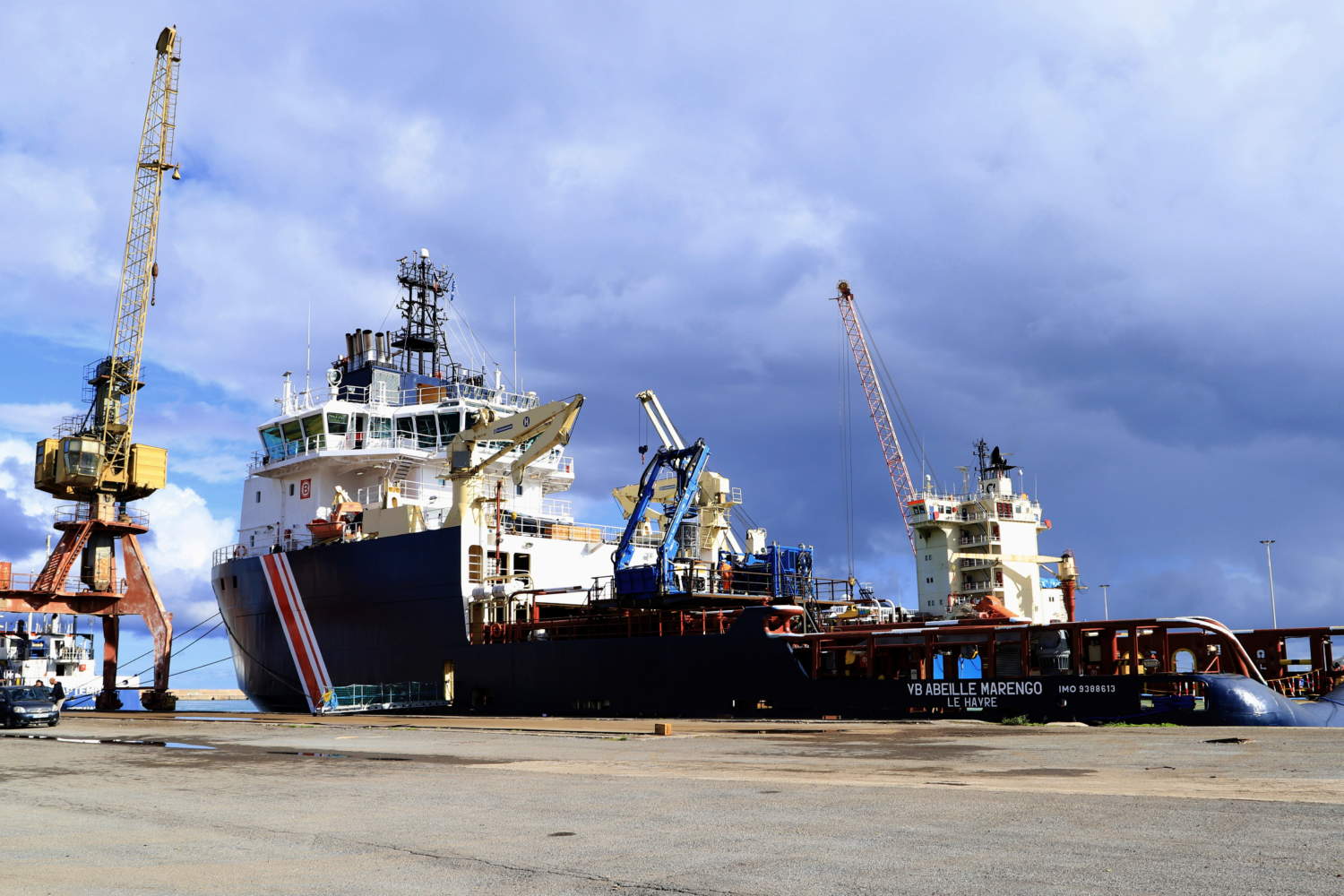
Preparatory work for the electricity interconnector between Greece and Cyprus has resumed amid heightened diplomatic tensions. Cyprus, Greece and Turkey have been exchanging NAVTEX notices and counter-notices, each seeking to gain the upper hand in a high-stakes dispute.
Speaking to Phileleftheros, Maria Gavouneli, a professor at the Law School of the National and Kapodistrian University of Athens and deputy director of the Research Centre for Public International Law, explains that NAVTEX notices are navigational warnings issued to mariners and do not, in themselves, establish sovereign rights. However, this “paper war”, as she describes it, allows states to put their claims on record so that they can invoke them if a dispute eventually reaches an international court.
Turkey, she says, is trying to shape public perceptions while placing obstacles in the project’s path, potentially even bringing it to a halt. According to the Greek international law expert, Ankara is attempting to achieve this by shifting the legal basis of the dispute and portraying the operations as marine scientific research, which she argues they are not.
“Turkey’s claims are completely baseless. Greece and Cyprus want to lay a cable and determine where on the seabed to place it. That is clearly not marine scientific research,” she says.
Athens and Nicosia, Gavouneli argues, have the means to support work on the Great Sea Interconnector (GSI), both through their presence at sea and with diplomatic backing from their allies. The challenge is to make clear that the interconnection will go ahead while keeping communication channels open so that any renewed intervention does not escalate into a crisis.

We have been hearing a great deal about NAVTEX notices recently. What exactly are they? Who can issue them, how legally binding are they and which maritime areas do they cover?
NAVTEX notices are simply navigational warnings issued to mariners.
Whenever an activity is taking place at sea – whether in a state’s territorial waters, another maritime zone or on the high seas – a NAVTEX notice is issued if the activity is being carried out by a vessel flying that state’s flag, or on its instructions, and could interfere with other vessels’ freedom of navigation.
In simple terms, it is a notice saying: “My vessel, or a vessel operating on my instructions, will be in this area carrying out a particular task, so please take care not to collide with it.”
A NAVTEX is not legally binding. It is simply a notification. And, of course, the use of a maritime area cannot continue indefinitely. It must be limited to a reasonable period, sufficient to complete the particular operation.
So disregarding a NAVTEX is not the same as violating a state’s sovereignty?
Absolutely not. A NAVTEX is simply a practical notice to mariners. Think of it as a warning, like a lighthouse out at sea.

What does it mean when a state issues an anti-NAVTEX?
Most of the time, it means very little. It is more of a “paper war”.
In most cases, every vessel or maritime activity must have a legal basis. You cannot simply go out into the high seas, remain in one place and announce that you intend to stay there for the next two years.
You must explain why you are there and justify your presence – for example, by exercising your right to lay submarine cables.
But someone else might come along and say that they also want to lay a cable in the same area. You then have competing activities.
Under the law of the sea, there are no mechanisms for determining who has priority. That means tensions and disputes can arise, and they frequently do.
It is a familiar “paper war”, and we have come to regard it as part of the process.
Does this exchange of notices serve any purpose?
Yes, in the sense that a country puts its demands and claims over a particular area on record.
If a dispute ever comes before an international court, all these notices can be used as evidence of the claims a country has made.
In essence, it is rather like a chess player moving pieces around the board to secure an advantage later on.
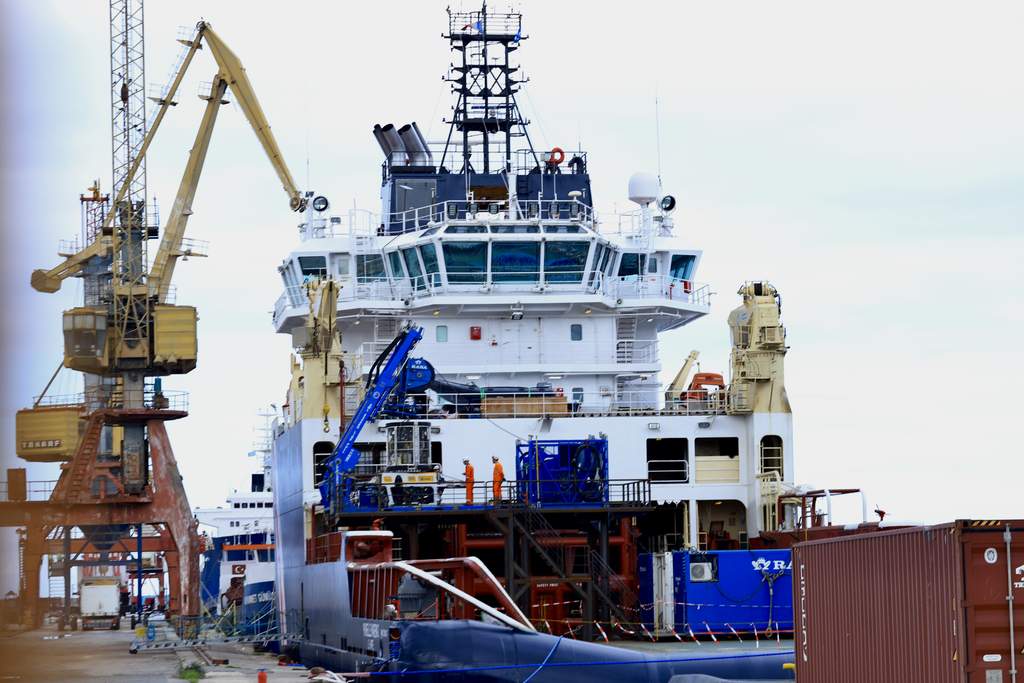
Turning to developments surrounding the GSI, we have seen the French survey vessel depart, signalling the resumption of survey operations. How significant is this development, and what are the next critical steps?
It is significant because efforts to complete the cable installation are getting under way again, and that is something we should be particularly pleased about.
Let me remind you that this is an important project of common European interest. It will connect the electricity systems of two EU member states, it is being financed with European funds, and it is being carried out by a company from another EU member state.
You could therefore describe it as a project carried out entirely within the EU.
Another very important point is that the operation is not over simply because the vessel has left port. On the contrary, we are still at the beginning.
The first phase involves completing the on-site surveys to establish exactly where the cable will be laid. That will take four to six months.
The second phase will involve the actual installation, with a vessel laying the cable on the seabed. That, too, will take considerable time because the Eastern Mediterranean is a very challenging region, both geographically and geologically.
The third phase, once the cable is in place, will involve bringing it into operation and establishing the electricity connection between Greece and Cyprus. This is expected to happen in 2030.
So, over the next four years, there will be plenty of opportunities for disputes. As you can imagine, every new development could prompt one side or the other to raise objections.
Ankara is playing with words
Turkey claims that the cable surveys are being conducted with its consent. What is Ankara trying to achieve, and what does international law say about this?
Turkey is doing something different this time.
It knows that laying a submarine cable is one of the freedoms of the high seas and does not require the consent of the coastal state, even if we assume, for the sake of argument, that Turkey itself is the coastal state concerned.
It knows that it has no legal basis for an objection on those grounds.
So it is trying to change the legal basis of the discussion. It now claims that this is not an exercise of a high seas freedom but marine scientific research, which, under the law of the sea, requires the consent of the coastal state.
Except that this is not marine scientific research.
In its first counter-NAVTEX, Turkey claimed that the necessary authorisation procedures were lacking.
Then, having apparently “forgotten” about authorisation, its latest NAVTEX explicitly refers to marine scientific research for which the Turkish authorities have given their consent.
We can all see that Ankara is playing with words, picking and choosing legal rules to suit its purposes.
And if those rules do not describe what is actually happening at sea, then so much the worse for what is happening at sea. That seems to be its approach.
And there is no one who can intervene, is there?
Turkey’s claims are completely baseless.
If Greece and Cyprus want to lay a cable and determine where on the seabed to place it, that clearly does not constitute marine scientific research.
Turkey makes whatever claims it wants and tries to gain whatever advantage it can.
We should also remember that international law has no central authority to determine whether a state can or cannot take a particular action.
We live in a horizontal legal system in which all states are simultaneously lawmakers, judges and enforcers of the law.
Taking a dispute to court requires consent, which means the likelihood of such proceedings is extremely low.
Can Turkey stop the work that has begun on the GSI? How should Cyprus and Greece respond if the interventions seen near Kasos in 2024 are repeated?
The work can only be stopped through the use of force.
Both Greece and Cyprus will be there to support the project.
The worst-case scenario would be to see frigates from both sides facing one another, with the situation eventually spiralling out of control.
The aim now, with the help of France, whose involvement moves the issue beyond a purely Greek–Turkish confrontation, is to overcome this obstacle without any of the three countries feeling, or appearing, to have lost.
Because in international law, it is extremely important not to be perceived to have lost.
That is why we are seeing this entire carefully choreographed diplomatic exchange, with verbal notes and notifications, allowing each country to maintain its arguments, avoid losing face and have something to say to its domestic audience.
How can Greece and Cyprus ensure that energy projects go ahead without every new development becoming another subject of Greek–Turkish negotiations?
There is no fail-safe mechanism, no magic solution that can guarantee that.
What is needed is persistence, consistency, caution and careful planning. We must not leave our vessels on their own. We need to back them up with naval power, with our navy.
We must send a clear message that this is going to happen.
Of course the Greek islands will be connected to one another, and of course two EU member states will be connected.
It simply has to be done in a way that prevents a dispute from escalating beyond control.
We also need strong allies, so that this does not become a recurring bilateral dispute.
We have to get the message across – and I believe we are succeeding – that this is a European project.

