


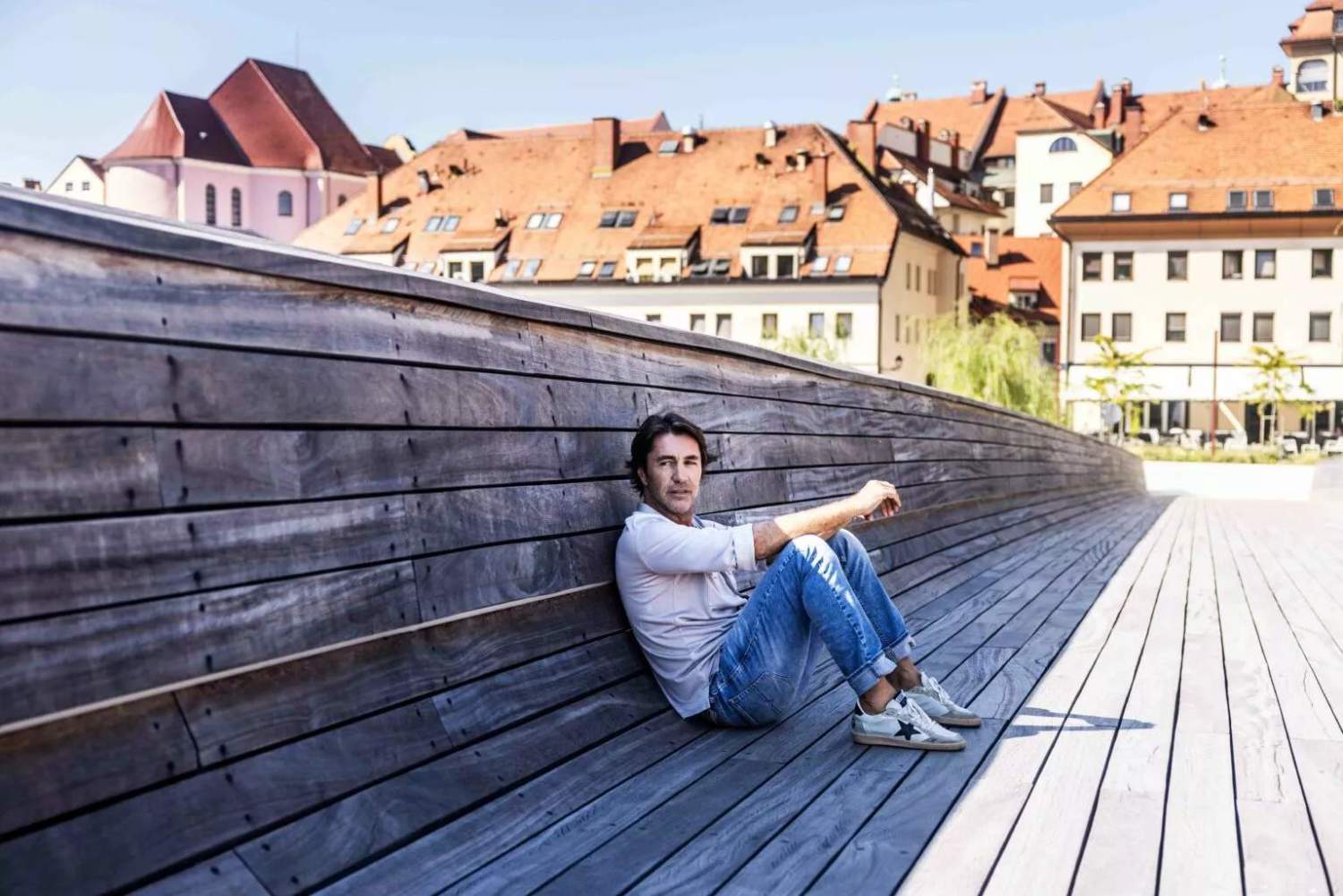
Internationally acclaimed choreographer Edward Clug arrives in Cyprus with the iconic Radio and Juliet, a work that has graced the world’s most prestigious stages and major festivals over the past 20 years.
What is your intention when you create a new work?
My intention is never to illustrate an idea, but to enter a state. I begin with a question, an image, or a tension that I don’t yet fully understand. Creation is a process of listening — to the material, to the dancers, to the space — until something essential begins to reveal itself. I am interested in works that don’t explain, but resonate.
How do you see your role in relation to a piece and its audience?
I see myself as a mediator rather than an author who dictates meaning. My role is to create conditions in which something can happen — emotionally, physically, imaginatively. The audience completes the work. Each spectator brings their own history, and that encounter is where the piece truly lives.
Where do you find the beauty of a work?
Beauty appears when necessity meets simplicity. When movement is unavoidable, when it feels truthful rather than decorative. Often beauty emerges in restraint, in silence, or in moments of fragility — when the body carries more than it can express.
When did you realise that dance was more than just an art form for you?
Quite early, but not suddenly. Growing up in a restrictive environment, dance became a language of inner freedom before I was conscious of it as such. Over time I understood that it was not only a profession, but a way of thinking, of surviving, of questioning the world.
How did the political and social context of the time affect the start of your career? Would you say that dance gave you a path to freedom?
Absolutely. It was a way out of the system. Some of the best Romanian dancers managed to escape abroad, and this became my goal at the age of 10, when I joined the ballet school in Cluj-Napoca. Dance offered me a path out of limitation — not only geographical, but mental. In that sense, dance was an act of resistance, even if it never declared itself as political.
Has success changed the way you approach your work or the expectations you have for yourself?
Success brings visibility, but it also brings responsibility. I try not to let it dictate my choices. The real challenge is to protect curiosity and doubt. I am more interested in staying vulnerable than in confirming expectations.
What does innovation mean to you today?
Innovation is not a goal in itself. If you chase it, it becomes empty. For me, innovation happens naturally when you are honest with your questions and attentive to the present moment. It is a consequence, not a strategy.
What has been your biggest challenge as a dance artist?
Remaining truthful while working within large institutional frameworks. Balancing artistic risk with structural responsibility — especially as an artistic director — requires constant negotiation.
Radio and Juliet is often called an “unconventional” performance. Why do you think it is seen that way? Was that your goal?
It was never about being unconventional. I think it felt different because it approached a familiar story through atmosphere rather than narration, and because it trusted emotional abstraction. The goal was intimacy, not provocation. Yet I agree — from a ballet-world perspective, you could say it is not what Shakespeare or Prokofiev had in mind.
Radio and Juliet has been performed internationally for many years. Do you think it communicates differently to today’s audiences?
Yes, and that is its strength. Each generation reads it through its own emotional landscape. The themes — love, isolation, loss — remain, but the context shifts. The piece ages with its audience.
Music plays an important role in your work. How do you choose it, and how does it shape a piece? Why Radiohead?
Radiohead is my favourite band, and it was a difficult decision to share my “intimacy” with the public. Music is structural, not illustrative. It defines rhythm, breath, and architecture. Radiohead carried an emotional intelligence and fragility that matched what I wanted to explore. Their music created space rather than filling it.
Is exploring new challenges essential to narrative ballet?
If narrative ballet does not renew its language, it risks becoming a museum form. The challenge is not to abandon storytelling, but to rethink how stories can be embodied today — through metaphor, through structure, through absence. Stories must engage the public, not simply entertain them.
How can dance stay meaningful in a world saturated with images?
By insisting on presence. Dance happens here and now, through real bodies, shared time, and risk. That cannot be reproduced or consumed in the same way as images. Its power lies in its ephemerality.
What is the place of European dance today?
European dance holds a strong tradition of conceptual depth and formal research. Its challenge is to remain open — to dialogue, to diversity, to other cultural perspectives — without losing its rigour.
Have you changed as a creator over the years?
Yes. I have become more patient, more attentive to silence, less interested in proving something. I trust intuition more, and I allow space for ambiguity. In many ways, I’m readier to learn, and my appetite is growing.
How important is storytelling in contemporary choreography?
We all need stories — stories that move us by moving dancers. Storytelling is essential, but not necessarily linear. I believe in emotional narratives, stories that are felt rather than explained.
What kinds of stories are missing today?
Stories of quiet transformation. Of inner conflict rather than spectacle. I am interested in narratives that deal with spiritual, ethical, and existential questions. Two days ago I saw the film Sentimental Value — I think it’s a good example.
What keeps you in Maribor, despite your international career?
Maribor is my ground. It offers continuity, depth, and a sense of responsibility. From here, I can work internationally without losing my centre.
What stage of your career are you in now, and what are you preparing for 2026?
The year 2026 marks an important step for me: my first opera staging, a natural extension of my choreographic work into a broader theatrical form. The premiere of Rameau’s Castor and Pollux will take place on 19 March at the Grand Théâtre de Genève. My next full-length ballet has its starting point in my land of origins, Transylvania, and will premiere with the Bayerisches Staatsballett in Munich on 25 November.
Info: Radio and Juliet and Proof will be presented in Limassol at the Pattihio Municipal Theatre on Friday 13 and Saturday 14 February at 8.30 p.m.
Tickets: soldouttickets.com.
Media sponsor: Phileleftheros
(Featured image by Josh Gantar)

