


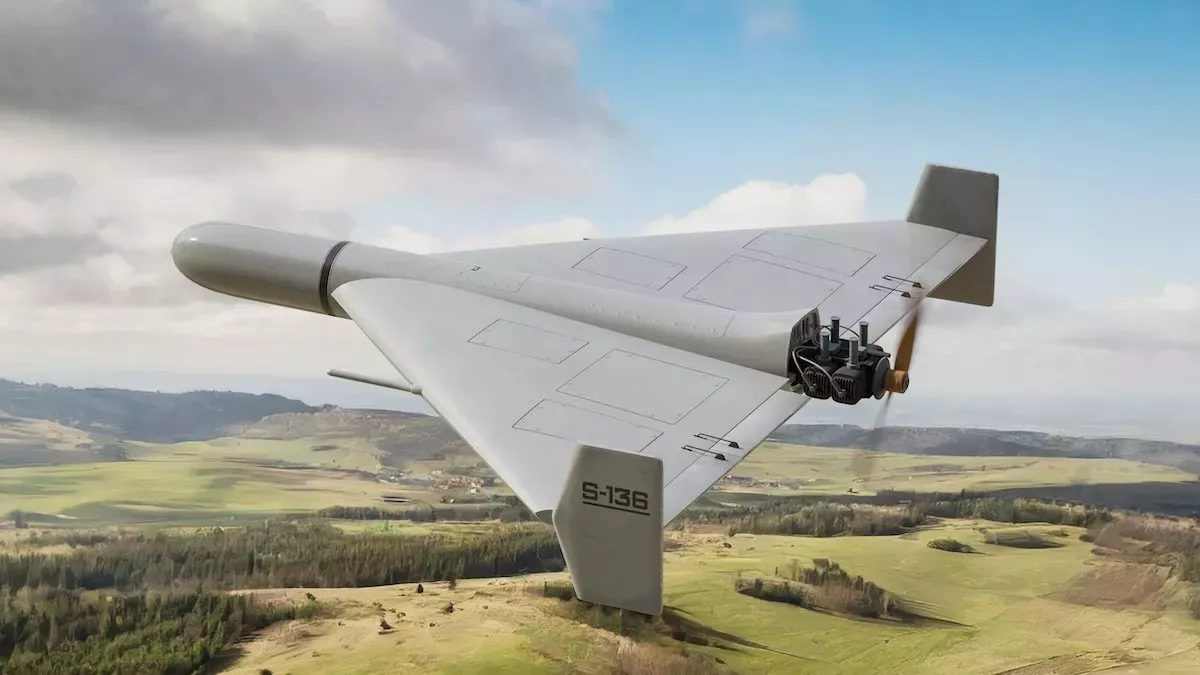
The explosion that rocked the British Sovereign Base at Akrotiri after midnight on Monday was caused by a Shahed 136 “kamikaze” drone, a low-cost but highly effective Iranian-designed weapon system.
Officially known as a “loitering munition” or “one-way attack drone,” the HESA Shahed 136 functions as a hybrid between an unmanned aerial vehicle (UAV) and a guided cruise missile. Its use against a strategic facility like RAF Akrotiri highlights how these systems are reshaping modern hybrid warfare.
Technical Specifications
The Shahed 136 is designed for one-way missions, meaning it is a disposable munition rather than a returnable aircraft. Its key physical features include:
- Dimensions: A delta-wing body approximately 3.5 metres long with a wingspan of 2.5 metres.
- Weight: Total weight of around 200 kg, carrying an explosive warhead of 40–50 kg at the tip of the fuselage.
- Navigation: Uses a combination of GNSS/GPS and inertial navigation systems (INS) to fly autonomously toward pre-programmed coordinates.
Tactical Advantages
The primary threat posed by the Shahed 136 lies in its operational efficiency and economic impact:
- Extended Range: Despite its simple design, analyses suggest it can cover distances of 1,000 km or more, allowing it to strike targets far from its launch site.
- Swarm Tactics: Its low production cost—significantly cheaper than traditional cruise missiles—allows operators to launch dozens or hundreds simultaneously. This “swarming” technique is designed to overwhelm enemy air defences and exhaust their interceptor stockpiles.
- Launch Flexibility: The system can be deployed from stationary ramps, trucks, or improvised mobile units, making it extremely difficult for intelligence services to locate and destroy launch sites before an attack begins.
Impact on Cyprus
Initial reports and unconfirmed security sources indicate that the strike on the Akrotiri airbase was carried out by this specific class of “suicide” drone. The incident proves that the operational reach of these systems has expanded beyond regional border conflicts into the broader geopolitical environment.
By utilizing low-cost, long-range technology, state and non-state actors can now challenge sophisticated anti-missile umbrellas and strike strategic installations with high intensity and relatively low financial risk.

