


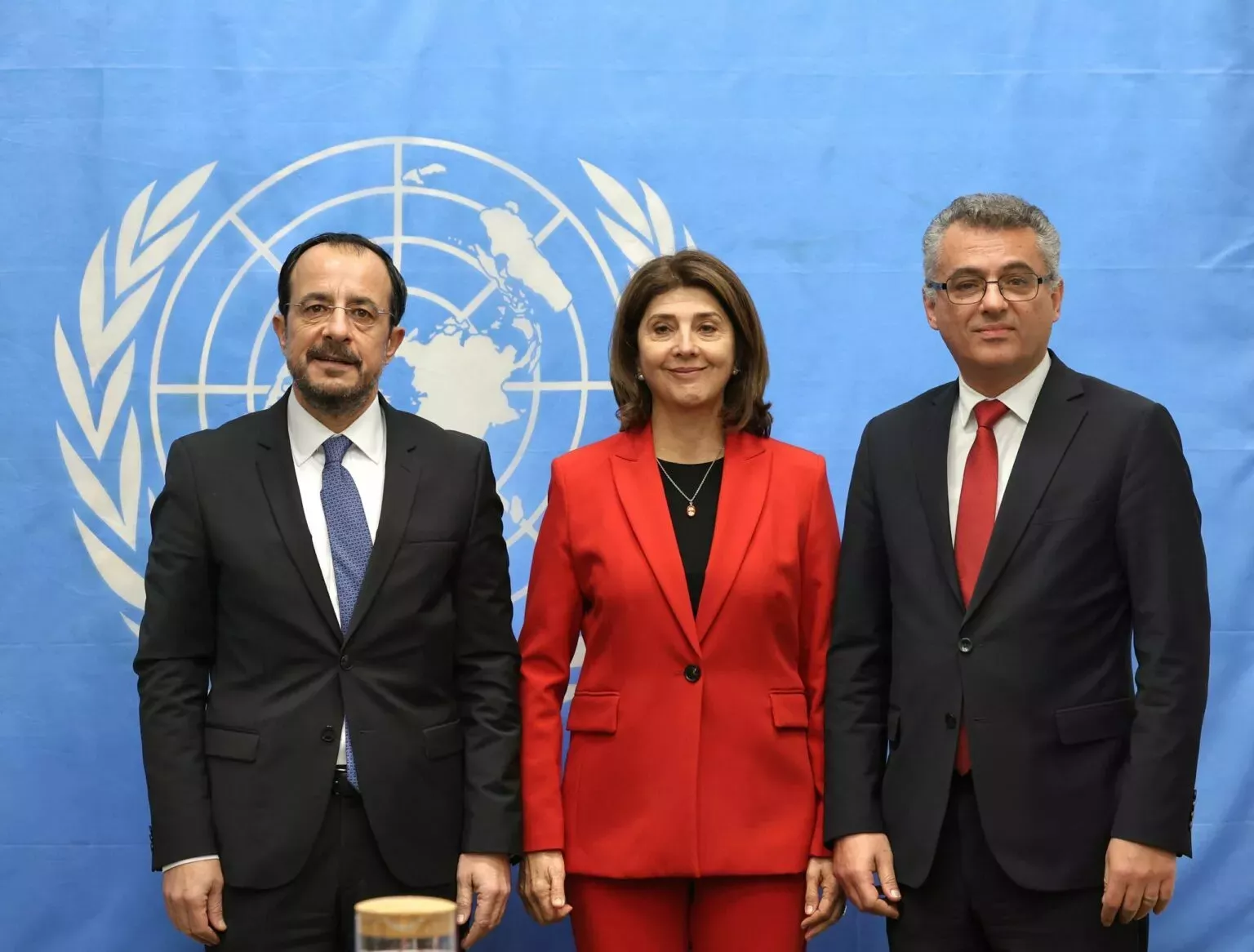
UN Secretary-General’s Personal Envoy María Ángela Holguín has warned that another failed attempt to restart Cyprus peace negotiations could cause “enormous damage” to efforts to resolve the decades-long dispute.
In interviews with the Sunday Mail and Politis, Holguín urged the Greek Cypriot and Turkish Cypriot leaders to agree on a clear negotiating process, including a timetable, agenda and mechanisms for overcoming deadlocks, before substantive talks resume.
Speaking to the Sunday Mail, she warned that another failure would seriously undermine the prospects for a settlement, describing the current UN initiative as an important opportunity that should not be lost.
“There will be enormous damage,” she said.
“That is why the UN Secretary-General does not want to proceed with a 5+1 meeting without proper preparation. Things must be different this time, because the feeling is that every failed meeting has widened the differences between the sides even further.”
Holguín also suggested a possible way around the disagreement over a rotating presidency.
She proposed that negotiations begin without preconditions, but with the issue placed first on the agenda. This would allow the two sides to establish from the outset whether an agreement is possible, rather than spending months negotiating before addressing one of their main differences.
Asked about the 19 proposals submitted for discussion by President Nikos Christodoulides last September, Holguín told the Sunday Mail that she had not received a written document outlining them.
She also questioned Turkish Cypriot leader Tufan Erhürman’s proposed approach to negotiations.
“What Tufan calls methodology is not methodology,” she said.
Holguín explained that a negotiating methodology should set out the procedural steps, timetable, agenda and arrangements for dealing with potential deadlocks.
Six points from Crans-Montana could form negotiating agenda
In her interview with Politis, Holguín stressed that both leaders must agree on a clearly defined process before substantive negotiations can begin.
This should include a specific timetable, an agreed agenda and mechanisms to help overcome disagreements.
She suggested that the six points presented by UN Secretary-General António Guterres during the Crans-Montana negotiations could provide the basis for the agenda.
“The perfect agenda is the six points. Call it whatever you want,” she said.
Asked about the UN document recording the convergences reached during the 2015–2017 negotiations and at Crans-Montana, Holguín said she did not intend to give it to the two leaders before talks began.
She explained that she wanted to avoid disputes over its contents that could revive tensions, as had happened with previous UN documents.
Domestic politics and lack of political will remain obstacles
Holguín also identified domestic politics as one of the biggest obstacles to resolving the Cyprus problem.
Elections and political considerations, she said, affect leaders’ ability to make decisions.
Asked whether political will was lacking, she answered yes, making clear that the problem applied to all sides.
In that context, she raised the possibility of Greek Cypriots considering even a short postponement of the presidential election if they believed it could help achieve progress.
Holguín also acknowledged that the weight of the past continues to affect both communities and efforts towards a settlement.
She posed a fundamental question for the two leaders: whether they want to return to the strong federation that had been under discussion at Crans-Montana.
“What is your destination port? If you know what your final destination is, it is much easier to get on board. This discussion must take place between the two leaders,” she said.
Her remarks underscored the importance of establishing a shared understanding of the outcome both sides are seeking.
Drawing on her experience of peace efforts in Colombia, Holguín said that even after a painful past, it was essential to look towards the future and the next generation.
“I don’t want to sound naive. I know how difficult the past is. But sometimes, even with that past, you have to think that life must be different. I wanted a different country for my son, but also for myself,” she said.
Holguín also noted that regional developments have made the Cyprus problem more complicated, with more actors involved, each pursuing their own interests.
Some, she suggested, might prefer to maintain the status quo.
Nevertheless, she stressed the need to make use of the current opportunity, warning that another failure would come at a significant cost to the prospects of restarting negotiations.

