


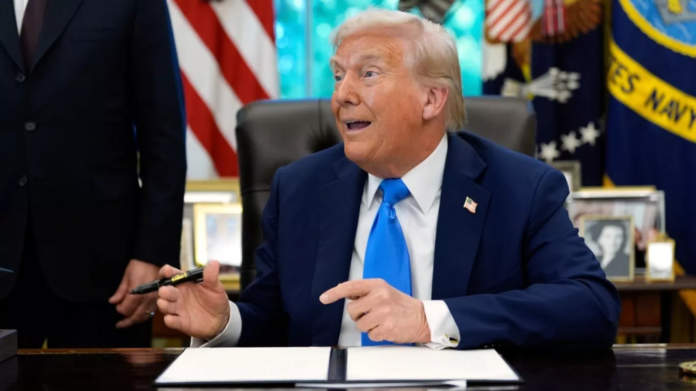
Donald Trump’s sweeping defeat in the US midterm elections has triggered a backlash within his Make America Great Again (MAGA) movement, with some of his most loyal supporters questioning his leadership, accusing Republicans of breaking their promises and debating whether the movement can survive beyond his presidency.
More than 20% of self-identified MAGA loyalists in a sample of online posts expressed doubts about the movement’s leadership and direction following Tuesday’s elections, according to an analysis conducted for Reuters by data intelligence firm PeakMetrics.
The findings reveal growing divisions within a political movement that has dominated the Republican Party for nearly a decade, as supporters turn their anger towards party leaders, White House advisers and, increasingly, Trump himself.
The election delivered Democrats decisive majorities in both chambers of Congress, including victories in traditional Republican strongholds such as Texas and Kansas.
Voter frustration over rising fuel prices, the war with Iran and corruption in Washington contributed to what became the Republicans’ worst electoral defeat in decades.
Yet the reaction within MAGA has been markedly different from the aftermath of Trump’s 2020 presidential defeat.
Claims of widespread election fraud, which helped unite the movement for years, have largely disappeared from the debate. Instead, supporters are demanding answers about the economy, foreign policy and promises they believe the administration has failed to keep.
More than 20% question MAGA’s leadership
The PeakMetrics analysis examined 12,850 posts sampled from approximately 4.6 million Trump-related comments published on X and Reddit between 9pm on election night and 8pm the following evening.
Among the self-described MAGA loyalists identified in the analysis, more than one in five raised concerns about the movement’s leadership and political direction.
About half of those expressing doubts continued to support MAGA but no longer backed Trump as its leader.
The remaining half stayed loyal to the president while criticising his decisions.
Among posts that assigned responsibility for the defeat, nearly a third pointed to the Iran war and Israel’s influence over American policy as factors that had overshadowed Trump’s political message.
A quarter blamed Republicans who had failed to fully embrace MAGA’s agenda.
The findings suggest that some supporters who once regarded Trump as the movement’s greatest political asset are beginning to question whether he has become a liability.
Trump responds by promoting hardline immigration architect
Trump’s first major response to the election came on Friday, when he appointed Stephen Miller as White House chief of staff, replacing Susie Wiles.
Miller, the principal architect of the administration’s hardline immigration policies, is closely associated with MAGA’s nationalist agenda.
Wiles, by contrast, had been regarded as a stabilising influence in an often chaotic White House.
The appointment was welcomed by some of the movement’s most committed supporters, who interpreted it as a return to MAGA’s anti-immigration roots.
“Exactly the energy we need,” conservative influencer Benny Johnson wrote on X, where he has 4.1 million followers.
“Solid move. It’s Miller Time.”
The White House did not directly answer Reuters’ questions about the election defeat, the losses suffered by candidates who embraced Trump’s false claims about the 2020 election, or MAGA’s future.
Instead, it referred to comments Trump made on Wednesday.
“If I were on the ballot, we would have won,” the president said.
He also acknowledged that the Iran war had contributed to the Republican defeat, saying it was “largely true” that the conflict had hurt the party because “it drove the gasoline up”.
Nevertheless, Trump said he would make the same decision again.
Anger erupts among Trump’s own voters
The divisions were visible on election night in Dallas, where supporters of Republican Senate candidate Ken Paxton had gathered expecting a victory celebration.
Instead, they left the hotel ballroom as the scale of the Republican defeat became clear.
At the hotel bar, Michael Little, a 59-year-old businessman who had voted for Trump three times, watched the president on television.
“People are pissed off at Trump. Trump has cost us,” he told Reuters.
His frustration reflected a broader sentiment emerging from interviews with more than a dozen MAGA activists, influencers, party strategists, Christian nationalist leaders and researchers who monitor right-wing politics.
The interviews, combined with a review of online discussions and podcasts, revealed a movement increasingly directing its anger inwards.
Former Trump adviser Steve Bannon, however, argued that the response should be to reinforce MAGA’s original agenda rather than abandon it.
“We have to rebuild,” Bannon told Reuters.
He called for a more aggressive populist and nationalist programme and praised Trump’s decision to appoint Miller.
“Miller’s appointment as chief of staff underpins my point,” he said.
“There is no more hardcore MAGA proponent than Stephen.”
Democrats’ victory reshapes American politics
The scale of the Republican defeat has dramatically changed the balance of power in Washington.
Democrats could hold as many as 56 of the Senate’s 100 seats, giving them considerable influence over Trump’s future judicial appointments.
Florida Governor Ron DeSantis warned that Republicans might struggle to regain control of the Senate before 2032.
“It’s the political equivalent of a meteor strike that went all around the United States,” DeSantis said during a post-election briefing.
Democrats will also control the governorships of seven battleground states that Trump carried in the 2024 presidential election.
Perhaps most strikingly, they won every statewide contest in Texas, a state that has not supported a Democratic presidential candidate since 1976.
‘MAGA is stale’: Supporters blame broken promises
For some prominent right-wing commentators, the defeat has exposed a loss of enthusiasm within Trump’s political base.
Rogan O’Handley, a MAGA influencer known online as DC_Draino, who has 2.3 million followers on X, rejected claims that election fraud explained the result.
“I have been banging the drum of rigged and stolen elections since 2020, but that is not why we lost the midterms,” he wrote.
“We lost because we failed to fix the things voters sent us to do.”
Another conservative influencer, Isabella DeLuca, accused Republican leaders of assuming that MAGA supporters would vote for them regardless of their performance.
DeLuca was among the thousands who entered the US Capitol during the January 6, 2021, attack.
She faced five criminal charges, including the theft of a table from inside the Capitol, and pleaded not guilty. Her case was dismissed after Trump returned to office and pardoned her.
Now 26, DeLuca said Republicans had failed to connect with younger voters concerned about living costs and avoiding foreign wars.
“Republicans were just lazy. They felt like that they were entitled to people’s votes and that people would vote for them no matter what,” she told Reuters.
“It goes to show you that you do have to earn people’s votes, and that even in a super red state like Texas, you’re not untouchable.”
She described MAGA as looking tired.
Research by Jennifer Golbeck, a University of Maryland professor who has analysed MAGA-related online activity since 2016, points to a similar decline in enthusiasm.
Golbeck found that engagement among some of Trump’s most committed supporters had steadily declined since January.
Posts and comments on Patriots.Win, a popular MAGA forum, fell by 27%.
“The enthusiasm and the passion even among this hardest core group of supporters hasn’t really been there,” she said.
“They are saying that ‘MAGA is stale.’ It’s not new and exciting like it once was.”
Fox News, a longstanding platform for MAGA commentators, also experienced a decline in its audience ahead of the elections.
According to Nielsen, the network’s total daytime viewership fell by 27% in October compared with the same month a year earlier.
Fox News responded by highlighting its performance against competing cable news channels on election night.
“FOX News has been the number one network in cable news for a quarter century,” spokesperson Caley Cronin said.
Economy, Iran war and Epstein files deepen divisions
The cost of living was not the only issue frustrating MAGA supporters.
Many also criticised the war with Iran, allegations of corruption and the administration’s handling of government investigative files concerning the late sex offender Jeffrey Epstein.
The administration’s decision to redact or withhold substantial portions of the Epstein files became another source of anger among supporters who believed Trump had failed to fulfil his promises.
Conservative commentator Ben Shapiro, co-founder of the Daily Wire, argued that economic concerns alone could not explain the defeat.
“If you’re talking about an electoral catastrophe – a wipeout like we saw last night – you need more ingredients,” he said on his online programme.
“Here are the other ingredients: chaos and corruption.”
Laura Loomer, an influential Trump supporter, offered a particularly bleak reaction on X.
“America is over and the American Dream is dead,” she wrote.
Nevertheless, Loomer told Reuters that the election defeat did not mean MAGA was finished.
“The Republican Party belongs to President Trump,” she said.
“The MAGA movement is still the majority of the GOP base, and whoever wants to run for president in 2028 on the GOP ticket, they would be unwise to be dismissive of President Trump.”
On Thursday, Loomer announced she was suspending her podcast until January, saying she had been “running on empty for too long” and wanted to concentrate on her personal life and forthcoming wedding.
Election fraud claims lose their grip on MAGA
One of the most notable changes following the election has been the retreat of claims about widespread electoral fraud.
Such claims became central to MAGA politics after Trump lost the 2020 presidential election to Joe Biden.
But this time, Republican candidates who supported Trump’s false allegations of widespread fraud suffered heavy defeats.
According to States United Action, a non-profit organisation monitoring election-denying candidates, at least 41 fewer congressional and statewide offices will be held by election deniers next year.
Candidates associated with election denial also lost 70% of the decided races for statewide positions overseeing elections.
Trump did not attempt to challenge the midterm results, instead blaming Republicans for the defeat.
With few close contests and no credible basis for challenging the results, many prominent pro-Trump activists abandoned fraud allegations and urged supporters to continue organising.
A small number continued making unsupported claims.
Among them was Mike Lindell, founder of MyPillow, who promoted false allegations about voting machines during the 2020 election.
Asked about Trump’s willingness to accept the latest results, Lindell told Reuters:
“That’s his opinion. I’ve got a different opinion.”
“I think it’s all been stolen.”
Such claims, however, remained largely confined to the movement’s fringes.
Wendy Via, co-founder of the Global Project Against Hate and Extremism, suggested that the election-denial movement could lose the financial support and public attention that had sustained it.
“Nobody’s going to be putting money behind it,” she said.
Christian nationalists split over Trump’s future
The election defeat has also divided prominent figures within MAGA’s Christian nationalist wing.
Retired Lieutenant General Mike Flynn, who previously promoted false claims that the 2020 election was stolen, accepted the latest defeat.
He described the results as “a massacre” and criticised Trump and his administration for failing to deliver on promises ranging from lowering living costs to releasing the Epstein files.
Responding to Vice President JD Vance’s assessment on X that the Iran war was “the reason we lost”, Flynn argued that the administration’s failures extended much further.
“The sheer number of broken promises is why the blue tsunami happened,” he wrote.
Flynn also criticised Christian voters for failing to turn out.
“As a Catholic and a Christian, I’m sorely embarrassed and disappointed,” he said.
Other Christian nationalist leaders disagreed sharply over whether MAGA could survive Trump.
Douglas Wilson, a pastor invited by Defence Secretary Pete Hegseth to deliver a sermon at the Pentagon in February, told Reuters that the movement “is not going anywhere”.
However, he argued that it needed to become less dependent on individual personalities and concentrate more on border security, tax cuts and avoiding foreign wars.
Joel Webbon, a far-right Christian nationalist pastor from Texas, took a very different view.
“Trump lost this all by himself,” Webbon said in a video posted on X.
He accused the president of abandoning his political base by supporting Israel, launching the war with Iran and failing to fulfil his promises on the Epstein files and mass deportations.
“MAGA is dead,” Webbon wrote in an accompanying post.
“Forever.”
(Reuters)


