


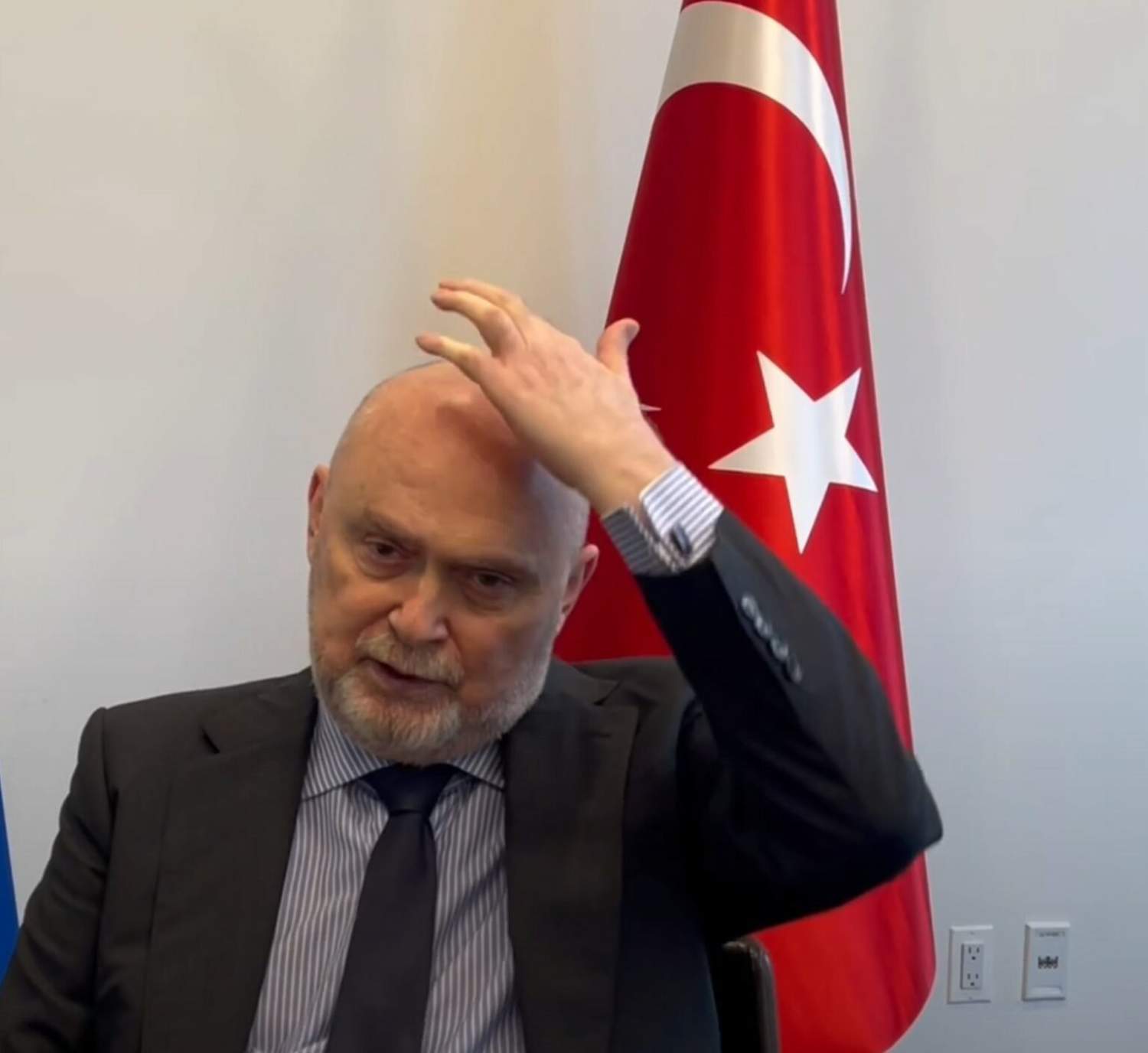
The Republic of Cyprus has launched an international diplomatic campaign to prevent Turkish official Feridun Sinirlioğlu from becoming the next United Nations Secretary-General, with Nicosia raising objections to his record on Cyprus and several other international issues.
The Foreign Ministry has embarked on a major diplomatic effort, contacting a number of countries to brief them on the background and political record of Ankara’s candidate.
The campaign began immediately after Turkey announced his candidacy. Ankara appears to be banking on an unexpected turn in the selection process that could allow its preferred candidate to secure the position.
Sinirlioğlu’s first test in a Security Council vote is regarded as a failure, but the process is far from over.
If the selection process reaches a deadlock, efforts could be made to find a compromise candidate. For example, if the United States rejects the current frontrunners and pushes for a third option, nothing can be ruled out.
This appears to be the scenario Ankara is counting on.
Nicosia is making its position clear through diplomatic contacts in New York and other capitals, as well as interventions at the highest political level from Cyprus.
It is explaining why it believes the Turkish official should not lead the United Nations.
Its objections extend beyond Sinirlioğlu’s position, and that of his country, towards Cyprus and Turkey’s continuing occupation of part of the island. They also concern his record on other international issues and allegations about his conduct.
His actions against Cyprus
During his service as undersecretary at Turkey’s Foreign Ministry and as ambassador and permanent representative to the United Nations, Feridun Sinirlioğlu systematically challenged, and continues to challenge, the existence of the Republic of Cyprus, a member state of both the UN and the European Union.
In a letter dated 19 May 2022, circulated as UN document A/76/842-S/2022/405, Sinirlioğlu repeated Turkey’s longstanding claim that the Republic of Cyprus ceased to exist as a legal entity in 1963.
He challenged its jurisdiction and advocated a settlement based on two states on the island and sovereign equality.
The letter explicitly stated that he was acting on government instructions.
This is just one of numerous examples. Turkey has established what amounts to a production line of letters to the United Nations challenging Cyprus and Greece.
During his tenure as permanent representative, Sinirlioğlu also forwarded letters and documents from the representative of the breakaway entity in the occupied north, who operates from offices at Turkey’s Permanent Mission to the UN.
The positions Sinirlioğlu expressed in New York, reflecting Ankara’s official policy towards Cyprus, can be summarised as follows:
- Non-recognition of the Republic of Cyprus: Turkey maintains that it does not recognise the Republic of Cyprus, despite its membership of the United Nations and the European Union.
- Challenges to Cypriot sovereignty: Through diplomatic interventions supporting Turkish violations, Sinirlioğlu challenged the Republic’s sovereignty both on land and at sea.
- Challenges to UN resolutions: Letters he submitted as Turkey’s permanent representative questioned the Republic of Cyprus and advanced arguments that undermined United Nations resolutions. Security Council Resolution 541 (1983), for example, explicitly calls on states not to recognise any Cypriot state other than the Republic of Cyprus. Yet this resolution appeared to carry no weight in the arguments advanced by the Turkish candidate, who now seeks to lead the very organisation that adopted it.
- European court judgments: He also sought to challenge decisions of the European Court concerning Turkey.
The China controversy
Sinirlioğlu repeatedly criticised China over its treatment of the Uyghurs, a predominantly Sunni Muslim ethnic group of Turkic origin living mainly in the Xinjiang autonomous region of north-western China.
He raised the issue through interventions at the United Nations.
His position was linked to Ankara’s policy of presenting itself as a protector of Muslims around the world, part of an effort to portray Turkish President Recep Tayyip Erdoğan as a paternal figure.
However, his interventions did not substantiate the allegations he advanced, while his approach contributed to tensions between China and Turkey.
Security Council records from 27 October 2021 document a heated exchange triggered by Chinese criticism of Turkey’s conduct in Syria.
Sinirlioğlu responded by questioning the human rights records of countries that had criticised Turkey.
The relevant passage of the Security Council proceedings, however, does not explicitly mention the Uyghurs.
Afghan women’s rights
Afghan women’s organisations have accused Sinirlioğlu of showing excessive understanding towards repression by the Taliban and proposing a path towards normalising international relations without sufficiently safeguarding women’s rights.
Sinirlioğlu was appointed Special Coordinator to conduct an independent assessment under UN Security Council Resolution 2679 (2023).
The resulting report proposed a framework for international engagement with Afghanistan and a conditional path towards normalisation.
Criticism of his work has focused on the conditions under which the international community would engage with the Taliban and the place given to women’s rights within that process.
Allegations involving the Armenian Church
Sinirlioğlu has also faced public allegations that he was willing to facilitate interference in the Armenian Church.
On 23 July 2026, the Armenian Centre for Political Rights, the Helsinki Committee of Armenia, the Forum for Religious Freedom in Europe and Christian Solidarity International issued a joint statement concerning a recorded telephone conversation made public on 8 July.
The organisations alleged that Sinirlioğlu appeared willing to consider supporting efforts to remove Karekin II, the Catholicos of All Armenians and supreme spiritual leader of the Armenian Apostolic Church.
The telephone call had been made by Russian pranksters impersonating Armenian Prime Minister Nikol Pashinyan.
The organisations acknowledged the origin of the call but maintained that Sinirlioğlu’s apparent willingness to offer assistance was incompatible with his position as Secretary General of the Organisation for Security and Co-operation in Europe (OSCE).
Allegations about his conduct
Sinirlioğlu, who serves as OSCE Secretary General, has also faced complaints about his behaviour towards colleagues and foreign officials.
These include allegations of verbal attacks, some reportedly directed at women, which appear to have been raised within the organisation following complaints from governments and individuals involved.
He has also been criticised over the way he presented the assessment of elections in Georgia.
Beyond these allegations, Sinirlioğlu has been accused of advancing Turkey’s bilateral interests while serving as OSCE Secretary General.
Critics point to his interventions on various international issues, including Ukraine and Hamas, as examples of this approach.
Athens’ role
Greece currently holds the presidency of the UN Security Council, giving it considerable scope to intervene in the selection process.
This also presents Athens with an opportunity to correct what was a mistake: its previous support for Sinirlioğlu’s appointment as OSCE Secretary General.
Turkey is evidently using that appointment as a stepping stone towards the next stage in the 70-year-old official’s career.
As a Security Council member, Greece has several ways to help prevent Ankara’s candidate from securing the top UN post.
Following the latest developments surrounding the Turkey-Libya maritime memorandum, Athens also has grounds to oppose his candidacy openly.
The Republic of Cyprus has begun intensifying its own efforts, mobilising its diplomatic resources and using every available channel.
Sinirlioğlu’s election would not merely reward Turkey, the occupying power, and provide it with another opportunity to rehabilitate its international image.
It would also spell the end of any meaningful prospects for resolving the Cyprus problem.
The implications for Cyprus and the Cyprus problem of having Feridun Sinirlioğlu as UN Secretary-General are not difficult to imagine.
It would be the end.
Cyprus problem: A possible next step, but no guarantee of progress
Discussions on the Cyprus problem are currently focused primarily on opening additional crossing points.
Nicosia is attempting to keep the diplomatic process moving by exploring different options and issues that could create opportunities for further steps.
The Turkish side, however, wants to avoid substantive discussions on the Cyprus problem and concentrate instead on confidence-building measures.
Even then, it is not prepared to discuss every confidence-building measure. Varosha, for example, remains off the table.
Meanwhile, UN Secretary-General António Guterres is seeking an opportunity to convene a meeting, initially between President Nikos Christodoulides and Turkish Cypriot leader Tufan Erhürman, before leaving office.
His aim appears to be to leave his successor a diplomatic process that can continue after his departure.
That is what seems to concern him most, particularly as any agreement to open new crossing points would not be implemented until after he steps down as Secretary-General.
The real objective, however, should not be to secure an agreement before Guterres leaves office, but to ensure continuity in efforts to resolve the Cyprus problem.
Nicosia has attempted to offer ways forward, facilitate the diplomatic efforts and achieve a result.
But it takes two to tango.
And the second partner, the Turkish side, is currently nowhere to be found when it comes to the bigger picture.
These efforts are clearly taking place in an atmosphere of tension rather than favourable diplomatic conditions.
That tension is linked both to the Turkey-Libya maritime memorandum and to expected developments concerning the Crete-Cyprus electricity interconnector, particularly Turkey’s anticipated response.
Even a single step forward would be significant, informed sources say.
But it is equally clear that one step will not be enough. There must be a continuation.
If Turkey genuinely wanted to move the process forward, it could have acted earlier rather than waiting until the last moment.
It could, for example, have done so before the European Commission published its report on Turkey’s progress.
Turkish Foreign Minister Hakan Fidan’s visit to the occupied north on Friday also carried a message: Turkey is in charge.
Of course, he did not need to travel there for everyone to understand that. But his visit served as a friendly reminder.
British diplomatic presence in Cyprus
Delegations from Britain’s Foreign Office and its Permanent Mission to the United Nations in New York visited Cyprus last week.
Among other engagements, the British diplomats visited the headquarters of the United Nations Peacekeeping Force in Cyprus (UNFICYP), where they met UN representative Khassim Diagne.
The peacekeeping force’s leadership briefed the British officials on developments in the buffer zone, with particular emphasis on recent incidents.
British officials have linked the visit to the UN Secretary-General’s report on UNFICYP, which is due to be circulated in January.
However, the report was not the only reason the two British delegations travelled to Cyprus from London and New York.
The visit also provided an opportunity to discuss other matters concerning Cyprus, the Cyprus problem, the British Sovereign Base Areas and developments across the wider region, particularly events in the surrounding area.

