


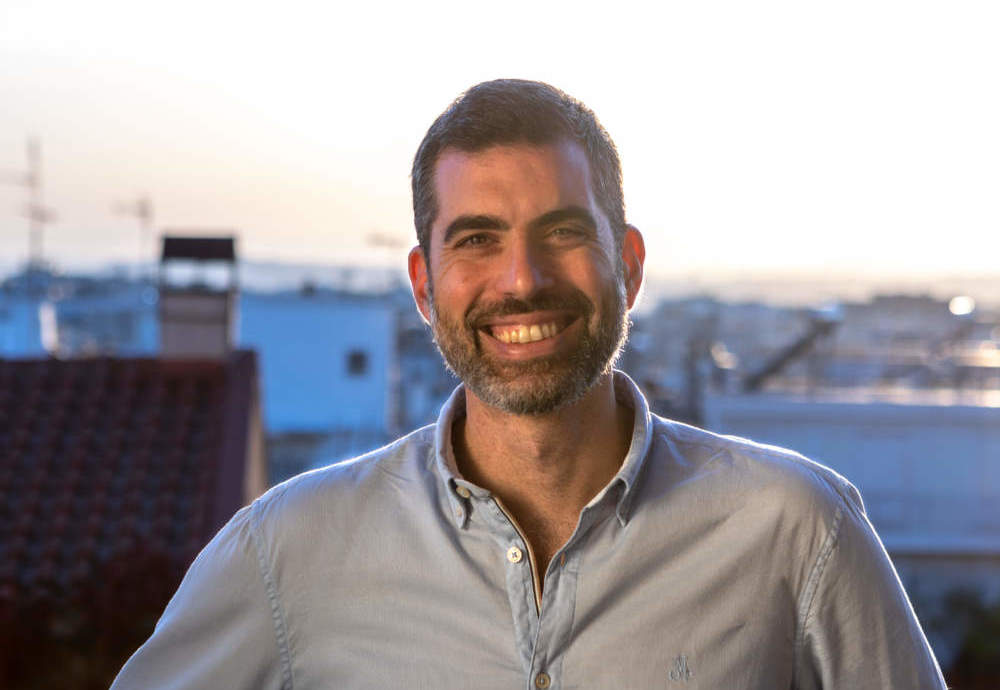
Did Churchill really say that heroes fight like Greeks? Did the Battle of Crete really play a part in the outcome of the Second World War? Historian, author and podcast host Stavros Panagiotidis, who was in Cyprus for presentations of his two books, ‘Myths, Misunderstandings and Uncomfortable Truths of Greek History’, both published by Kedros, debunks the myths of Greek history, arguing that the truth beneath them is more compelling than the legends and needs no embellishment.
Your first book, ‘Myths, Misunderstandings and Uncomfortable Truths of Greek History’, was prompted by a historian with a doctorate from the University of Macedonia whom you heard repeating well-known historical myths…
That was the last straw. I’d realised years earlier that many people have heard mistaken interpretations of historical events and, above all, that they were forming opinions about the present on the basis of those mistaken ideas about the past. When I heard someone in a university setting refer to all sorts of far-fetched tales as if they were the truth, I thought someone needed to write a book that brought them together, explained the truth and showed how we know these things are false. Partly to inform people, and partly to get them used to thinking about history more scientifically.
How is a historical myth born?
There are all sorts of stories circulating on the margins of history and, at some point, those in power usually seize on one that suits them. When it’s the state, it makes the story official, puts it in textbooks and on monuments, and turns it into received wisdom. The Secret School, for example, is a story that began circulating in the early 19th century. At some point the Greek state took it up and used it to boost the role of the Church, since the Patriarchate was known to have excommunicated the revolutionaries. Kolokotronis himself went as far as saying, in his famous speech to students on the Pnyx hill, that the Patriarch and the rest of the clergy did whatever the Sultan told them. When the state found the legend of the Secret School, it took it, polished it up, dressed it up and put it in the history books.
Then there’s the myth of the Evzone. It started with a British newspaper’s Greece correspondent, who was actually in Cairo that day. Why did this happen? Because truth is the first casualty of war. With the best of intentions, he wrote an article full of heroic moments to lift morale. It included the story of Konstantinos Koukidis, who supposedly jumped from the Acropolis wrapped in the Greek flag when the Germans entered the city. The story stuck and at some point, when Avramopoulos was mayor, it was decided to put up a monument to this non-existent hero. Yet the Hellenic Army History Directorate itself says not the slightest evidence of his existence has been found! It’s worth noting that part of the Left also endorsed this myth. Glezos and Farakos said we should honour him to highlight the role of the resistance against the Nazis. Very good intentions, very wrong way of going about it.
Why do we need to create, and above all perpetuate, these myths?
All nation states create national myths when they’re formed. But the more secure, stable and prosperous a society is, the more it looks to its present and future, and the less it needs to idealise the past. It’s like someone in a happy new relationship. They live in the present and look forward to the future, without dwelling on their exes. When do we romanticise our past relationships? When the current one isn’t going well. Societies are the same: when the present is hard and the future uncertain, they retreat into an idealised past. Greece, like many Balkan countries, didn’t enjoy that kind of prosperity for long periods, which made it hard to shake off the heroic, embellished and often mistaken image of its past.
Did the diversity of the newly founded Greek state also play a part in this need, so as to build a national consciousness that did not exist?
Yes, because the Balkans were a patchwork of peoples and cultures that later had to be presented as one. In Greece, for example, national identity was built through schools and the official language, sometimes by force. There are many accounts of schools in northern Greece, around Florina for instance, where if children spoke Slavomacedonian, the teacher would call their parents in. Even recently, when Banda Entopica sang a Slavomacedonian song in Florina, it was branded “irredentist”, and the mayor saw it as a great opportunity to sell patriotism to his fellow townspeople. What Balkan countries have in common is that they had mixed populations. That’s a problem for the later narrative, which insists these lands always belonged to one nation. So we cut the awkward parts out of history, and whatever or whoever reminds us of them, we tend to see as a traitor.
You note that in Byzantine times the term “Hellene” was associated with paganism. How, then, did the Orthodox inhabitants of what is now Greece define themselves?
Tellingly, even Kosmas the Aetolian told enslaved Christians: “You are not Hellenes, you are not impious, heretics, atheists, but you are baptised in the name of the Father, the Son and the Holy Spirit.” How they saw themselves depends on the period. The empire we call Byzantium wasn’t called that; it was the Roman Empire, and its people were Romans. When the Ottomans conquered its lands in the 15th century, they called the sultan’s Christian subjects “Rum”, meaning Romans, a term that covered many different peoples, not just Greeks, who turned it into “Romioi”. In those days people put their local identity first: “I’m a Souliot”, “I’m a Maniot”. But it depends on exactly when, where and who. A farmer, a merchant and a scholar would each have given you a different answer.
When did the label “Hellene” stop being something to be ashamed of?
As everywhere else, in the age of nation-building, the 18th and 19th centuries, when the idea took hold that we are a nation: people who want to live freely in a community of their own, making their own decisions. It’s about political identity. Towards the 18th century the word “Hellene” began, first in educated circles, to take on a new meaning linked to ancient Greece. Some people gave their children ancient Greek names, and some shipowners did the same with their ships. The Patriarchate, and Patriarch Gregory V in particular, openly disapproved, seeing it as a drift away from Christianity. It filtered down to other social classes only slowly; klephtic songs had no patriotic references until very close to the Revolution. Being Greek, in the sense of belonging to a Greek nation state, took shape through the revolution of 1821 and was “completed” afterwards by the state itself, through schools, the army and the civil service, which brought the nation’s different elements together and imposed a common language.
One example of a myth is the line attributed to Churchill: “Hence we will not say that Greeks fight like heroes, but that heroes fight like Greeks.” Was there really deliberate misinformation, including from Greece’s Foreign Ministry?
In 2007 the Education Ministry put out a statement saying the line had probably come from Philip Noel-Baker, who was a minister under Churchill and later won the Nobel Peace Prize. Two years later the Foreign Ministry released a video showing Churchill saying it, which was fake. But I think what matters is how easily we believed it. We tend to believe what makes us feel good and confirms what we already think. The thing is, we know he didn’t say it, because the Churchill archive holds all his statements, articles and speeches. The archive is online, so anyone can search it and see there’s no such statement, or anything like it.
Why do you think we need to present heroes as flawless figures?
When we watch a film or a series, what usually draws us to the main characters is their grey areas, their light and shade, their contradictions. The real protagonists of history were like that too, and we should look at them without shying away from their darker sides out of fear we’ll no longer be able to honour them. We still can, just for who they really were. Our role models have to be real people, so that we, as ordinary people, can follow their example.
Karaiskakis, for example, died fighting for the Revolution at the end, but at the start he had one foot in and one foot out. He fought the Ottomans and at the same time tried to make peace with them. We also remember Androutsos as an innocent victim of the infighting, but forget that he’d been arrested for making deals with the Ottomans. People back then hadn’t been born into a nation state as we have. They made the revolution, but they didn’t all know exactly what they wanted from it, so they could be ambivalent.
What about “dark” figures who acquired a dual legacy, such as Grivas in Cyprus or Metaxas in Greece?
That’s a different matter. These are people much of whose record is glossed over by the official story, as with Grivas. With Metaxas, at certain political moments the negative side disappears when some decide the public needs to be “fed” more nationalism and authoritarianism, because they’ve nothing else to feed it. I remember in the 1990s, when I was at primary school, being taught that Metaxas was a dictator and that it was the people who said “No”.
In the years that followed, I felt that version slowly fading from public debate. Greece went through the bailout memoranda, and to contain popular anger, governments couldn’t encourage anything that recalled a more militant or radical version of Greek history. So Metaxas had to be presented less as a dictator who hunted down democrats and leftists and more as a champion of the national interest.
How we see the past, or how those in power and those who shape the official story try to make us see it, always depends on the needs of the present. We historians have to resist that and give people accurate facts and sound interpretations of history. From there, everyone can judge whether Metaxas was a good or bad influence, but according to their own politics and their own morals.
You dedicated the book “to those who can bear to tear down their myths and face the ruins of the new truth”. Is it really that hard to tear down myths?
It is hard, especially when the myth is something you carry inside you, something you love. There were things I found painful too when the truth came out. I’d also heard, and believed, that the Battle of Crete delayed the German attack on the Soviet Union, so that the harsh Russian winter caught up with them, and that this was the beginning of the end of the war and of the Nazis. A lovely story showing that, even in defeat, we helped win. But it isn’t true. In the end, though, a new truth can emerge from the ruins of that myth: that fighting to the end for your freedom is always worth it.
You write that in many cases we don’t need the myth, because reality is just as beautiful…
Maybe even more so. People often ask me what’s wrong with myths, especially when they serve the nation or the cause of freedom. The problem is that they rob us of the truth, which we all have a right to know. They also get us used to misreading the past, and we carry that over into how we read the present. On top of that, the people who peddle these myths gain credibility and can build careers in journalism, publishing or politics on the ignorance they cultivate. That damages our intellectual and political life. But there’s something else: myths hide the real beauty of history. The 1821 Revolution, the National Resistance and the Epic of ‘40 are events of such historical importance and brilliance, for Greece and for Europe, that they need no embellishment.
You also said that knowing the historical truth is bound up with democracy itself. How do you see that?
Nobody has the right to decide for us what we’re allowed to know. Truth is a precondition for any meaningful debate. People often say we should avoid conflict, but science, politics and ideas all move forward through it. For disagreement to be productive, though, it has to rest on the facts. First we need to agree on what happened, then argue about what it means. That’s what democracy is about.

