


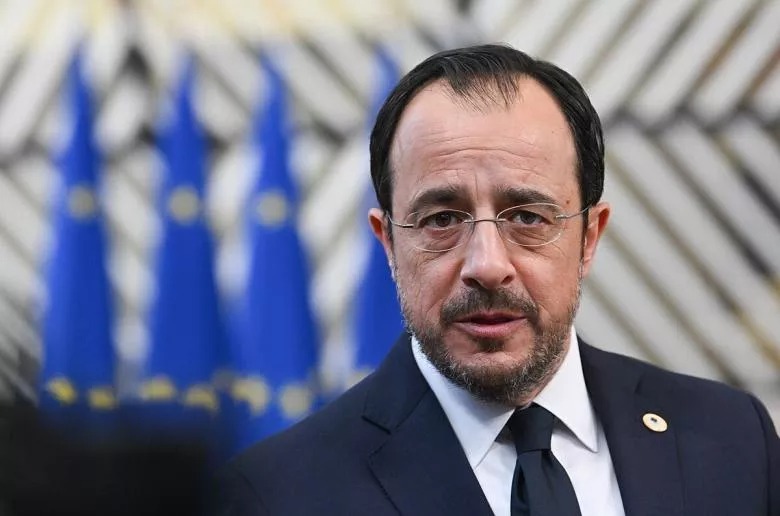
President Nikos Christodoulides was mid-address to EU leaders on the Middle East on Thursday when he received a security threat alert on his phone for the Akrotiri base.
He stopped, read the message aloud to those present — the same alert sent to Akrotiri residents — and used the moment to drive home what he had been arguing all week: that the conflict is not abstract for Cyprus.
The episode coincided with one of the summit’s more tangible outcomes for Nicosia.
The European Council’s final conclusions committed the EU to supporting Cyprus-UK dialogue on the future of the British Bases — language Christodoulides had pushed to include and which, according to sources closely following the Brussels discussions, he secured after briefing EU leaders on how Cyprus has been affected by the bases’ presence.
The conclusions state that the European Council “recognises Cyprus’s intention to open discussions with the United Kingdom on the British Bases in Cyprus and declares itself ready to provide assistance where needed.”
The EU also reaffirmed it stands “firmly and unequivocally” with member states close to the conflict zone, welcoming military deployments to the Eastern Mediterranean in support of Cyprus.
The conclusions further referenced Cyprus’s maritime corridor in Gaza, calling on Israel to allow immediate, unimpeded humanitarian access “including through Cyprus’s Maritime Corridor, complementary to land routes.”
Israel was also called upon to revoke its decision on the NGO registration law, reopen Gaza’s border crossings and comply fully with international law, including international humanitarian law.
On European defence, the conclusions noted risks facing member states “most directly affected by the situation in Iran and the Middle East,” reaffirming that defending all EU land, air and maritime borders contributes to overall European security.
Kallas friction
Christodoulides arrived at the summit having already gone public with his disagreement with suggestions — including from EU foreign policy chief Kaja Kallas — that the war in Iran is not Europe’s war.
After Monday’s Foreign Affairs Council, Kallas had said plainly: “This is not Europe’s war,” adding that European interests were nonetheless affected by the crisis.
Government sources said Christodoulides’s pushback was a direct response to Kallas. Nicosia’s frustration centres on the framing’s failure to account for the fact that Cyprus — an EU member state — has already borne direct consequences from the conflict.
Article 42/7
According to diplomatic sources in Brussels, Nicosia is investing heavily in securing a decision to activate Article 42/7 of the EU Treaty.
Christodoulides has drawn encouragement from his contacts with EU institutional leaders: both European Council President António Costa and European Commission President Ursula von der Leyen have approached the question positively in the event a member state comes under threat.
Government circles clarified that Cyprus had not sought to invoke Article 42/7 from the outset, as its immediate security needs were met by forces deployed by Greece, France and Italy.
In an interview with Italian newspaper Corriere della Sera published during the summit, Christodoulides said the EU “should promote a de-escalation initiative, together with other interested partners,” describing it as “the expectation of leaders in the region.”
He added: “We must find the right path to reduce tension. That is the most important message we need to send.”
He described Cyprus as a safe hub, saying the island had experienced only one incident — at a British Base — and had never itself come under attack.
Greece, France, Italy, Spain and the Netherlands had all responded immediately with offers of support, he said, stressing the assistance was not sought to draw Cyprus into the war “but to make Cypriot citizens feel safe.”
On Article 42/7, Christodoulides said Cyprus had not activated it because it was not at war, but argued the episode carried a broader lesson.
“We must use the Cyprus example to be ready, as a Union, to respond immediately if one day a member state activates Article 42/7,” he said.
He also singled out Italian Prime Minister Giorgia Meloni, saying she was among the first leaders to call after the Akrotiri incident and noting that she always raises the need for greater EU engagement in the region.
Christodoulides closed his address to the Council by reiterating his call for dialogue with the British government on the status of the Bases — to begin after the end of the war in the Middle East.
Read more:

