


Turkey is launching behind-the-scenes diplomatic initiatives in the Euro-Turkish sphere to build a wall of pressure around Nicosia. While various international actors are placing the European card back on the table for the latest push to resolve the Cyprus issue, different parties hold entirely different views on how it should be used. Turkey is building bridges with EU member states, and NATO is expected to enter the equation at a later stage.
Ankara intends to build this pressure network at the end of this month, calculating that Nicosia will lose the political advantage gained during its six-month EU Council Presidency. Turkey is attempting to frame itself as a major, indispensable nation for the EU, arguing that the Republic of Cyprus should not block the development of Euro-Turkish relations.
Turkey’s Foreign Minister, Hakan Fidan, expressed irritation at the European presence and actions of the Republic of Cyprus during statements in Vienna on 30 April 2026. Speaking at a joint press conference with his Austrian counterpart, Beate Meinl-Reisinger, Fidan sent a broad message, claiming Cyprus is blocking a grand strategic perspective for Europe. He remarked that while collective goals could be achieved across various fields with a combined population of 500 million people from Turkey and EU states, a nation with a population of less than one million can largely block this process without anyone stopping them.
Ankara is advancing this narrative across European capitals to harden its stance, asking EU member states to pressure Nicosia because the ongoing impasse costs them as well. Under this tactic, the occupying side argues that the two communities in Cyprus can hold discussions on undisclosed topics while Turkey simultaneously progresses its EU accession path and opens new negotiation chapters. Turkish officials insist that European interlocutors should not let the Republic of Cyprus create obstacles and are asking them to intervene to bring Nicosia into line. This narrative is finding a receptive audience among certain partners, including Germany.
NATO and European Dynamics
The Turkish strategy also involves NATO, aiming to revive the false claim that the Republic of Cyprus obstructs EU-NATO relations due to its objections in the Euro-Turkish arena. Ankara hopes that introducing NATO into the discussion could eventually trigger a reaction from US President Donald Trump.
Nicosia remains fully aware of these behind-the-scenes Turkish manoeuvres and the scenarios designed to pressure the Cypriot side. The main point of contention is why pressure should be applied and what the Republic of Cyprus will be asked to accept. Turkey and some European partners want to unfreeze the accession process while leaving the next steps for the Cyprus issue deliberately vague. Turkey offers no commitments and no substantial change in its stance on the core Cyprus problem, seeking instead to create movement on the island while simultaneously advancing its relationship with the EU.
UN Secretary-General António Guterres also links Euro-Turkish relations to the Cyprus problem, though not in the way Ankara intends. Guterres views the European arena as an opportunity for progress since Ankara continues to invest in its EU accession path. He appears to have discussed the matter with Turkish officials, but the Turkish side has given no indication of how it intends to link this scenario to a solution. While Ankara states it is interested in Euro-Turkish relations, it continues to maintain a policy of tension in Cyprus and the Aegean.
Holguín’s Mission to Unlock Deadlock
The arrival of María Ángela Holguín, the UN Secretary-General’s Personal Envoy on Cyprus, for meetings in Nicosia this week marks a renewed effort to unlock the peace process. Her aide previously held preparatory contacts in Nicosia to pave the way. Holguín, who will visit Athens, Ankara, London, and Brussels after Nicosia, aims to establish the necessary conditions for an informal five-party conference. Guterres, who leaves office this year, has set this conference as a key objective.
Sources indicate Holguín will attempt to secure a renewed commitment from President Christodoulides and Turkish Cypriot leader Tufan Erhürman to use the convergences achieved up to 2017 as the basis for negotiations. While this is the long-standing position of Nicosia, the occupying side maintains a different stance. The UN believes this approach could succeed because Erhürman previously expressed his acceptance of these convergences during talks with the Secretary-General. However, when Guterres visited Ankara, Turkish officials informed him that they do not want any reference made to the Crans-Montana talks.
Guterres will not convene an informal meeting without clear common ground, as informed sources state he intends to use any five-party conference to announce the formal resumption of negotiations. If this is not achievable, he will see no reason to call a meeting, choosing not to end his tenure on the Cyprus issue with another failure. Holguín is also pushing for the opening of at least one new crossing point, though current conditions make this difficult, meaning only minor low-level political measures may be announced.
Staged Business Pressure in Fenced Varosha
Increased activity is occurring inside the fenced area of occupied Varosha, with Turkey taking small steps toward its revival while attempting to obscure its true intentions. This activity includes pressure from businessmen who claim they face bureaucratic obstacles to operating in the area, though it is unclear if they are acting independently.
A recent post in the occupied area stated that a Turkish Cypriot businessman, who reportedly bought hotels inside the fenced city of Varosha in 2023, strongly reacted to the licensing procedures for his properties. He stated that if he is not granted the necessary permits within a month, he will enter the properties and start tourism activities, even if it results in his arrest. He added a warning that if the permits are not issued, he will cancel all sales and return the properties to Greek Cypriots. He claimed that in such a scenario, the Greek Cypriot government would be pleased with the outcome, while the real losers would be the governments of Turkey and the breakaway regime.
In July 2023, reports circulated widely that a Turkish Cypriot businessman claimed to have purchased four hotels inside the fenced city of Varosha and had started taking bookings for 2025 through a specific website. However, anyone attempting to book through that website or other applications found it impossible, and the website no longer exists. The individual presenting himself as the buyer of the hotels is Yusuf Kısa, the owner of the “Bakis” newspaper, who has faced legal issues in the past.
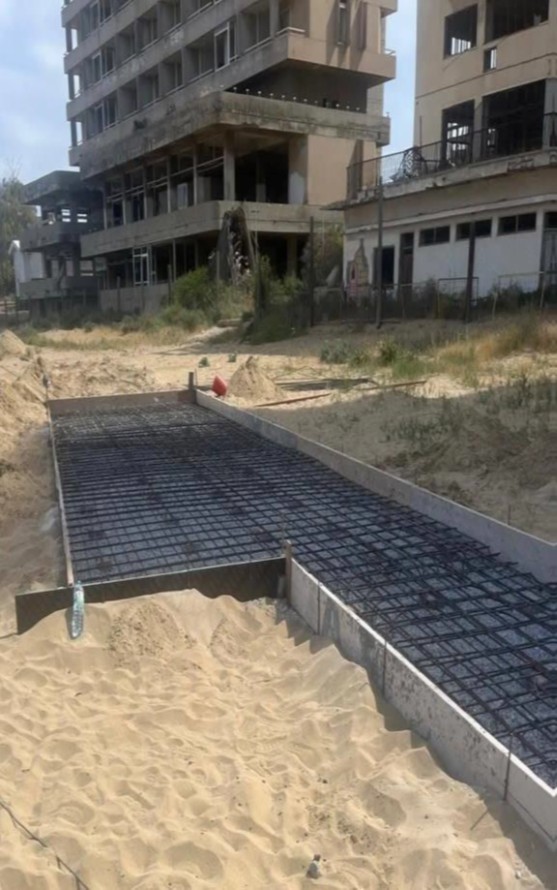
In a separate move, the occupying power is constructing a pedestrian walkway on the beach directly in front of the “Florida” and “Aspelia” hotels inside the fenced city of occupied Varosha. Although presented as an innocent project, the action points to a tactic of gradual encroachment aimed at the step-by-step colonisation of the area. Turkey consistently uses the Varosha issue as leverage or for public relations impact, keeping the colonisation of the area on its agenda while executing moves carefully to avoid triggering sharp international reactions.

