


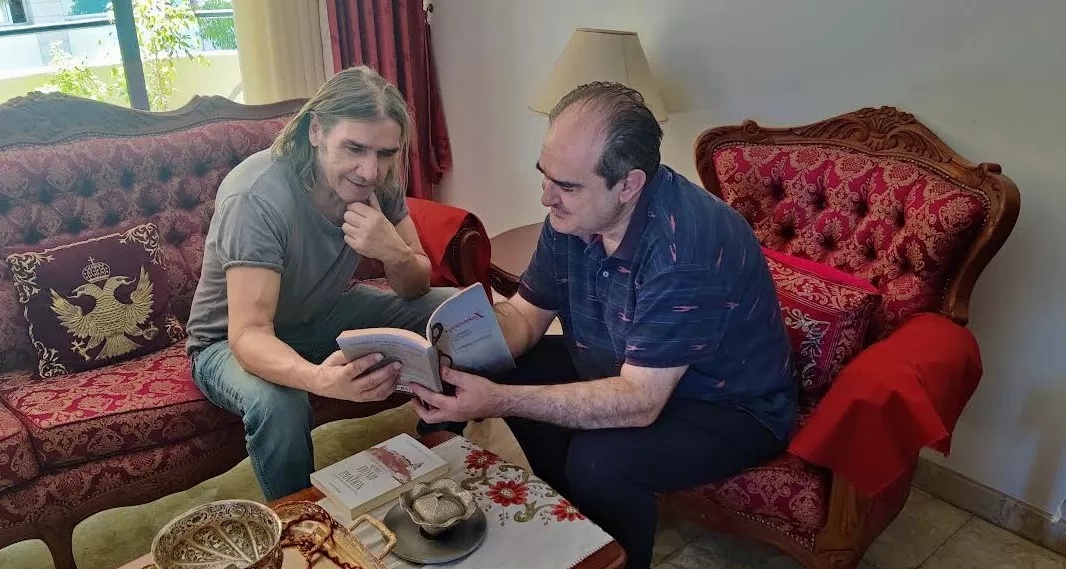
Yesterday (5 August), I visited the writer and researcher Stefanos Evangelides at his home in Nicosia. Although he lives and works in Athens, he is currently in Cyprus, and we discussed the two harrowing books he has written about notorious crimes committed by women in colonial Cyprus during the first half of the twentieth century.
The books, Styliani X and Medeas and Clytemnestras, are the product of years of painstaking research. Far more than simply recounting the crimes in stark, unsparing detail, they expose the brutal reality of everyday life for women and children in Cyprus right up to the 1950s and the island’s independence. In this stark portrait of violence in the pastoral yet deeply backward Cyprus of the colonial era, Evangelides, a lawyer, lecturer in law in Athens, and member of the Hellenic Society of Authors, notes that although his books are about women who killed, the reality was that, in those years, “women in Cyprus were overwhelmingly the victims, not the perpetrators.”
Of the eight cases featured in Medeas and Clytemnestras, one stands out for me: the horrific murder of four-year-old Maria Stylli in July 1931. The child’s stepfather plunged a large knitting needle into her belly, while her own mother took part in the killing. Both were tried, convicted and hanged within months.
In her statement to the officer in charge of a police station in a village in the Paphos district, the mother revealed that after the death of her first husband and her second marriage, she had sent her three eldest children away to work two years earlier in what were effectively conditions of slavery. Her nine-year-old daughter was sent to Limassol to work as a servant “for a man called Giorgos”. Her eight-year-old son was sent to labour “for a man called Neophytos”. Her youngest son, just six years old, was sent to work “for a man called Panayiotis”.
Styliani X tells the story of Styllou Christofi from Rizokarpaso, who murdered her German daughter-in-law in London in 1954. She was tried, sentenced to death and executed at Holloway Prison. Evangelides notes that Christofi never went to school. As a young girl, she broke stones to help build the road linking Rizokarpaso and Yialousa.
Evangelides stresses that the women whose stories he tells “lived in a relentlessly harsh reality in which many women were murdered by husbands who saw themselves as their masters simply because the food was not good enough, and were subjected to sexual abuse without daring to speak out, for fear of bringing shame upon the family’s honour and reputation.”

