


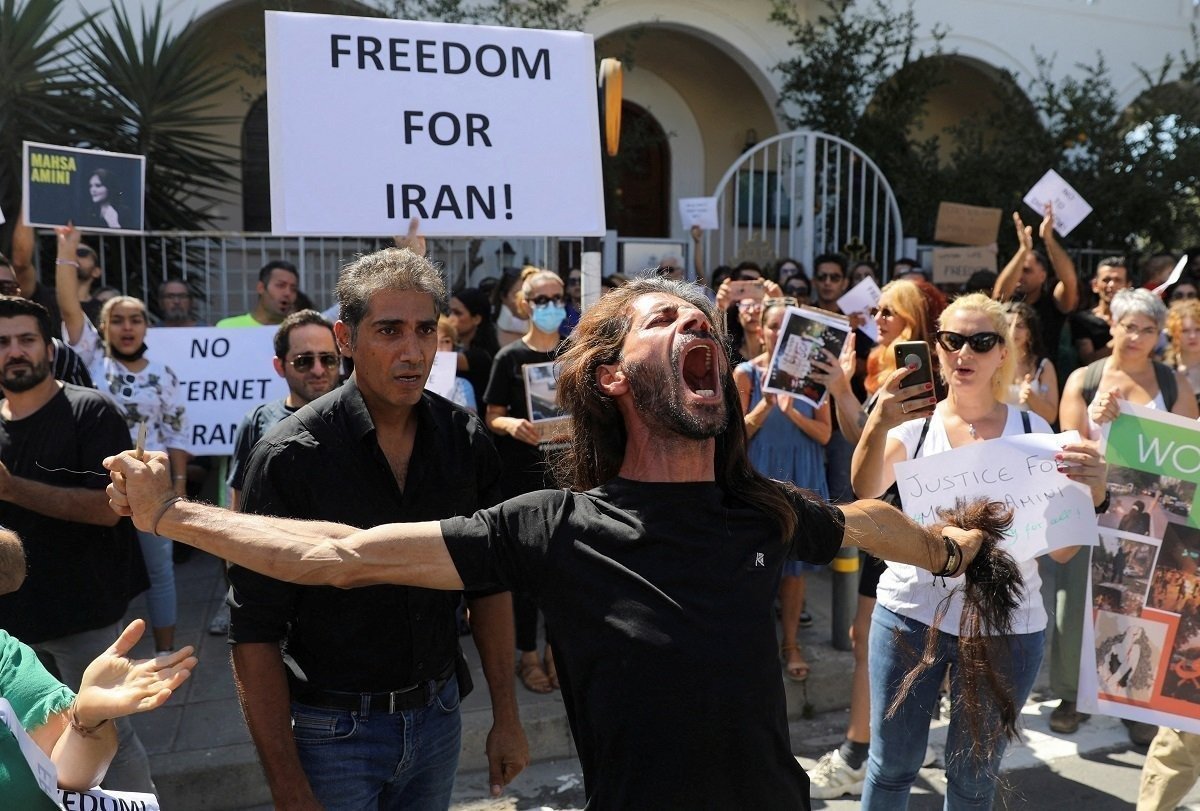
Truly, how many of us can recall the issue that dominated global headlines for weeks around this time last year? What event had deeply moved and resonated with us? What case had occupied the majority of news bulletins and informational programmes? What was the shocking incident that had set social media ablaze with thousands of posts, comments, and photos? Does the name Mahsa Amini ring a bell?
Fortunately, for those of us who tend to forget, the European Parliament reminded us by awarding the 2023 Sakharov Prize for Freedom of Thought to the unjustly silenced Mahsa Amini and the movement “Women, Life, Freedom.” In doing so, they honoured the struggles of those courageous and uncompromising individuals fighting for equality, dignity, and freedom in Iran.
Let’s refresh our memories a bit. Mahsa Amini, of Kurdish descent, was only 22 years old when, during her visit to Tehran, she unexpectedly found herself in prison and ultimately dead. The “crime” she committed, paying for it with her life, was a few strands of hair that had protruded from her hijab!
The murder of the 22-year-old by the notorious morality police (Iran’s Guidance Patrol), simply because she did not wear her hijab “correctly,” sparked a wake-up call for an entire revolution against oppression, patriarchy, and religious fundamentalism. Thousands of women, defying the fear of punishment or death, knowing in advance that, at best, they would end up in prison, took to the streets with matches and scissors. They cut their hair in public view, burned their hijabs, and wrote history.
And then suddenly, the wave of anger waned. Not of Iranian women, of course, who continue to fight for basic rights, but of all of us here in the West. We, can’t even imagine the suffering of Muslim women under Iran’s theocratic regime. There, women are treated as second-class citizens with countless restrictions and minimal rights. Other events emerged, more local and “interesting,” and just as we forgot about the war in Ukraine, we also forgot about the women of Iran.
However, despite the challenges, those women persevered. They insisted, fought, got arrested, were beaten, and died. Their struggle did not end for them, as it did for us, who have the illusion that because we briefly sided with them against their oppression, it ceased to exist. Nearly a year later, almost nothing has changed in Iran. The morality police, monitoring that women adhere to the country’s strict dress code, returned harsher to the streets of Iran. A new bill even proposes that women not wearing their hijab correctly be punished with 60 lashes and a 10-year imprisonment.
The undertaking for systemic change is incredibly difficult, but no revolution was ever easy or bloodless.
After all, history is not written by those who hesitate, fear, or waver. History changes with the mad and daring, the daring and idealistic, who oppose all forms of oppression and restrictions on human rights. History is written by people like Mahsa Amini and the brave and wonderful women of Iran.
(Featured image by Reuters/Yiannis Kourtoglou)

