


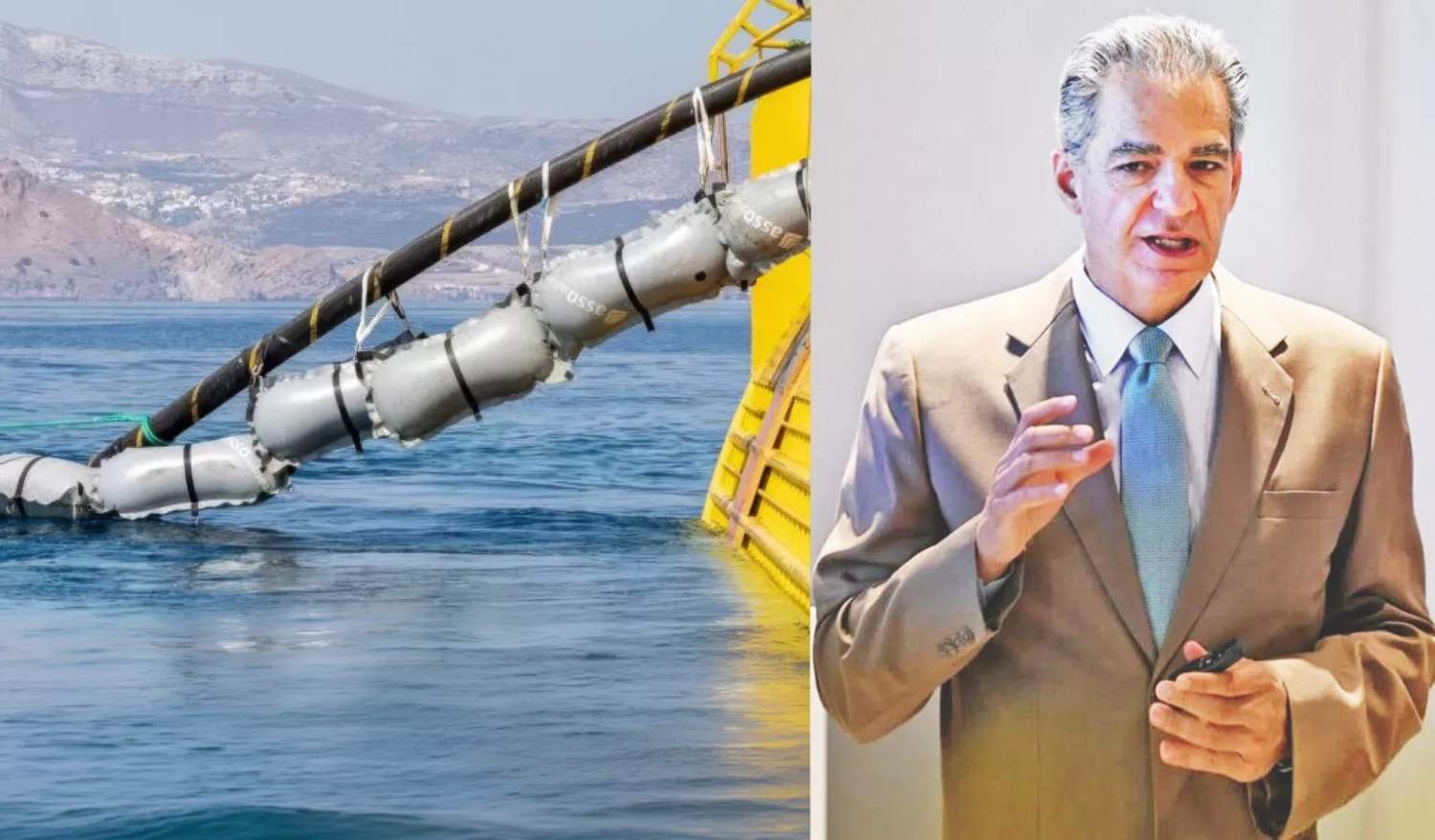
Angelos Syrigos is one of those Greek politicians who never forget Cyprus. A parliament member for Athens, he is Professor of International Law and Foreign Policy at Panteion University and a former Deputy Minister of Education and Religious Affairs.
Remember, he was the one parliament member who was savaged in the chamber in 2022 for daring to speak a hard truth: that the junta did not fall because of the Athens Polytechnic uprising, but “collapsed in 1974 under the weight of its misdeeds, and above all under the weight of the Cyprus tragedy”. I mention it to make a point. His interest in Cyprus is anything but a passing one. He has, after all, written important books on the Cyprus problem and Greek-Turkish relations.
What he told Stella Stylianou on philenews’s sTELLus Vidcast about national issues deserves close attention. Above all, what he said about the electricity interconnector, which is back in the spotlight these days amid the row between DIKO and DISY on one side and Makis Keravnos on the other. He helps us see what this project is really about.
From everything he said, I have picked out a few points that shed light on the interconnector’s most important side: its strategic value. Something, of course, that Keravnos doesn’t trouble himself with. He sticks to his own patch, which is the project’s economics.
On the money question, Syrigos puts it like this:
“Greece has bought Rafale jets and Belharra frigates. We don’t expect them ever to pay for themselves. We do it because we have to. That’s how the message of deterrence gets through to Turkey. You don’t buy weapons because you think you’ll make money out of them. What matters is what they give you strategically.
“In this case, does the cable pay off, linking Cyprus to the European grid? For a start, it benefits the Cypriot consumer too. But what we care about is the cable’s strategic importance. Right now, the future of energy is power cables carrying electricity from places where it is produced cheaply to places that need it. Where is it cheap? Africa. Which countries have the edge here? Spain, Italy and Greece, for geographical reasons. They are close, and a cable link is easy. What is Turkey trying to block with the stance it has taken on the cable? Greece becoming an electricity hub, and Cyprus too, once it is connected to Israel.
“Right now we are talking about the Greece-Cyprus link, and after that Cyprus-Israel. Later, when the IMEC corridor from India to Europe is built, there will be a power cable there as well, along with telecoms cables. Further down the line, there will be other cables carrying cheap electricity from parts of the Middle East. That is what Turkey is trying to block right now. This is a strategic issue.”
He was also asked how the Turkish threat can be deterred. His answer:
“During the seabed survey and the laying of the cable, ships from either the coast guard or the Greek navy will be alongside the vessel doing the work, in case help is needed on the spot. I say this because I keep hearing about what the French will do, whether they will send a ship. We will be there.
“Beyond that, the challenge for the Greek side, and I include both Greece and Cyprus, is to lay the cable without compromising the sovereign rights of Greece and Cyprus. In other words, nobody asks Turkey’s permission for the cable to pass, the cable is laid and switched on, and there is no military incident. That takes delicate diplomatic handling.”
Syrigos also pointed out that the project “has everything it takes to spark an incident on the ground”. But, he added, “we are determined that the cable will be laid”.
Which leaves, it seems, one question for Cyprus to settle: what does this project actually offer us strategically?

