


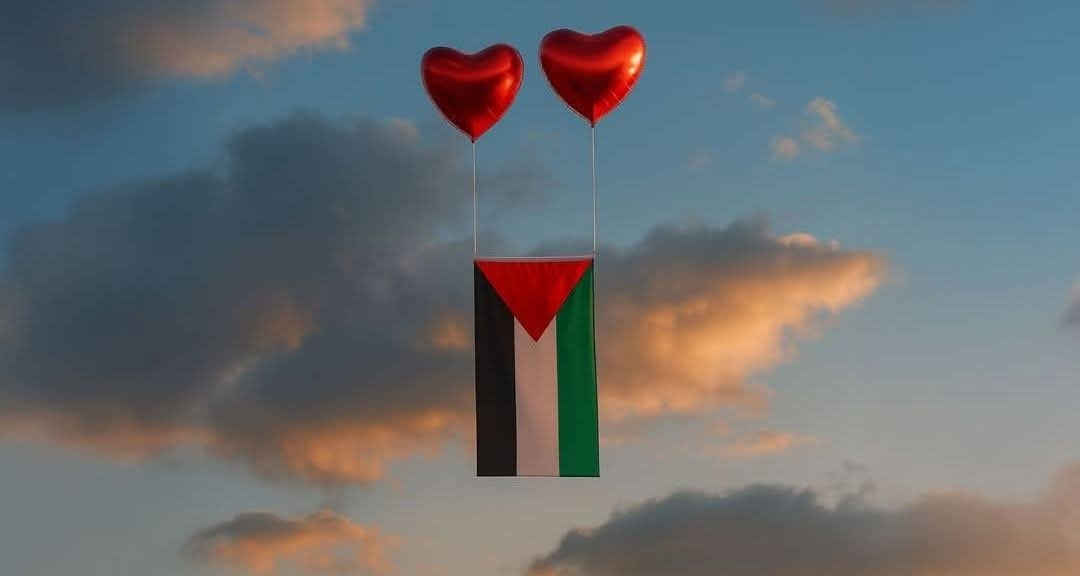
Three years after Israel’s war on Gaza began, one thing has become increasingly difficult to deny: Palestine has acquired a political voice in Europe that governments can no longer simply ignore.
The devastation of Gaza since 7 October 2023 has been almost unimaginable. More than 74,000 Palestinians have been reported killed, according to Gaza’s health ministry, whose figures the UN has considered reliable. The destruction of homes, hospitals, universities and civilian infrastructure, alongside mass displacement and restrictions on food and medicine, has produced what UN experts and investigators have described in increasingly stark terms, including the accusation of genocide.
But three years on, the political story is not only one of destruction. It is also a story of resistance, mobilisation and a slow but fierce shift in public consciousness.
From Dublin to Paris, London to Brussels, from university campuses to the streets of European capitals, Palestine has become a question that cannot be comfortably pushed to the margins. The flags, marches, boycotts, strikes, films and demonstrations are part of something larger which is a growing refusal to accept the idea that European governments can speak endlessly about human rights while treating Palestinian lives as an exception.
From the streets to the state
Perhaps the clearest evidence of this political shift can be found in the changing position of European governments.
In May 2024, Ireland and Spain, alongside Norway, formally recognised the State of Palestine. Spain’s Pedro Sánchez presented recognition in terms of “peace, justice and consistency”, while Ireland described Palestinian statehood as a legitimate right.
These decisions were significant precisely because they broke with the familiar European pattern of treating Palestinian statehood as something that could be discussed indefinitely while Israel’s occupation continued to deepen.
But the movement did not stop there.
In September 2025, France and the United Kingdom formally recognised Palestine, alongside a wider wave of countries. Emmanuel Macron declared that the time had come “to do justice for the Palestinian people” and recognise Palestine in Gaza, the West Bank and Jerusalem. The United Kingdom similarly recognised Palestine, with former Prime Minister Keir Starmer presenting the decision as an attempt to preserve the possibility of a political future in which Palestinians could have their own state.
Recognition alone does not encompass liberation, it is however a step closer to the situation Palestinians found themselves in the first couple of months of Israeli bombardment. Palestinian voices themselves have repeatedly warned that symbolism must be accompanied by material pressure.
Recognition must mean consequences: an end to military support for Israel, sanctions where necessary, opposition to settlement expansion, support for Palestinian self-determination and accountability for alleged international crimes. This is something increasingly being witnessed even in the halls of Brussels and Strasbourg, where recognition of the ongoing genocide has become a rallying point for Members of the European Parliament and European Commission employees pushing for sanctions against the State of Israel.
The universities became battlegrounds
Perhaps nowhere has this transformation been more visible than among students.
Across Europe, university campuses became sites of political resistance. Encampments appeared in Britain, Ireland, the Netherlands, France and Belgium, echoing similar occupations in the United States. Students demanded that universities divest from companies connected to Israel, sever institutional ties and acknowledge Palestinian rights.
At Trinity College Dublin, a five-day student encampment resulted in the university agreeing to divest from Israeli companies operating in occupied Palestinian territory and listed by the UN. The university also committed scholarships and accommodation for students from Gaza.
Furthermore, across Britain alone, dozens of campuses became sites of protest. The movement was met in some places with repression, accusations and attempts to portray students as extremists. Yet the persistence of these protests suggested something different: a generation increasingly unwilling to accept the political compromises of its leaders.
From Corbyn to Polanski to Burnham
The changing politics of Palestine in Britain can also be seen in the relationship between Jeremy Corbyn and Zack Polanski. Although they represent different generations and political movements, both have placed Palestinian liberation within a broader critique of militarism, occupation, racism and imperialism.
Corbyn has spent decades advocating for Palestinian rights and, since October 2023, has consistently demanded an immediate ceasefire, an end to the occupation and an end to British military support for Israel. His politics have helped establish Palestine as a central issue for Britain.
Polanski represents a newer generation of this politics. As Green Party leader, he has made ending the destruction in Gaza and supporting Palestinian freedom prominent parts of his political platform. His rise has also attracted former Corbyn supporters and activists who feel increasingly alienated from Labour’s approach to Gaza. The Guardian has reported that Green Party membership has grown dramatically, with Palestine playing an important role in this political realignment.
In October 2026, the Green Party went a step further and adopted a policy defining Zionism as a form of racism, with the policy linking Zionism to the displacement and alleged genocide of Palestinians. Polanski defended the motion’s definition, arguing that displacement and genocide of Palestinians is clearly racism.
Meanwhile, UK Prime Minister Andy Burnham has attempted to distance himself from Labour’s earlier position on Gaza, apologising for the party’s initial response and promising greater pressure on Israel, including further sanctions and possible restrictions on trade with illegal settlements. However, Burnham has stopped short of calling Israel’s actions in Gaza a genocide, arguing that this should ultimately be determined by international courts.
Taken together, the growing mobilisation of students, activists, trade unions and politicians across the UK suggests that Palestine has moved from the margins of British political debate into a powerful political movement.
The voice is growing, but solidarity must become action
None of this means that Europe has suddenly become pro-Palestinian.
European governments remain deeply inconsistent and as has become quite evident recognition can coexist with military cooperation. Politicians can condemn suffering while refusing meaningful sanctions and governments can call for peace while continuing relationships that help sustain the structures producing violence.
That contradiction is precisely where Europe must become and remain uncompromising. The lesson of these three years is not that governments will save Palestinians from the ongoing aggression of the Israeli government, but that pressure from below can change what governments believe is politically possible.
The marches matter. The students matter. The trade unions matter. The artists matter. The boycotts matter. Palestinian testimony matters. And every time another government is forced to recognise Palestinian statehood, every time another university is forced to confront and remove itself from its investments, every time a cinema audience sits in silence listening to Hind Rajab’s final words, the boundaries of what can be publicly said are shifted.
Palestine is no longer an issue that can be safely contained within diplomatic conferences. It can be found loudly in European streets, in cinemas, in the civilian flotilla aid boats sailing the mediterranean waters and in European elections. It now even finds itself within the mayoral seat of New York City. Most importantly, it is increasingly embedded in the political imagination of a generation that has grown up watching genocide in Gaza unfold on their iphone screens.
Three years of destruction have not erased Palestine, if anything, they have produced a new generation of people determined that Palestinian lives, Palestinian freedom and Palestinian self-determination cannot be treated as negotiable.
(Sources: United Nations and The Guardian)
Read more:

