


By Antonis Pastellopoulos, Postdoctoral Researcher, University of Cyprus
In the Republic of Cyprus, the dominant narrative surrounding the British colonial period presents enosis, the union of Cyprus with Greece, as the unquivering political demand of the anti-colonial movement, pursued more or less uninterruptedly from the arrival of the British in 1878 to the activity of the National Organisation of Cypriot Fighters (EOKA) in the late 1950s. This account, however, oversimplifies a more complicated reality. Enosis was neither the sole anti-colonial demand under British rule nor, at times, the most widely supported. During the British colonial period three distinct positions can instead be identified – enosis, independence and self-government.
A modern national myth that has been widely circulated is that Archbishop Sophronios III demanded enosis from the British upon their arrival in 1878. As Rolandos Katsiaounis demonstrated in Labour, Society, and Politics in Cyprus During the Second Half of the Nineteenth Century (pp. 25-28), this narrative is a fiction invented in the early 20th century by a circle of Greek Cypriot nationalists. Sophronios III in fact welcomed the British and, as head of a Church well embedded in the structures of Ottoman authority, followed the prevailing political strategy of the Church, that of non-resistance to authority. The key function of this myth, then, is to reassure that enosis was from the very beginning the key demand of the Cypriots, the “age-old longing” that was both legitimate and indisputable.
The emergence of a Greek national consciousness amongst the island’s Orthodox Christians, which could in turn make enosis a popular demand, was instead much slower. It was connected with the spread of the Greek curriculum through mass elementary education, the interlinked development of literacy and the Greek Cypriot press, the consolidation of a class of vocational politicians with the formation of the Legislative Council in 1882, and, crucially, the eventual nationalisation of the Church of Cyprus by 1910. A similar, though not necessarily identical, process can be observed within the island’s Muslim community during the 1920s and 1930s.
While enosis was promoted by an emerging Greek Cypriot nationalist political and religious elite, an alternative mode of politics also appeared in the 1920s with the formation of the Communist Party of Cyprus (CPC). Basing its analysis on working-class internationalism, the CPC fiercely opposed enosis, viewing it, on the one hand, as a divisive slogan amongst Cyprus’ multi-ethnic working class and, on the other, as a prolongation of economic exploitation: a demand that, if realised, would only change the nationality of the exploiters, not the social and economic conditions of the working class. The CPC therefore supported the independence of Cyprus through the formation of a Cypriot Soviet Republic.
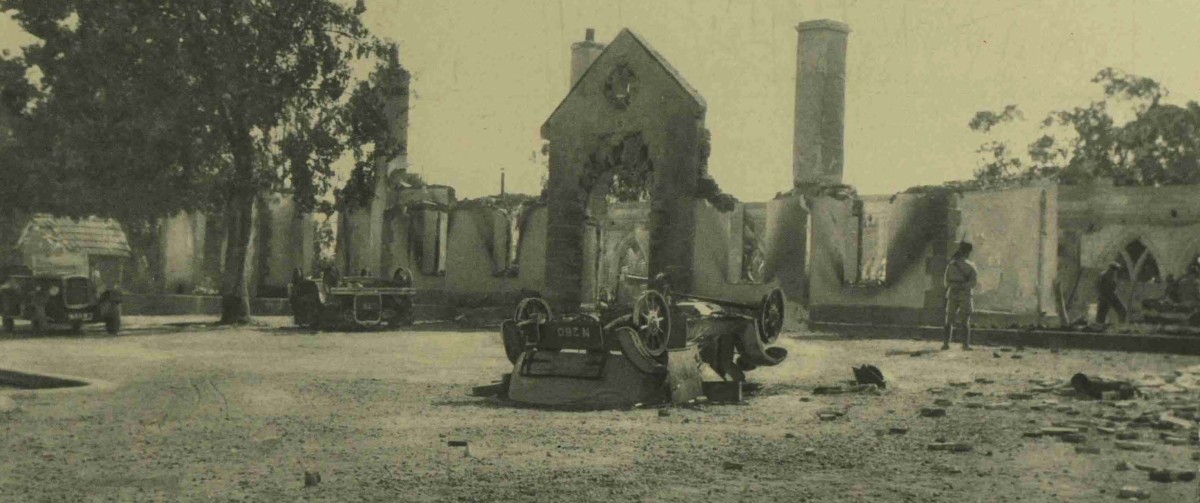
The 1931 Cyprus revolt was perhaps the most vibrant expression of anti-British and pro-enosis sentiment up to that point. While the causes of the revolt were fundamentally economic, it took on an enosis character from the beginning. The political repression that followed, commonly referred to as the Palmerocracy, banned political organising, exiled key nationalist and communist leaders, abolished all existing forms of electoral representation and established a dictatorship under the British governor. It was within these harsh political conditions that a constitutionalist movement emerged in Cyprus and London, aiming to make Cyprus a dominion within the British Commonwealth of Nations and thereby establish democratic self-governance through a liberal democratic constitution.
During the 1930s, the constitutionalist movement served as a key catalyst of politicisation, bridging communal, ideological and urban-rural divisions by uniting Greek Cypriots and Turkish Cypriots, nationalists and leftists, and town and village under a common political aim. In the absence of any legal political organisation on the island, the movement coordinated Pancyprian petitions in support of self-governance, a tactic Cypriots had until then typically used for economic, rather than political matters. The pinnacle of this process was the drafting and publishing of a proposed Cypriot democratic constitution by the Committee for Cyprus Autonomy, a left-leaning political organisation active in London. Remnants of the constitutionalist movement appear to have survived until the early 1940s, but the shifting political environment brought about by the Second World War, combined with the British colonial administration’s refusal to engage with self-governance during the 1930s, appears to have contributed to the movement’s eventual fading.
The loosening of political restrictions in the early 1940s marked a new phase in Cypriot politics. With political organising legalised and municipal elections once again held, the CPC, surviving during the 1930s through trade union organising, restructured itself through the formation of the Progressive Party of Working People (AKEL) in 1941. In contrast to the CPC, however, AKEL abandoned the position of independence in favour of enosis. It is however worth noting that independence was still publicly supported by the small Trotskyist Party of Cyprus (1945-49), keeping it part of Cypriot political discourse until the late 1940s.
Although AKEL agreed with the Greek Cypriot nationalist right on the key anti-colonial aim, it differed fundamentally over strategy, supporting self-governance as a stepping stone to enosis, a strategy the right fiercely opposed in the 1940s. As an emerging political force, AKEL challenged the traditional hegemony of the religious and political nationalist elites, who would have to compete with it for power if democratic self-governing institutions were established. The 1940s also saw the crystallisation of a bitter split between left and right, fuelled significantly by the Greek Civil War, a split that still echoes in Cyprus today. Within this context, the nationalist right adopted the position of ‘enosis and only enosis’, refusing to negotiate or discuss anything less than immediate enosis. Thus, unlike AKEL, the right refused to participate in the Consultative Assembly (Diaskeptiki), held by the British in 1948 in an attempt to introduce limited self-government under a new constitution. The Assembly’s failure was a key contributing factor to an internal crisis brewing in AKEL by the late 1940s, leading the party to abandon support for self-governance, even as a transitional stage towards enosis, switching to the right’s ‘enosis and only enosis’ position instead.
The subsequent events are relatively well known: the petition for enosis in 1950, Makarios III’s election as archbishop in the same year, Greece’s appeal to the United Nations in 1954, and the EOKA campaign of 1955–59. Rather than a representation of the British colonial period as while, the 1950s should be viewed as the culmination of a broader political process gradually narrowing the range of anti-colonial aims to a single position within the Greek Cypriot community, that of uncompromising enosis. Far from being self-evident, enosis became the prevailing position only through a series of political and ideological contestations. That these contestations have been largely forgotten is itself a product of this process. The eventual hegemony of enosis, accompanied by the myth of an age-old longing, was projected backwards through later narratives, erasing the alternatives of independence and self-government from collective memory.
Note: All information on the 1930s and the constitutionalist movement originates from Chapter 4 of Alexis Rappas’ excellent Cyprus in the 1930s: British Colonial Rule and the Roots of the Cyprus Conflict, published originally by I.B. Tauris in 2014. The photograph accompanying this article shows the the exterior of Government House in Nicosia following the 1931 Cyprus revolt. It was first published in The Illustrated London News on 07/11/31.
This article is part of a series exploring themes of refugeehood and emplacement in relation to Cyprus.


